Bank of Korea's 'Reinvestment Income' Statistics Cumulative Calculation
Issues with Retained Earnings Domestic Remittance, Double Taxation, etc.
Tax Law Revised from This Year, Making It Tax-Exempt
Companies Suffering from High Interest Rates Get Temporary Relief
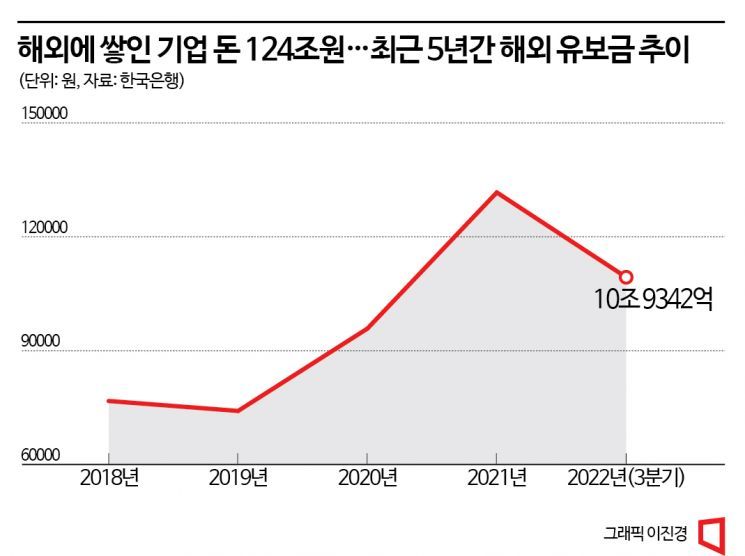
Money that South Korean companies had been accumulating overseas, which had been growing uncontrollably every year, is expected to flow back into the country starting from the new year. The retained earnings that South Korean corporate overseas subsidiaries have kept abroad without remitting to the domestic market exceed 124 trillion won. Using the Bank of Korea's Economic Statistics System to calculate the 'reinvestment income receipts' of our companies' overseas subsidiaries, the cumulative overseas retained earnings from 1980, when statistics began, to the third quarter of last year reached 98.866 billion USD (approximately 124.8677 trillion KRW). Reinvestment income receipts refer to the profits earned by foreign direct investment companies in which Korean companies hold more than 10% equity, which are retained without being distributed as dividends or reinvested domestically.
◆Even though companies earn tens of trillions, they do not remit domestically due to double taxation issues=Industry insiders say that half of the large corporations' money is overseas. Reinvestment income receipts have continuously increased since 2010, when South Korean companies' overseas direct investment expanded. In 2021, it recorded 10.43 billion USD (approximately 12.48677 trillion KRW), marking the largest scale ever. It is highly likely that overseas retained earnings increased to an all-time high last year as well. As of the third quarter, overseas retained earnings stood at 8.6574 billion USD (approximately 1.09342 trillion KRW).
Last year, South Korean companies complained about cash shortages. This was due to interest rates that had risen as much as they could. It became difficult to secure funds in the domestic capital market, including the corporate bond market, initial public offerings (IPO), and paid-in capital increases. In this situation, why did companies not bring back the money held overseas? Corporate officials say it is not that they 'did not bring it back,' but that they 'could not bring it back.'
The explanation is tax issues and foreign exchange controls imposed by overseas countries that have frozen the funds. The virtually only way to bring money from overseas subsidiaries is through dividends. However, until now, there has been a double taxation problem where taxes are paid both in the country where the subsidiary is located and again in South Korea.
For example, if an overseas subsidiary earns 10 billion KRW locally and pays 2 billion KRW in local corporate tax, it must pay an additional 800 million to 2 billion KRW (10-25% domestic corporate tax rate) again under domestic dividend procedures. Under current law, some tax credits are applied to overseas dividends. The tax credit amount is calculated by multiplying the local corporate tax by the ratio of the overseas subsidiary's dividend to the income earned by the subsidiary after deducting local corporate tax. However, companies ultimately pay corporate tax both in Korea and overseas, and since there is a limit on the amount refunded when deducting domestic corporate tax, double taxation issues arise.
◆In the era of high interest rates, tax law amendments open the way for overseas retained earnings to return to Korea=However, a revision to the Corporate Tax Act that exempts dividends sent from overseas subsidiaries to the domestic market from taxation passed the National Assembly at the end of last year. It exempts 95% of dividend income received from foreign subsidiaries in which domestic companies hold more than 10% equity from taxation (non-inclusion in taxable income). Professor Lee Jeong-hee of the Department of Economics at Chung-Ang University said, "It is expected that the double taxation on dividends sent by overseas subsidiaries to Korea will be improved," adding, "In the era of high interest rates, this will ease the financial constraints of companies."
Additionally, with the dollar showing strength, it is evaluated that companies are more likely to send the money earned overseas back to Korea. Last year, the exchange rate reached the 1,400 KRW per dollar level. Although it is now in the high 1,200 KRW range, psychologically, the dollar price is still perceived as high, so many companies want to convert dollars into won.
However, even if the money overseas is their own, it is difficult to freely bring it back to Korea. Many countries have made large-scale foreign currency remittances legally and institutionally complicated. In the case of China, 'profit remittance' to the home country is allowed, but through complicated documentation procedures, practical restrictions are imposed. A small and medium-sized enterprise official said, "We needed to remit funds domestically and tried to remit retained earnings from the Chinese subsidiary, but due to lengthy and complicated paperwork, timely remittance often did not occur." Recently, with the liquidation process of companies becoming more complicated, if a company received tax benefits such as '2 years tax exemption and 3 years 50% income tax exemption' from local governments, laws and systems have been introduced that require the company to repay the tax benefits when liquidating the company.
Argentina, which has experienced default nine times, has virtually blocked the outflow of foreign money overseas. Companies investing less than 100 million USD cannot obtain foreign currency remittance approval from the central bank. To gain relatively free rights to send money overseas, the investment amount must exceed 1 billion USD. Companies investing more than 1 billion USD can remit foreign currency overseas up to 60% of their export volume. A manager of a South Korean company’s Argentina branch said, "Even if local subsidiaries generate profits, they are not granted remittance approval to the home country, so they hold local currency or invest in other assets such as real estate and finance."
Professor Kim Ki-chan of the Department of Business Administration at Catholic University said, "Excessive taxes and regulations have constrained companies, which are the source of employment and growth, domestically. Therefore, after globalization, companies did not bring funds back to Korea," adding, "In the context of reshoring (return of manufacturing to the home country) and deglobalization trends and liquidity crisis phases, it is time to consider ways to bring the fruits of globalization back to Korea."
© The Asia Business Daily(www.asiae.co.kr). All rights reserved.
![Clutching a Stolen Dior Bag, Saying "I Hate Being Poor but Real"... The Grotesque Con of a "Human Knockoff" [Slate]](https://cwcontent.asiae.co.kr/asiaresize/183/2026021902243444107_1771435474.jpg)















