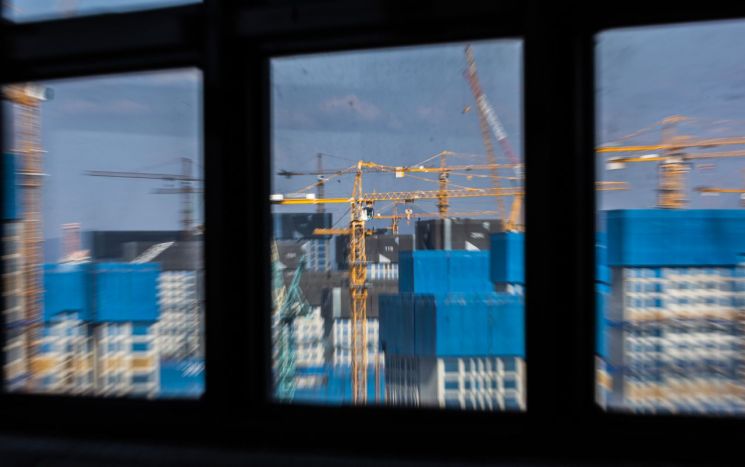
 October 2022, view of the reconstruction site of Dunchon Jugong Apartment in Gangdong-gu, Seoul / Photo by Yonhap News
[Asia Economy Reporter Noh Kyung-jo] Amid expectations that the domestic construction market will remain challenging this year, liquidity and safety management, as well as business restructuring, have been identified as the three major management issues for construction companies.
According to the Construction Trend Briefing (No. 888) recently published by the Korea Construction Industry Research Institute on the 1st, the ability of construction companies to secure funding and manage liquidity is expected to become more important than ever this year.
The institute predicted that the profitability of construction companies will decline due to reduced investment caused by the downturn in the construction market and an increase in unsold units resulting from the real estate market slump. This is based on the fact that the social overhead capital (SOC) budget for this year has decreased by 10.7% compared to last year (28 trillion won), and that the real estate market is expected to continue its slump due to sustained high interest rates and weakened investment sentiment.
In particular, it forecasted that financing for construction companies will become more difficult than before due to the contraction of the real estate project financing (PF) market. The institute explained, "With continued interest rate hikes this year, overall funding costs for companies will rise significantly. Additionally, as PF contingent liabilities are expected to increase, the credit ratings of construction companies are likely to be downgraded, which will lead to higher financing costs, requiring caution."
It also emphasized the need to consider difficulties in cost management due to soaring raw material prices and rising labor costs. As the Russia-Ukraine war prolongs, the price of bituminous coal, a key fuel for cement, has surged. Cement prices, which were 75,000 won per ton in 2021, rose to 93,000 won in the first half of last year and 105,000 won in the second half.
During the same period, rebar prices also surged, jumping from about 700,000 won per ton in the first quarter of 2021 to 991,000 won in February last year, and currently maintaining a market price around 1,050,000 won. The institute reported that on-site labor costs have increased and that securing foreign workers has become more difficult since the COVID-19 pandemic.
It stressed, "To ensure stable project execution this year, it is essential to establish management strategies focused primarily on liquidity management."
The importance of safety management at construction sites was also highlighted. Although the Serious Accidents Punishment Act was enacted in January last year, serious accidents in the construction industry have continued to occur. In response, the government has set a goal through the 'Serious Accident Reduction Roadmap' to reduce the accident fatality rate to the average level of the Organization for Economic Cooperation and Development (OECD) (0.29?) by 2026.
The institute stated, "Safety is a value that must be upheld above all else in industrial workplaces, and there is strong public interest and demand for creating safe workplaces. Since accidents cause significant difficulties in corporate management, utmost efforts must be made in site safety management this year as well."
Furthermore, it added that business portfolio restructuring and workforce reorganization are necessary. This is due to the recent downturn in the construction market, especially the rapid freezing of the housing market.
Until the first half of last year, the housing market had been booming for several years, leading construction companies to focus their management activities on the housing sector. Business portfolios were concentrated in the housing sector, and workforce allocation was similar. Conversely, the shares of overseas and civil engineering/plant sectors decreased.
The institute said, "This year, based on workforce reorganization in the housing sector, efficient human resource management plans should be sought. At this point, facing declining profitability and high labor costs, exploring ways to utilize personnel efficiently is essential for effective management activities."
© The Asia Business Daily(www.asiae.co.kr). All rights reserved.
![Clutching a Stolen Dior Bag, Saying "I Hate Being Poor but Real"... The Grotesque Con of a "Human Knockoff" [Slate]](https://cwcontent.asiae.co.kr/asiaresize/183/2026021902243444107_1771435474.jpg)















