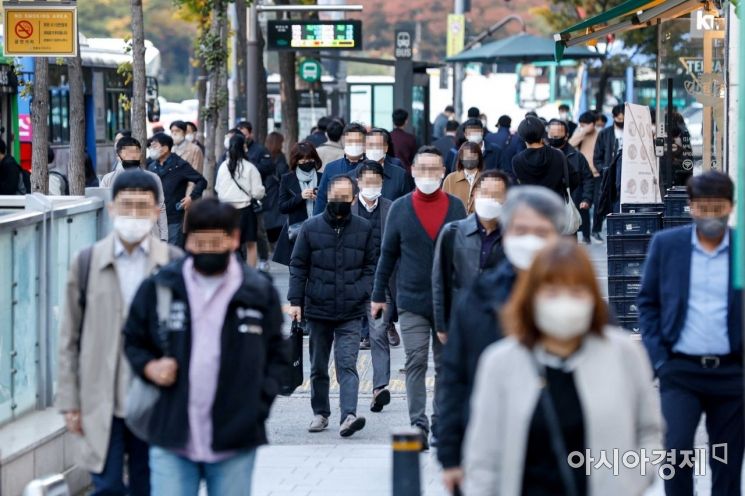
 Office workers are putting on coats and heading to work near Yeouido Station in Seoul. Photo by Jinhyung Kang aymsdream@
[Asia Economy Reporter Kim Hyung-min] From the new year 2023, our daily lives will change significantly due to the enactment and revision of related laws, including the introduction of expiration date labeling, the use of international age, and the requirement for vehicles turning right to make a complete stop.
The Ministry of Government Legislation announced that a total of 397 laws and regulations (excluding amendments to other laws, as of December 29, 2022) will be newly enforced from January to June 2023, and selected 10 key laws that the public should be aware of.
① Regulations on the Collection, Receipt, and Utilization of Hometown Love Donations
Starting from the new year, local governments nationwide can only collect and receive Hometown Love Donations from people who are not residents of the respective area. According to the newly enacted "Act on Hometown Love Donations," local governments must establish funds to efficiently manage and operate the collected donations. These funds must be used solely for purposes such as revitalizing the local economy and improving residents' welfare. Additionally, local governments are required to disclose the status of donation receipts and the results of fund operations.

② Introduction of Consumer-Centered Expiration Date Labeling System
According to the amendment of the "Act on Labeling and Advertising of Foods, etc.," the term "expiration date" will be changed to "consumption period" starting from the new year. Since the expiration date can cause consumers to misunderstand the disposal timing of food, the new consumption period labeling system aims to prevent consumer confusion, ensure food safety, and reduce food waste.
③ Establishment of Support System to Address Population Decline
With the enactment of the "Special Act on Support for Population Declining Areas," provisions have been set regarding the establishment and implementation of five-year response plans for population declining areas at the city, county, and provincial levels, as well as national response plans. Accordingly, central administrative agencies must prioritize population declining areas when promoting relevant policies or projects and prepare support measures accordingly. Furthermore, to support settlement of youth and middle-aged populations, priority support should be given to related projects such as jobs, startups, and housing. Special provisions will also be established in areas such as childcare, education, medical care, housing and transportation, culture, foreigners, management of aged and idle facilities, and industrial complexes in population declining areas.
④ Temporary Stop for Vehicles Turning Right at Intersections
From the new year, vehicles intending to turn right at intersections must make a complete stop before proceeding. Specifically, to ensure pedestrian safety at intersections, when the traffic lights for vehicles and bicycles show red, vehicles and bicycles intending to turn right must first stop and then proceed without obstructing other traffic according to the signal. Additionally, a right-turn traffic signal will be added to the types of traffic lights.
⑤ Introduction of Partial Rejection System and Reexamination Request System for Trademark Registration Applications
Starting from the new year, if only some of the designated goods listed in a trademark registration application are subject to rejection, the remaining designated goods can still be registered under the newly introduced partial rejection system. Also, when the reasons for rejection of a trademark registration decision can be easily resolved, a reexamination request system will be introduced as a new appeal method outside of the trial procedure.
⑥ Expansion of Objection Request System for Administrative Dispositions and Introduction of Statute of Limitations for Sanction Dispositions and Reexamination System for Dispositions
Parties who have objections to administrative dispositions will have a general basis to file an objection request with the administrative agency. In principle, administrative agencies cannot impose dispositions such as suspension, cancellation, or revocation of permits or approvals, deletion of registration, or impose fines in lieu of closure or suspension of business establishments if five years have passed since the violation ended. For dispositions other than sanction dispositions and administrative enforcement, if the facts or legal relations underlying the disposition change favorably for the party after the disposition becomes unchallengeable through litigation, the party may apply to the administrative agency within 60 days from the date of awareness to cancel, revoke, or amend the disposition.
⑦ Basis for Establishing General and Professional Graduate Schools in Remote Universities
The types of graduate schools that remote universities can establish and operate will be expanded from the current special graduate schools to include general graduate schools and professional graduate schools, excluding the fields of medicine, dentistry, Korean medicine, and law.
⑧ Obligation to Verify Driver Qualifications Using the Driver Qualification Verification System When Renting Vehicles
To prevent illegal vehicle rental and driving by unlicensed persons and to ensure traffic safety, it will be mandatory to verify driver qualifications using the driver qualification verification system when renting vehicles.

⑨ Establishment of Gangwon Special Self-Governing Province and Special Provisions
The Gangwon Special Self-Governing Province will be established, preserving the regional, historical, and cultural characteristics of the former Gangwon Province, with guaranteed high-level autonomy. Heads of central administrative agencies will be able to provide special administrative and financial support to Gangwon Special Self-Governing Province. To guarantee autonomy and enhance competitiveness, special provisions will be granted, including the establishment of a special account for balanced national development, delegation of autonomous affairs, resident referendums, personnel exchanges and dispatch of public officials, and preferential recruitment of local talents.
⑩ Use of International Age for Administrative Age Calculation and Display
To make it easier for the public to understand that the use of international age is the principle in administrative fields, general principles and standards regarding the calculation and display of administrative age will be clearly defined, which is expected to minimize unnecessary legal and social disputes related to age.
© The Asia Business Daily(www.asiae.co.kr). All rights reserved.
![Clutching a Stolen Dior Bag, Saying "I Hate Being Poor but Real"... The Grotesque Con of a "Human Knockoff" [Slate]](https://cwcontent.asiae.co.kr/asiaresize/183/2026021902243444107_1771435474.jpg)

















