Nakao's Hiring Policy Conservative... Game Companies Restructure New Businesses
Returning to Office After Remote Work... "Next Year's Crisis, Must Improve Work Efficiency"
[Asia Economy Reporter Yuri Choi] "I'm revising next year's business plan for the third time, but the budget keeps getting cut."
A cold wave has fully hit Pangyo, the IT hub. Not only startups undertaking large-scale layoffs but also major IT companies like Naver and Kakao have begun reducing their hiring to cut labor costs. The work-from-home system, introduced as a welfare measure to improve work efficiency, is being gradually abolished. This is a complete turnaround from last year, when companies competed fiercely in salary and welfare benefits to attract developers. Concerns are growing that a restructuring storm will sweep across the entire IT industry, starting from Pangyo.
According to industry sources on the 30th, Naver affiliate Line Plus has officially announced a hiring freeze for next year. While they had been hiring necessary personnel on an ongoing basis, they plan to close the hiring window next year. Although the freeze is currently limited until March next year, this policy is expected to continue unless the economic situation changes significantly.
Naver and Kakao plan to reduce their hiring scale starting next year. Naver is reportedly only replenishing staff in development roles to cover natural attrition such as resignations for the time being. Kakao is cutting down developer hiring, which was previously in the triple digits, as part of labor cost reduction efforts. Wage negotiations for next year are currently underway, and there are talks that the raise rate, which was in the double digits, will fall to single digits next year.
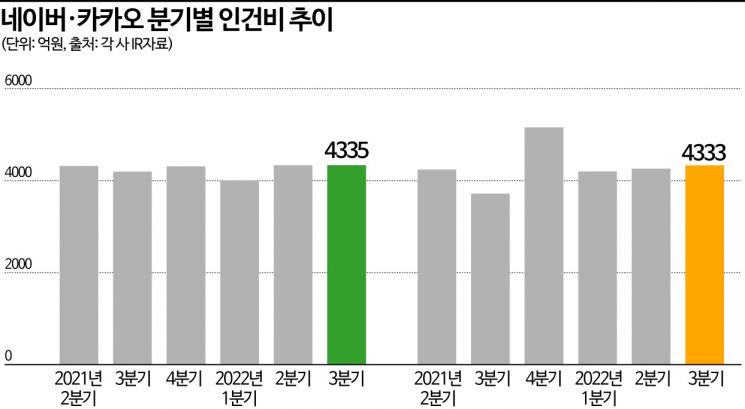
The change in hiring trends is already noticeable. The labor cost growth rate, which had been increasing by more than 10% each quarter, began to slow down in the second half of this year. In the third quarter of this year, Naver's labor costs were 433.5 billion KRW, slightly down by 200 million KRW compared to the previous quarter. Kakao's labor costs were 433.3 billion KRW, increasing by only 2% from the previous quarter.
The layoff storm is even fiercer among IT startups. They are not only halting new hires but also reducing staff through restructuring. Sandbox Network, the largest domestic multi-channel network (MCN) with hundreds of YouTubers, is undergoing restructuring involving 50 to 100 employees. Humart Company, which operates the mental care solution "Trost," is reported to have cut about 30% of its staff.
Even developers, who were once able to command high salaries, are not exempt from the restructuring atmosphere. Today’s Table, operator of the same-day seafood delivery service "Oneulhoe," has laid off most of its staff, including the Chief Operating Officer (COO). Logistics startup Two Hands has notified more than 50% of its headquarters employees, including developers, of recommended resignations.
An HR manager at a startup said, "Investors are demanding a lot of management efficiency, so from next year, we are reviewing whether some tasks can be outsourced or replaced with temporary workers."
The gaming industry is also actively pursuing cost efficiency. They are not only cutting labor costs but also winding down new projects. Netmarble announced it will adjust fixed costs such as marketing and labor expenses in line with performance. NCSoft, which has reduced labor costs for three consecutive quarters this year, is in the process of selling the fandom platform "Universe," which was promoted as a new business.
A gaming industry insider said, "The structure is such that money earned from a few intellectual properties (IPs) is distributed to development studios, but there is a growing atmosphere that each project needs to focus and prioritize. We often hear that uncertain early-stage projects are being wound down."
More companies are ending work-from-home policies and returning employees to the office to improve work efficiency. Work-from-home started due to COVID-19 but had become routine in some companies as a welfare system.
Kakao will implement a work system based on office attendance starting March next year. Since July, a hybrid system of office attendance and work-from-home was possible, including full remote work, but it will switch to full office attendance. The "Nolgeum" system, which allowed taking every other Friday off, will be abolished from January next year. Instead, a "Recovery Day" off on the last Friday of each month will be introduced.
NCSoft also recently announced it will maintain full office attendance next year. It switched from work-from-home to office attendance in June when social distancing was fully lifted, judging that this approach is more suitable during an economic downturn. They explained that to speed up development amid the failure to release new titles this year, improving work efficiency is necessary.
An IT industry insider said, "At a meeting to share next year's business plans, executives emphasized a sense of crisis. While they are not planning large-scale layoffs like global big tech companies, the frozen atmosphere cannot be avoided."
© The Asia Business Daily(www.asiae.co.kr). All rights reserved.
![Clutching a Stolen Dior Bag, Saying "I Hate Being Poor but Real"... The Grotesque Con of a "Human Knockoff" [Slate]](https://cwcontent.asiae.co.kr/asiaresize/183/2026021902243444107_1771435474.jpg)











