North Korea Holds Party Plenary Meeting Without Mentioning 'Unmanned Drone'
Kim Jong-un Orders 'Combat Power' Following 'Defense Capability Goals'
Concerns Over North Korea's Misjudgment Arise After Yoon's 'War' Remarks
[Asia Economy Reporter Jang Hee-jun] North Korea continued its Party plenary session without any mention of the 'drone intrusion.' The plenary session is a venue where important policies of the North Korean Communist Party are discussed, and major decisions such as nuclear tests have been made in the past.
Following North Korea's drone provocations, President Yoon Suk-yeol has been raising his voice daily about strong responses and retaliation policies, while Kim Jong-un, through this plenary session, ordered the 'strengthening of national defense,' continuing the confrontation at a strong level. As expectations arise that the pattern of 'North Korean provocations - South Korea-US deterrence' will continue next year, inter-Korean relations are expected to deteriorate for the time being.
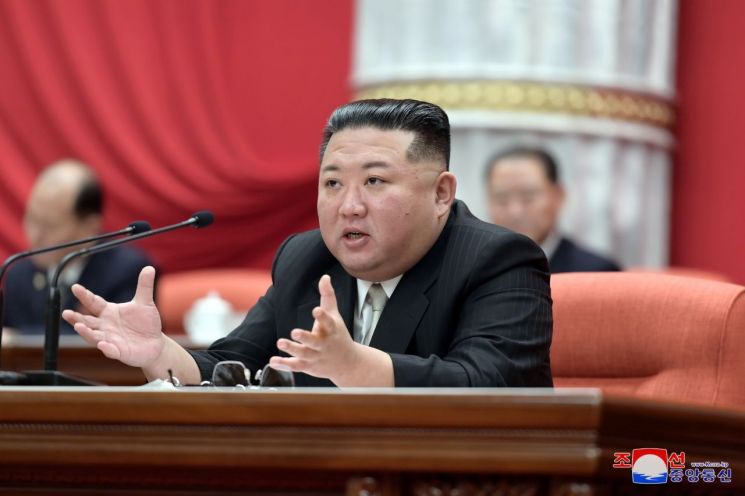 North Korea, 3rd Day of the Plenary Meeting... Kim Jong-un "Party Organizations Must Increase Combat Power"
 [Image Source=Yonhap News]
According to the Korean Central News Agency on the 29th, Chairman Kim emphasized at the third day of the 6th plenary meeting of the 8th Central Committee of the Workers' Party held the previous day that it is "the most critical and responsible period in the history of the strengthening and development of the Republic," and that "the combat power of Party organizations must be continuously increased and Party work must be carried out more innovatively."
At the earlier second-day meeting, Kim presented new core goals for strengthening self-defensive national defense, implying the 'strengthening of nuclear forces.' Although the specific details of the goals were not disclosed, they are evaluated as an extension of the core five tasks of the five-year plan for national defense development announced at the 8th Workers' Party Congress in January last year.
However, North Korea has not mentioned the 'drone intrusion' at all through official media such as the Rodong Sinmun or propaganda outlets. While the military authorities failed to respond effectively as the drone flew over Seoul's airspace, a situation that has drawn criticism, this is a 'satisfactory' outcome for North Korea, but it seems they are conscious that officially acknowledging it would invite criticism from the international community.
Earlier this year in January, it was reported through sources that North Korea established and organized a 'drone unit' under the Strategic Forces. The North Korean Strategic Forces operate ballistic missiles, and creating a drone unit under them is interpreted as an intention to accelerate the development of offensive drones. There is also speculation that North Korea may expand and reorganize its drone units following this incident.
Jung Sung-jang, director of the North Korea Research Center at the Sejong Institute, diagnosed, "North Korea realized through this drone intrusion that drones are a very useful means to cause confusion in the South and that South Korea cannot easily shoot them down," adding, "It is highly likely that they will accelerate drone-related technology development or expand drone units in the future."
Yoon: "Overwhelming War"... Warning vs. Concern over Misjudgment
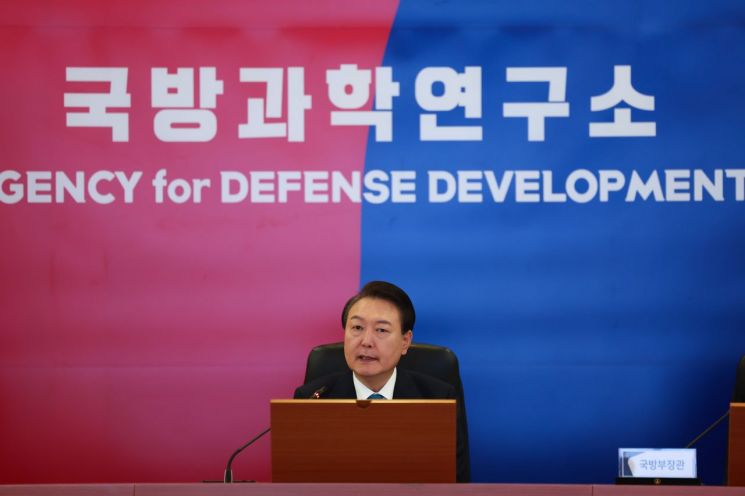
President Yoon Suk-yeol visited the Defense Acquisition Program Administration (ADD) in Daejeon on the same day and stated, "The airspace intrusion by North Korean drones is an absolutely unacceptable incident," and "We must make them realize that severe consequences will inevitably follow provocations."
According to the presidential office, President Yoon reiterated, "Only firm punishment and retaliation against acts that infringe on our freedom can deter provocations," and "To achieve peace, we must prepare overwhelmingly superior war capabilities."
These remarks by President Yoon are interpreted as coming from the principle of 'deterrence' in response to North Korea's 'provocations.' However, since he mentioned the keyword 'war' and ordered overwhelming responses, it is evaluated as a strong warning directed at North Korea.
Professor Park Won-gon of Ewha Womans University’s Department of North Korean Studies analyzed, "Deterrence largely involves psychological factors. While the Moon Jae-in administration pursued an 'engagement' approach, the current administration is sending warnings that there will be more retaliation against provocations."
However, there are also concerns about the harsh remarks. Such expressions, which North Korea may react sensitively to, could provoke misjudgments. Director Jung pointed out, "It is natural to always be prepared for war, but mentioning overwhelming responses or war is quite a dangerous statement."
He continued, "While firm responses to North Korean provocations are necessary, mentioning overwhelming responses rather than proportionate ones could cause misjudgments by the opponent (North Korea) or excessive loyalty by soldiers at the Demilitarized Zone, potentially leading to unintended consequences," and evaluated, "As a national leader, these remarks were not cautious and were somewhat politically motivated domestically."
North Korea Likely to Maintain Hostile Policy... "Dialogue Expectations Are Low"
As North Korea continues to imply nuclear force strengthening, our government maintains a confrontational stance with 'high-intensity responses.' Accordingly, the pattern of 'North Korean provocations - South Korea-US deterrence' is expected to continue next year. The consensus is that a transition to a dialogue phase in the near future is unlikely.
Researcher Jung Sung-yoon of the Korea Institute for National Unification forecasted, "North Korea will continue its hostile policy toward the US and focus on achieving the highest priority strategic goal of advancing nuclear and missile capabilities as quickly as possible."
He added, "North Korea has low willingness for dialogue and compromise, and the US has little need to make concessions. Although there is sufficient incentive for both countries to explore intentions behind the scenes, it will be difficult for official dialogue resumption or denuclearization negotiations to follow."
Professor Park Won-gon said, "The key will be how much of the Party plenary session's decision document is disclosed," adding, "However, looking at the overall content of the plenary session held so far, it is notable that there is no change in policy." The lack of change in North Korea's policy means it is a continuation of the 'all-out advance' mentioned at the 5th plenary meeting of the 7th Central Committee in 2019.
Professor Park diagnosed, "The term 'anti-enemy struggle' that appeared in this plenary session was also declared by Kim Yo-jong, the Party deputy director, when the inter-Korean joint liaison office was blown up," and "North Korea will continue to push three keywords: 'self-reliance,' 'nuclear capability strengthening,' and 'long-term struggle.'"
He added, "The key to the long-term struggle is how much economic power supports it," and explained, "Considering North Korea's economic difficulties and China's support, prospects are mixed, so this is a factor to watch."
© The Asia Business Daily(www.asiae.co.kr). All rights reserved.



















