Government Overhauls Employment Permit System for the First Time in 20 Years
Strengthening Preferences for Foreign Workers Proficient in Korean
Abolishing New Employment Permit Issuance Limits, Increasing Allowed Quotas
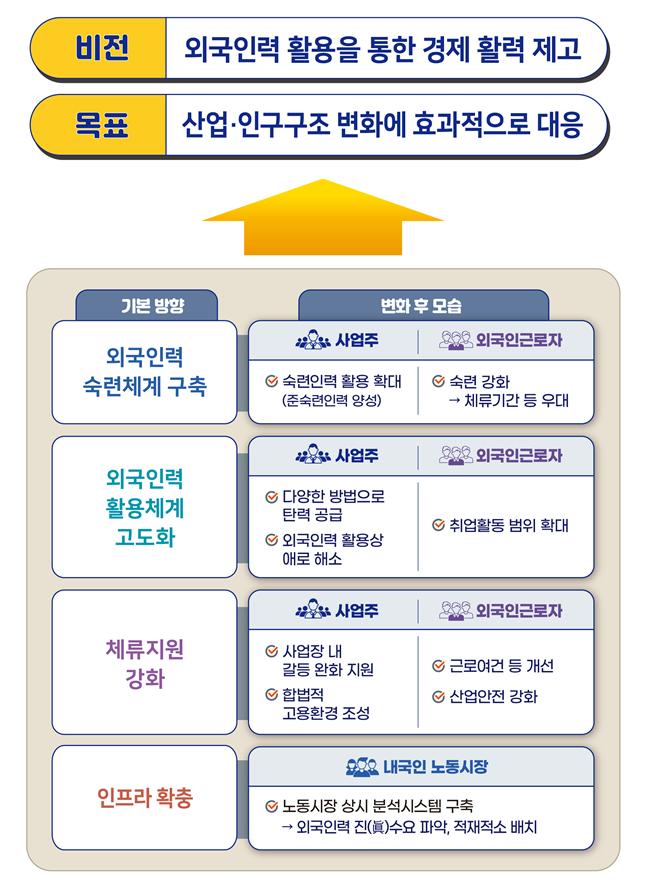
The government, considering the growing need for skilled foreign workers in domestic industries, has decided to establish a 'long-term service exception' system that favors skilled foreign workers with Korean language proficiency. Additionally, to facilitate easier employment of foreign workers, the government will abolish the issuance limit on new employment permits starting next year and expand the allowable number of foreign workers in small-scale businesses.
On the 29th, the government announced the 'Employment Permit System Reform Plan' after deliberation and resolution at the 36th Foreign Workforce Policy Committee meeting.
The current Employment Permit System will mark its 20th anniversary next year but has operated without major changes, leading to criticism that it has not effectively responded to changes in the industrial field. In particular, as issues such as labor shortages in industrial sites, expansion of non-professional foreign workers, and illegal stay have worsened, calls for reforming the system have increased.
Accordingly, based on improvement tasks identified during the operation of the Employment Permit System, the government decided to reform the system focusing on strengthening the formation of skilled foreign workers, diversifying and flexibilizing workforce utilization systems, enhancing labor market analysis, and actively supporting stay.
Skilled Foreign Workers Can Serve Long-Term for 10 Years
First, the government will introduce the 'E-9 (Non-professional Employment) Foreign Worker Long-term Service Exception' system, which favors foreign workers who have formed skills by working for a certain period or longer at the same workplace and possess Korean language ability. For workers under this exception, a preferential stay period will be supported, allowing them to stay and work in Korea for up to 10 years without the need for departure and re-entry procedures. The government also plans to consider providing vocational training and separate incentives.
Next year, the government will allow the employment of E-9 foreign workers in certain service sectors with severe labor shortages, such as waste collection, transportation, and disposal, as well as food and tobacco brokerage industries, including loading and unloading jobs. The permitted industries will be adjusted in the future based on labor supply and demand conditions.
Considering industries that require temporary labor during specific periods throughout the year, the government will review various workforce supply methods and support flexible workforce utilization, such as utilizing foreign students. This involves converting foreign students with excellent Korean language skills who wish to work domestically into E-9 status. Instead of sending students who cannot find employment as professional workers (E-7) back to their home countries, they will be utilized as non-professional workers and later trained as skilled or professional workers.
In particular, the government will abolish the annual issuance limit of new employment permits per workplace starting next year and temporarily increase the total allowable number of foreign workers by 20% for small-scale manufacturing businesses with fewer than 50 employees.
Strengthening Support for Foreign Workers’ Living Conditions
As the number of foreign workers residing in Korea increases due to these reforms, the government will also strengthen living support. Support for improving residential environments, such as public dormitories, will be enhanced, and operations of Foreign Worker Support Centers and employment adaptation support projects for workers during their initial arrival will be expanded. For foreign workers employed in small-scale farming and fishing households, support for lodging rental fees and commuting bus operation costs will be considered.
To prevent domestic workers from suffering job losses, the government will also promote systematic labor demand analysis. A continuous analysis system will be established, including periodic in-depth labor demand analysis by an independent advisory body composed of experts, and the procedures for receiving, analyzing, and reviewing suggestions related to permitted industries for foreign workers will be systematized.
Regional demand will also be reflected when determining the scale of foreign workforce introduction. The Ministry of Employment and Labor explained, "The total introduction scale will reflect foreign workforce demand submitted through labor-management consultations based on regional business conditions and labor supply and demand status."
Park Jong-pil, Director of Planning and Coordination at the Ministry of Employment and Labor, said, "Over the 20 years since the Employment Permit System was implemented, the basic framework of the system has been maintained without major changes, leading to high system fatigue in the field," adding, "To implement this reform plan, we will prepare amendments to related laws next year and proceed with sufficient labor-management and expert consultations as well as coordination with relevant ministries."
© The Asia Business Daily(www.asiae.co.kr). All rights reserved.
![Clutching a Stolen Dior Bag, Saying "I Hate Being Poor but Real"... The Grotesque Con of a "Human Knockoff" [Slate]](https://cwcontent.asiae.co.kr/asiaresize/183/2026021902243444107_1771435474.jpg)















