India, Vietnam, Thailand, Bangladesh, and Malaysia Aim to Become the Next Manufacturing Powerhouses
[Asia Economy Reporter Yoon Seul-gi] Amid the weakening position of China, the 'world's factory,' following the US-China conflict and the COVID-19 pandemic, Asian countries are accelerating their competition to become the next 'manufacturing powerhouse.'
On the 27th, US economic media Insider reported that five countries?India, Vietnam, Thailand, Bangladesh, and Malaysia?are enhancing their competitiveness to replace China's role.
China became a manufacturing powerhouse over 40 years through globalization and integration into global supply chains, but its position weakened after experiencing a trade war with the US during the Trump administration in 2018.
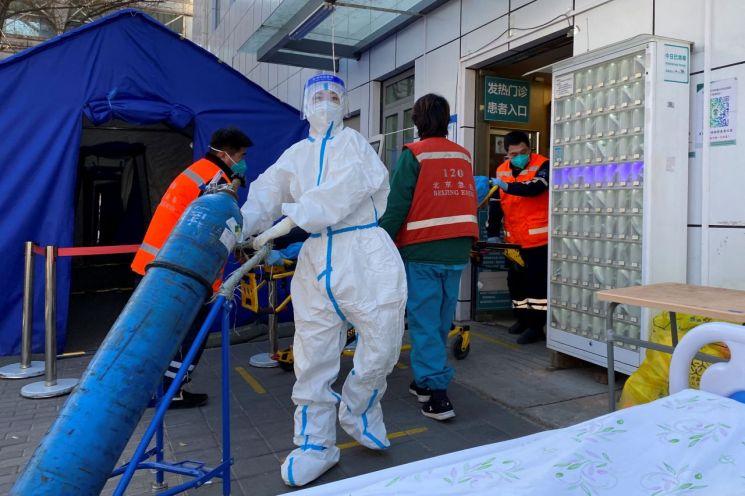 On the 23rd, a nurse is carrying an oxygen tank at a fever clinic in Beijing, China. Photo by Reuters·Yonhap News
In particular, the COVID-19 pandemic accelerated the 'de-China' trend. Previously, the Chinese government maintained a lockdown-centered 'Zero COVID' policy for nearly three years, and in November this year, when COVID-19 cases were detected at Foxconn's factory in Zhengzhou City, Henan Province?the largest production base for Apple?the factory was shut down.
Following the factory closure order, Foxconn employees, who were resentful of the government's harsh quarantine policies, staged a mass escape, causing disruptions in iPhone production and increasing Apple's losses.
After the Foxconn incident, Apple began reorganizing its global supply chain. It has currently moved iPhone manufacturing facilities to India and is also considering relocating iPad factories. In a report released in September, JP Morgan forecasted that by 2025, one out of every four iPhones would be manufactured in India, indicating Apple's expansion of manufacturing facilities there.
With India's population expected to surpass China's next year, India is being strongly considered as a production base to replace China, based on its cheap and young labor force.
 On September 16 (local time), customers are examining the iPhone 14 at the Apple Store in Beijing, China. Photo by AP·Yonhap News
Apple has also relocated iPhone manufacturing facilities to Vietnam and plans to move MacBook production factories. Since economic reforms began in 1986, Vietnam has rapidly grown, attracting manufacturing facilities from companies like Nike, Adidas, and Samsung.
Sony and Sharp are planning to relocate factories to Thailand, the second-largest economy in Southeast Asia. In 2019, Sony announced plans to close its smartphone factory in China and relocate related facilities to Thailand and other locations.
Bangladesh has already become the world's second-largest clothing exporter after China. It is rapidly increasing foreign investment in the garment sector by leveraging low wages. The average monthly wage of Bangladeshi workers is under $120 (about 153,000 KRW), which is even lower than one-fifth of the wages of workers in Guangzhou, China.
The trend of relocating manufacturing facilities away from China is also creating opportunities for Malaysia. According to official government statistics, foreign direct investment (FDI) inflows last year reached the highest level in five years.
© The Asia Business Daily(www.asiae.co.kr). All rights reserved.
![Clutching a Stolen Dior Bag, Saying "I Hate Being Poor but Real"... The Grotesque Con of a "Human Knockoff" [Slate]](https://cwcontent.asiae.co.kr/asiaresize/183/2026021902243444107_1771435474.jpg)
















