Jet Stream That Blocked Cold Air Mass Southward Weakens Due to Warming
Cold Air Moves South Forming Massive Low Pressure... Creating Snowstorm
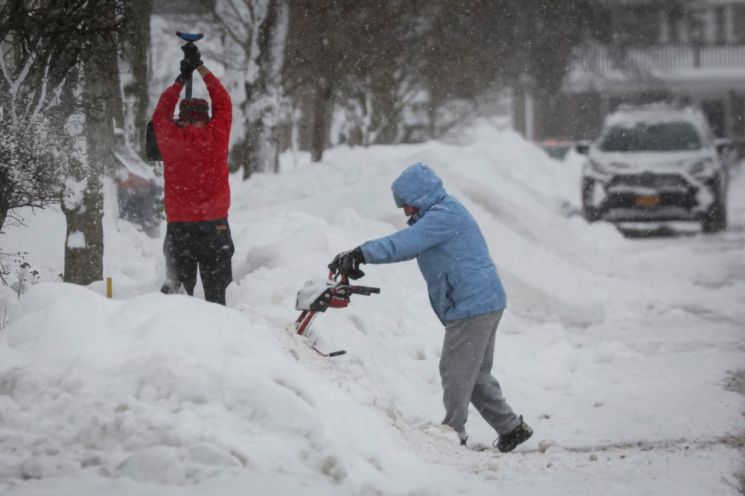
[Asia Economy Reporter Lee Hyun-woo] Amid reports that more than 50 people have died due to a winter storm sweeping across the United States, U.S. meteorological authorities have forecast that the severe cold will continue through this week. The main cause of this cold wave has been identified as a 'Bomb Cyclone,' whose intensity is expected to weaken, leading to a return to average temperatures.
This bomb cyclone is known to have formed as a result of global warming causing a significant rise in the average temperature of the Arctic region, weakening the high-latitude jet stream that used to trap cold air masses in the Arctic, which then allowed large amounts of cold air to move southward. While bomb cyclones have typically occurred about once every ten years, there are concerns that with worsening global warming, they may occur every winter, bringing sudden cold waves.
What is the 'Bomb Cyclone' that swept across the U.S.?
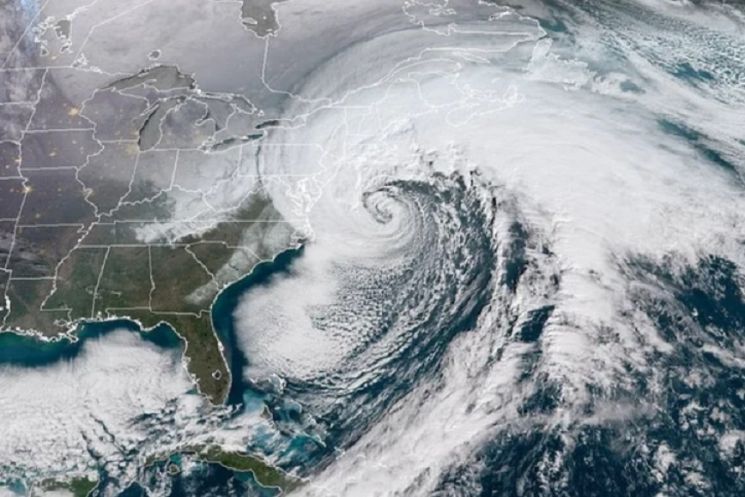
According to Voice of America (VOA) on the 26th (local time), the U.S. National Weather Service (NWS) reported that the winter storm bringing cold and heavy snow across the country was formed by a bomb cyclone, which is expected to rage through this week before subsiding starting next week.
According to the NWS, a bomb cyclone refers to a low-pressure storm formed when cold air currents from the Arctic rapidly move southward and meet warm, moist air lingering near the surface, creating a low-pressure vortex. Unlike cyclones (tropical cyclones) that typically form over hot oceans in summer, the term 'bomb' is used because of the explosive occurrence of strong winds and blizzards. It is also called 'bombogenesis' or 'explosive cyclogenesis.'
Bomb cyclones usually occurred once every ten years across the U.S. continent, but recently they have been frequently forming in the North Pacific region during winter months from December to March. This is because the jet stream, which used to block the southward movement of cold air masses from the Arctic, has weakened due to global warming, allowing cold air trapped in the Arctic to move southward into mid-latitude regions more frequently.
This southward movement of Arctic cold air masses is occurring simultaneously and repeatedly in eastern Siberia, Canada, and northern parts of the U.S., separated by the Bering Sea. It is also a cause of sudden cold waves and heavy snowfalls in the Korean Peninsula region.
'La Nina' persisting for 3 years is also a major factor of the cold wave
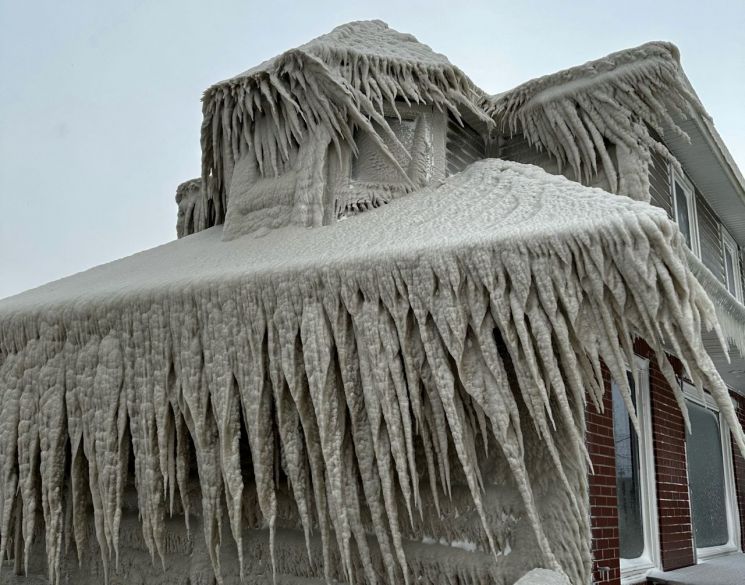
Along with the southward movement of Arctic cold air due to global warming, the 'La Nina' phenomenon, which has persisted for three years, is considered a major factor of the cold wave. La Nina, caused by a rapid rise in sea surface temperatures, has continued for over three years, potentially triggering abnormal weather across the entire Pacific region.
According to Bloomberg News, the La Nina phenomenon, now in its third consecutive year, is expected to continue through the end of the year, causing cold waves and heavy snow in countries around the Pacific, including the U.S. and Northeast Asia. La Nina occurs when, due to global warming, the trade winds in East Asia strengthen beyond usual levels, causing sea surface temperatures in the western Pacific to rise sharply, while cold deep ocean water in the eastern Pacific rises due to density differences, leading to a rapid drop in sea surface temperatures there.
Previously, even when La Nina occurred, sea surface temperatures typically returned to normal within a short period. However, this time, La Nina that began in September 2020 has persisted for three years. This is the first time in the 21st century that a 'Triple Deep' La Nina, lasting three consecutive years, has occurred. The U.S. National Oceanic and Atmospheric Administration (NOAA) Climate Prediction Center estimates a 75% probability that La Nina will continue until February next year, and about a 60% chance it will persist until March.
When sea surface temperatures in the eastern Pacific drop significantly due to La Nina, atmospheric circulation in the western Pacific changes, causing abnormal weather around the Pacific region. Southeast Asia, Australia, and southeastern Africa face increased chances of typhoons and heavy rains, while the U.S. Midwest, Peru, Chile, and other parts of western Latin America are more likely to experience cold waves and droughts.
© The Asia Business Daily(www.asiae.co.kr). All rights reserved.
![Clutching a Stolen Dior Bag, Saying "I Hate Being Poor but Real"... The Grotesque Con of a "Human Knockoff" [Slate]](https://cwcontent.asiae.co.kr/asiaresize/183/2026021902243444107_1771435474.jpg)

















