①Jeonse Contract Market Price - Check Sale Price
②No Matter How Busy, Moving-in Report Is Essential
③If Deposit Not Paid, Register Lease Right
A similar incident has occurred again involving the 'Villa King,' who owned over 1,100 villas and officetels but died without returning the security deposits.
As cases of tenants not receiving their security deposits are rapidly increasing, experts advise exercising caution to prevent damage even before signing contracts.
 The view of a villa village from a building in Yangcheon-gu, Seoul, where villa transaction volumes are increasing on the 11th. Photo by Mun Ho-nam munonam@
Villa King Owning Dozens of Villas and Officetels at Age 27
According to the Housing and Urban Guarantee Corporation (HUG) and others on the 27th, Song Mo (27), who owned dozens of villas and officetels in areas such as Michuhol-gu, Incheon through gap investment, passed away on the 12th, resulting in a surge of tenants unable to recover their jeonse security deposits.
Although Song was a registered rental business operator, it was found that he did not subscribe to the mandatory rental deposit guarantee insurance that rental business operators are required to join.
Among the houses he owned, about 50 were confirmed to be subscribed to HUG's Jeonse Deposit Return Guarantee Insurance.
Some tenants covered by HUG's Jeonse Deposit Return Insurance have received their deposits back through inheritance subrogation registration procedures, but about 40 properties have not yet reached the end of their lease terms, so the guarantee insurance completion period has not yet arrived.
It is estimated that the total amount of deposits tenants should recover from the houses under Song's name that are subscribed to HUG's Jeonse Insurance alone reaches 10 billion KRW.
When a landlord dies, victims who have subscribed to jeonse insurance face difficulties receiving their deposits back from HUG.
For HUG's subrogation payment (where the guarantee institution first returns the deposit to the tenant and then recovers it from the landlord), the tenant must notify the landlord of the termination of the lease contract, but since the landlord has died, this step encounters obstacles.
Victims who did not subscribe to guarantee insurance must recover their deposits through property auctions.
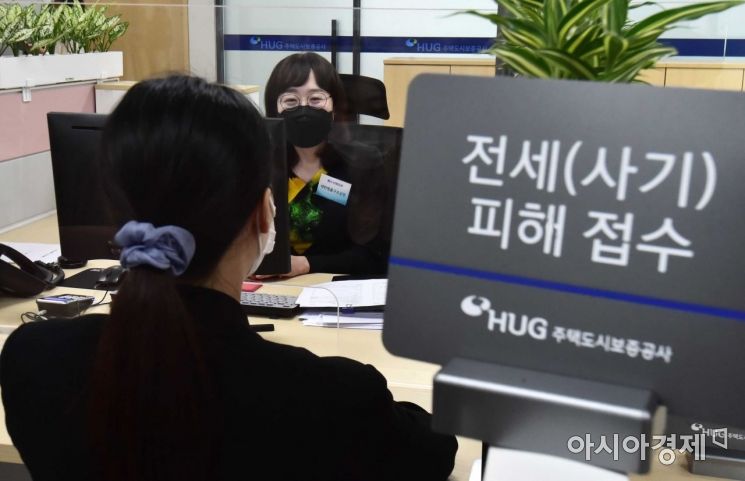 On September 28, a citizen is receiving consultation from the Korea Legal Aid Corporation regarding the reporting of jeonse fraud damage at the Jeonse Damage Support Center located inside the Korea Chamber of Commerce and Industry on Hwagok-ro, Gangseo-gu, Seoul. Photo by Jinhyung Kang aymsdream@
① First Step to Reduce Deposit Accidents: 'Check Surrounding Market Prices Before Contract'
Recently, due to the real estate market downturn and falling jeonse prices, cases where security deposits are not returned on time are increasing uncontrollably. Real estate specialist lawyer Eom Jeong-suk (Beopdo Comprehensive Law Office) advises, "It is important to check three things before and after the contract to prepare for any unforeseen circumstances."
The most important is to check the surrounding market prices before signing the contract. When jeonse prices are falling, naturally, people tend to look for cheaper listings than usual.
However, simply looking for the lowest price is not always the best approach. When jeonse prices fall, sales prices often fall as well, and there are cases where the difference between jeonse and sales prices is nonexistent or even where jeonse prices exceed sales prices.
② No Matter How Busy, Always File a Move-in Report Immediately After Moving
The second way to prevent deposit accidents is to always file a 'move-in report.' It is a simple and common-sense procedure, but many still skip it due to personal circumstances or situations.
If you do not file a move-in report, you may not be able to receive your jeonse deposit on time later or be recognized as a tenant if problems arise with the landlord. In other words, the move-in report serves as objective evidence that the tenant resides in the property, and without it, securing priority during auctions is difficult.
Lawyer Eom said, "The move-in report plays a role in recognizing tenants as first-priority creditors even if the landlord's property is auctioned due to debts or other lawsuits," adding, "Therefore, the move-in report should be regarded as an essential procedure that must be done, not something to be avoided for convenience or other reasons."
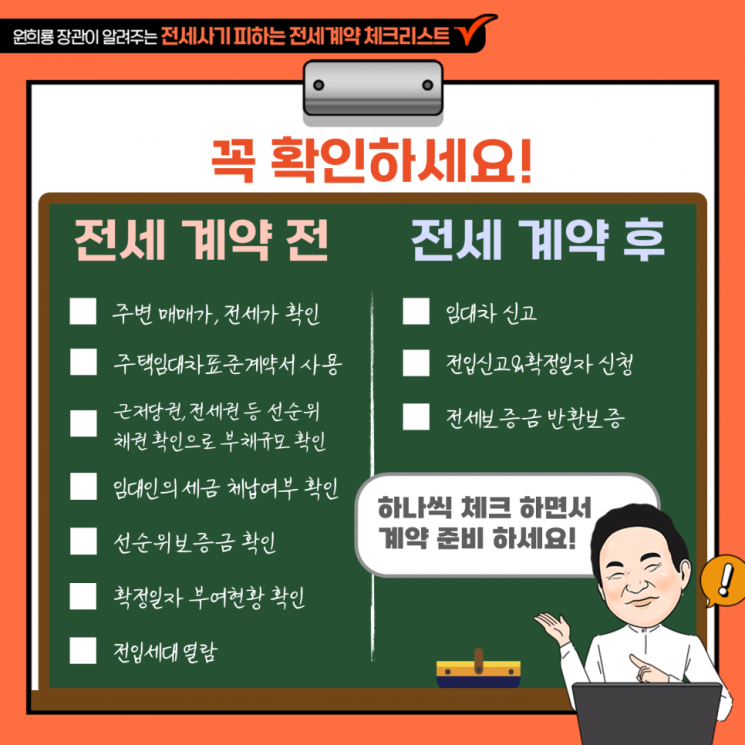
③ If You Need to Move but the Landlord Does Not Return the Deposit, Use Leasehold Registration
The last preventive measure is to prepare for what could be a prolonged legal battle. Unless the jeonse price has risen and everyone must contract at the higher price, it is not easy to find a definite solution when jeonse prices have fallen.
Existing tenants signed contracts at the previous higher jeonse price, but it is difficult to find new tenants willing to pay that amount. In this case, it may take a long time to find new tenants, and the tenant's moving-out deadline may approach.
Lawyer Eom said, "In this situation, you can use leasehold registration," explaining, "Leasehold registration has the effect of maintaining the tenant's move-in report for the existing house even if the tenant moves and files a move-in report elsewhere, so even if the property goes to auction, the tenant's priority repayment rights and opposability are preserved."
© The Asia Business Daily(www.asiae.co.kr). All rights reserved.



















