Early Diagnosis Difficult and Rapid Progression Lead to 97% Fatality Rate
Ameba in Freshwater Enters Through Nose... Causes Inflammation and Tissue Destruction Upon Reaching Brain
Ameba Thriving in Warm Water... Habitat Expands as Earth Warms
 A 9-year-old girl in Kansas, USA, died after being infected with a brain-eating amoeba. (Photo by YouTube video capture)
[Asia Economy Reporter Yoon Seul-gi] A man in his 50s infected with the so-called "brain-eating amoeba," Naegleria fowleri, died after 10 days. It is known that the patient stayed in Thailand for four months and developed symptoms after returning to Korea. Naegleria fowleri infections have mainly occurred in North America, but recently, due to global warming, its habitat range is expanding. In the United States, it has been observed to move northward to relatively cooler regions, and cases of amoeba infections have been continuously reported in Asia as well.
According to the Korea Disease Control and Prevention Agency on the 26th, Naegleria fowleri infection was confirmed in a meningitis death case after returning from overseas. This is the first domestic infection case. Previously, the patient was urgently transported on the 11th due to symptoms including headache, fever, loss of speech ability, vomiting, and neck stiffness, and died 10 days later on the 21st. Genetic testing confirmed infection with Naegleria fowleri among the three amoebic encephalitis pathogens: Acanthamoeba, Balamuthia, and Naegleria fowleri.
Naegleria fowleri is a parasite that causes inflammation and tissue destruction when it reaches the brain. If detected early, appropriate treatment can lead to survival, but the problem is that early diagnosis is difficult and the disease progresses acutely. From 1962 to 2021, 154 infection cases were reported in the U.S., with only 4 survivors. The fatality rate is about 97%.

Most Naegleria fowleri infections occur during swimming or leisure activities in lakes or rivers. The amoeba enters the nose during swimming and travels along the olfactory nerve to the brain, causing primary amoebic meningoencephalitis (PAM). Additionally, infections have been reported from using contaminated water in nasal irrigation devices (neti pots), often used for religious purposes or rhinitis treatment.
While Naegleria fowleri infections have mainly occurred in North America, the range is gradually moving northward. In September, a child in Omaha, Nebraska, in the central U.S. died from this amoeba infection. According to last year's report by the U.S. Centers for Disease Control and Prevention (CDC), the amoeba was usually found in southern states with higher temperatures such as Arizona, but recently, its range has expanded to include central and cooler regions like Minnesota.
In Asia, infection cases are also increasing. As of last year, 41 cases were confirmed in Pakistan, 26 in India, 17 in Thailand, 6 in China, and 2 in Japan. In Korea, the possibility of its presence was reported in 2017 when Naegleria fowleri genes were detected at 6 out of 52 nationwide water source survey points.
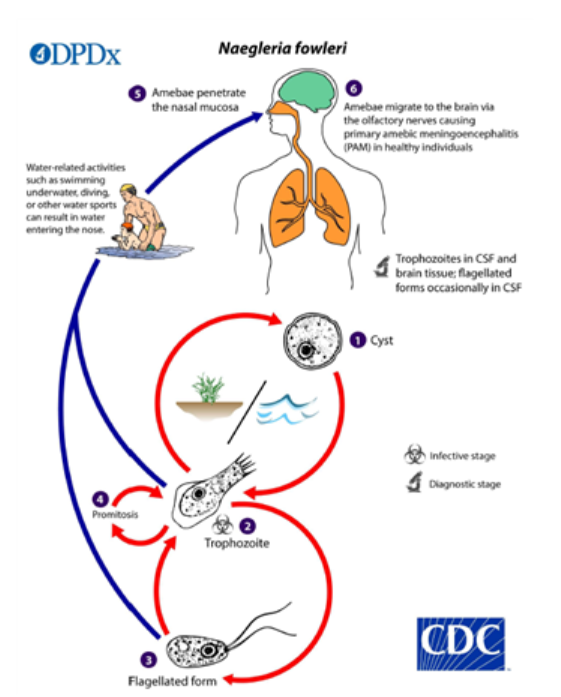 Life cycle of Naegleria fowleri created by the U.S. Centers for Disease Control and Prevention (CDC). Photo by Korea Disease Control and Prevention Agency
The expansion of Naegleria fowleri habitats is due to global warming. The amoeba inhabits freshwater at temperatures between 25°C and 46°C, and as warm temperature conditions are met, its range is increasing.
Although Naegleria fowleri has a high fatality rate, prevention methods do exist. Infection can be prevented by avoiding water entering the nose during aquatic leisure activities.
It is advisable to wear nose clips when entering water and to avoid swimming and leisure activities in areas where Naegleria fowleri has been reported. Especially during the warm summer or in warm resorts, the risk of infection increases, so swimming, leisure activities, and hot spring bathing in lakes or rivers should be avoided.
© The Asia Business Daily(www.asiae.co.kr). All rights reserved.
![Clutching a Stolen Dior Bag, Saying "I Hate Being Poor but Real"... The Grotesque Con of a "Human Knockoff" [Slate]](https://cwcontent.asiae.co.kr/asiaresize/183/2026021902243444107_1771435474.jpg)
















