Deputy Prime Minister Choo Kyung-ho, 231st Foreign Economic Ministers' Meeting
Steel and Aluminum Hit Unavoidably by EU Carbon Regulations
209.7 Billion KRW Support for Carbon Neutrality Core Industrial Technology Development Project
Green Finance Scale Expanded from 3.8 Trillion to 9.4 Trillion KRW
[Asia Economy Reporter Song Seung-seop] The government has introduced a policy to transition domestic companies with high carbon emissions to a low-carbon structure. More than 9 trillion won will be invested in green finance for carbon neutrality. This comes amid concerns over the impact on domestic companies due to the implementation of global climate change regulations such as the European Union (EU)’s Carbon Border Adjustment Mechanism (CBAM).
On the 26th, Choo Kyung-ho, Minister of Economy and Finance and Deputy Prime Minister, held the 231st Foreign Economic Ministers’ Meeting at the government complex in Jongno-gu, Seoul, stating, “Recently, the EU has been introducing country-centric systems to address climate change and supply chain issues,” and added, “We will implement measures to minimize the burden on our economy and leverage opportunities.”
At the meeting, the agenda item “Current Status and Response Measures for CBAM” was discussed and approved. CBAM is a type of “carbon tax” introduced by the EU. It imposes taxes on products imported into the EU from countries with lax greenhouse gas emission regulations. The carbon emissions generated during product manufacturing are estimated and linked to the EU Emissions Trading System (ETS). On the 18th, a legislative agreement was reached among the EU Commission, Council, and European Parliament.
The targeted items include six categories: steel, aluminum, cement, fertilizer, electricity, and hydrogen. After a transition period starting next October, the system will be fully implemented in 2026. The free allocation of ETS allowances by the EU will also be abolished between 2026 and 2033.
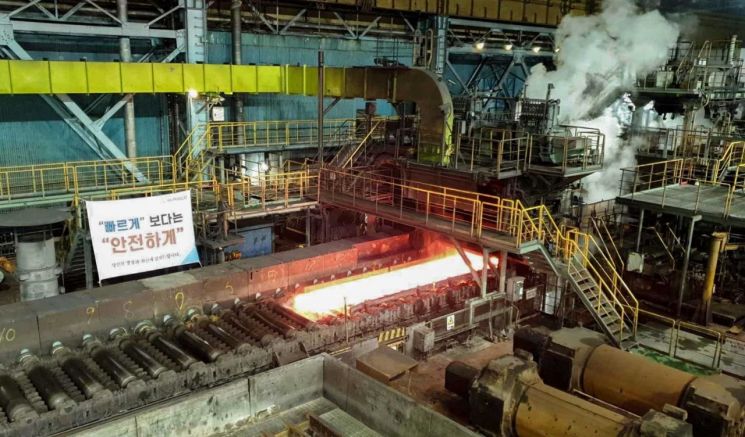
The implementation of the system will inevitably impact domestic companies. For steel companies, exports to the EU last year alone amounted to 4.3 billion USD. South Korea ranks fifth among the EU’s steel import countries. Moreover, Korean steel companies use more blast furnaces, which emit more CO2, compared to electric arc furnaces, making losses unavoidable. Aluminum is also an industry with high carbon emissions during the ingot production process. Currently, 95% of total carbon emissions come from ingots, which are entirely imported from countries such as Malaysia and Australia.
Administrative and cost burdens are also expected to increase. During the transition period, domestic export companies must report carbon emission data to the EU quarterly. This includes not only the carbon emissions embedded in export products but also the carbon prices already paid at the origin. Furthermore, after the full implementation of the system and the abolition of free ETS allocations, companies will need to purchase more certificates.
The government plans to support the strengthening of domestic companies’ response capabilities. Through the Carbon Neutral Industry Core Technology Development Project, 209.7 billion won will be supported for steel from next year until 2030. This includes converting blast furnaces to electric arc furnaces and supporting the development of carbon reduction technologies to transform the steel industry into a low-carbon production structure. In the mid to long term, support will be provided for the development of process design technology for “hydrogen reduction steelmaking,” which produces steel using hydrogen.
Efforts will also be made to create a sustainable carbon reduction environment by utilizing financial markets. Green finance for supporting carbon-neutral facility investment will increase from 3.8 trillion won this year to 9.4 trillion won next year. Of this, 3.9 trillion won will be invested in green bonds, and 3.5 trillion won in green finance interest subsidies. To encourage voluntary carbon reduction, activation of the emissions trading market will also be pursued. Specifically, measures such as allowing third-party participation in the emissions trading market or introducing an emissions futures system are being considered.
Additionally, the government will strengthen the response capabilities of export companies to the EU, including small and medium-sized enterprises (SMEs) and mid-sized companies. A practical guidebook will be produced and distributed, and related briefing sessions will be held. Training for personnel involved in the Measurement, Reporting, and Verification (MRV) stages will be provided, and a simplified system will be developed.
Deputy Prime Minister Choo emphasized, “We will continue consultations to ensure our position is reflected as the EU’s implementing regulations are detailed,” and added, “Domestically, we will actively respond focusing on sectors with significant impact.”
© The Asia Business Daily(www.asiae.co.kr). All rights reserved.
![Clutching a Stolen Dior Bag, Saying "I Hate Being Poor but Real"... The Grotesque Con of a "Human Knockoff" [Slate]](https://cwcontent.asiae.co.kr/asiaresize/183/2026021902243444107_1771435474.jpg)















