Sajo Committee Issues Safety Recommendations to Ministry of Land and KORAIL
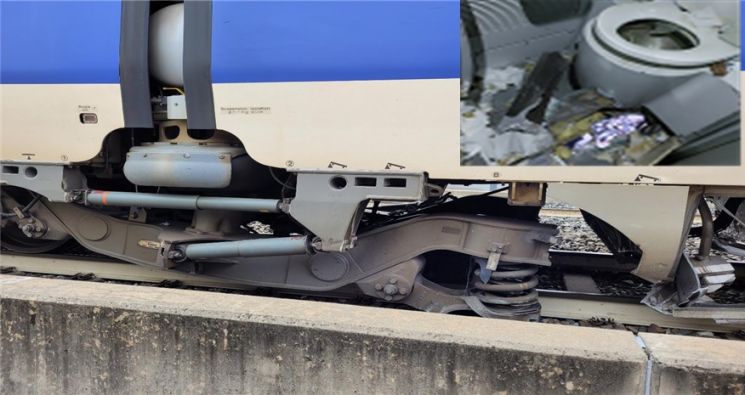 The scene of the Korea Railroad Corporation (KORAIL) KTX-Sancheon derailment accident that occurred on January 5th between Daejeon and Gimcheon-Gumi stations on the Gyeongbu High-Speed Line southbound / Photo by Ministry of Land, Infrastructure and Transport
[Asia Economy Reporter Noh Kyung-jo] The Aviation and Railway Accident Investigation Board (ARAIB) announced on the 26th that the main cause of the KTX-Sancheon derailment accident that occurred between Daejeon and Gimcheon-Gumi stations on the down line of the Gyeongbu High-Speed Line on January 5 was wheel failure due to fatigue fracture. In this regard, safety recommendations were issued to the Ministry of Land, Infrastructure and Transport and Korea Railroad Corporation (KORAIL).
The accident train, which was traveling at approximately 285 km/h at the time, derailed at the 193 km mark from Seoul Station when the right wheel of the second axle of the middle car in the direction of travel was damaged. Continuing to run in that state, the accident train lost the axle about 1 km later due to the impact of operation. Eventually, about 3 km further, the emergency brake was engaged due to damage to the brake device's air pipe, and the train came to a final stop about 5 km later.
According to ARAIB, the cause of the accident was that the wheel fractured due to fatigue failure before reaching the usage limit (wear limit) specified in the manufacturing specifications. The maximum usable diameter due to wear is 850 mm, but at the time of the accident, the diameter was 869 mm. Fatigue failure refers to a fracture that occurs when repeated loads smaller than the allowable load act on a material over a long period. Microcracks gradually progress until final rupture occurs.
The train, composed of 10 cars, was carrying 303 passengers. There were no casualties from the accident, but seven passengers sustained minor injuries. The vehicle (body, car, restroom, glass, etc.), rails, sleepers, and overhead line equipment were damaged, causing disruptions to 215 trains (197 delayed and 18 canceled).
ARAIB stated that immediately after the accident, they began investigating the cause by inspecting the condition of the vehicles, debris, and rails, and analyzing operation records, wireless recordings, and closed-circuit television (CCTV) footage.
In particular, axle fragments and broken wheel pieces were found along the track about 3 to 4 km behind the stopped accident train, indicating a problem with the running gear. Accordingly, on January 10, five days after the accident, an urgent safety recommendation was issued to KORAIL to conduct a special inspection of the running gear of KTX trains introduced around the same time as the accident train. KORAIL replaced all wheels (432 units) from the same manufacturer introduced during the same period as the damaged wheel over approximately two weeks.
ARAIB also conducted visual inspections, fracture surface analysis, mechanical property tests (hardness measurement), and compositional analysis on the accident wheel to identify the cause of the wheel failure, which appeared to have triggered the accident.
The results showed that the hardness and tensile strength of the damaged wheel were below the minimum allowable values of the EN 13262 standard (European wheel manufacturing standard), and microvoids were clustered and distributed at the crack initiation site. The existing ultrasonic inspection method was unable to detect internal defects throughout the entire wheel early enough, which also contributed to the wheel fatigue failure.
ARAIB issued a safety recommendation to KORAIL to establish and implement quality and safety assurance measures throughout the entire lifecycle of KTX wheels, from ordering to maintenance. Above all, they recommended improving the ultrasonic inspection method and frequency to enable early detection of internal defects throughout the entire wheel. Although KORAIL has been implementing improvement measures since May, their effectiveness was deemed insufficient.
They also recommended strengthening training on manuals to ensure compliance with maintenance and inspection cycles such as wheel truing, ultrasonic testing, and actions to be taken when KTX vehicle hunting (lateral vibration above a certain level) occurs. They reviewed the frequent occurrence of vehicle hunting in the control area of Gwangmyeong Station (33?45 km from Seoul Station, a 24 km round trip section) and advised taking improvements or other measures as necessary.
The Ministry of Land, Infrastructure and Transport was requested to verify and inspect the safety and quality assurance of KTX wheels under Article 31 (Post-approval management such as type approval) of the Railway Safety Act.
An ARAIB official said, "We will immediately send the investigation report to the relevant agencies to submit results or plans for implementing safety recommendations, and regularly check and encourage implementation to do our best to prevent similar accidents from recurring."
© The Asia Business Daily(www.asiae.co.kr). All rights reserved.
![Clutching a Stolen Dior Bag, Saying "I Hate Being Poor but Real"... The Grotesque Con of a "Human Knockoff" [Slate]](https://cwcontent.asiae.co.kr/asiaresize/183/2026021902243444107_1771435474.jpg)















