WSJ "Electric Vehicle Operating Costs Higher Than Internal Combustion Engine Vehicles"
[Asia Economy Reporter Haeyoung Kwon] Due to the Ukraine war, electricity prices in Europe have surged sharply, causing the operating costs of electric vehicles (EVs) to surpass those of internal combustion engine (ICE) vehicles, resulting in a 'reversal phenomenon.' There are concerns that the energy crisis in Europe could slow down the transition to eco-friendly vehicles.
On the 25th (local time), The Wall Street Journal (WSJ) reported, "Rising electricity prices in Europe are increasing costs for EV owners." Previously, EV maintenance costs were cheaper than those of ICE vehicles, but with the spike in electricity prices following Russia's invasion of Ukraine, the cost advantage of EVs has disappeared.
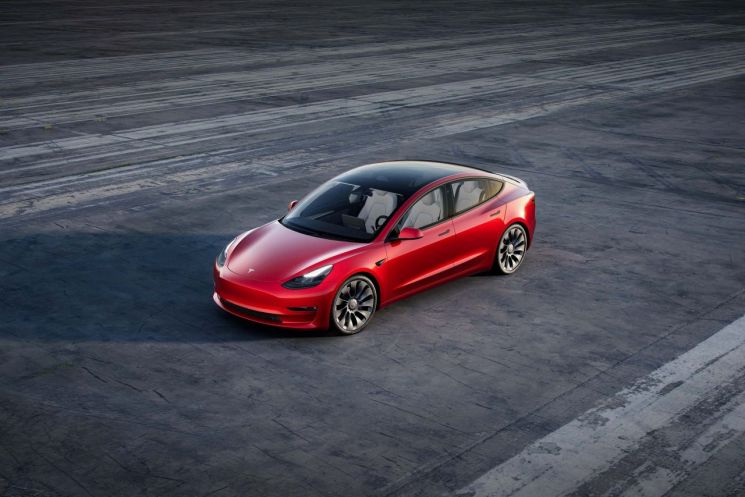
According to the newspaper, the charging cost of the Tesla Model 3, the most efficient mid-sized EV according to the U.S. Environmental Protection Agency (EPA), is 18.46 euros per 100 miles at Tesla's fast-charging stations (Superchargers) in Europe. This is higher than the fuel cost of the Honda Civic, an ICE vehicle of similar class, which is 18.31 euros per 100 miles based on EPA data. Tesla has raised fast-charging costs seven times this year alone in Germany, leading to increased EV operating expenses.
In particular, the reversal of operating costs between EVs and ICE vehicles has been prominent in Germany, where electricity prices have surged sharply this year. German electricity prices rose from 0.33 euros per kWh in the first half of the year to about one-third higher currently. According to the German Federal Statistical Office, residential electricity prices in December were 0.43 euros per kWh, nearly double that of France (0.21 euros per kWh in the first half of the year).
The problem is that if the Ukraine war prolongs and the energy crisis continues, electricity prices may keep rising. Some German power companies have announced plans to raise electricity prices to over 0.5 euros per kWh starting January next year. German government advisory committees composed of economic experts predict that while electricity prices may decline in the mid to long term, they will not return to pre-crisis levels.
WSJ analyzed, "Economists expect electricity price increases to persist for years," adding, "The strong incentive for consumers to switch to EVs due to their lower operating costs compared to ICE vehicles has disappeared."
So far, there are no signs that EV sales have declined due to increased maintenance costs from rising electricity prices. According to the European Automobile Manufacturers Association (EAMA), EV sales in the third quarter reached 259,449 units, an 11% increase from the previous quarter and a 22% increase year-on-year. However, as the cost advantage of EVs due to low operating costs disappears amid rising electricity prices, it is expected that the transition to eco-friendly vehicles will slow down not only in Europe but globally.
Another negative factor for the EV sales market is the trend of some governments abolishing EV purchase subsidies. WSJ predicts this will threaten Europe's greenhouse gas reduction targets and make it difficult for European EV manufacturers to recoup the significant investments made in the EV transition.
Maria Bangson, a partner at the global accounting firm Ernst & Young, said, "With electricity prices rising sharply, it will take longer for EV prices to become lower than those of traditional ICE vehicles." She added, "Before the energy crisis, the tipping point for EV transition was expected around 2023-2024, but now it is anticipated to be delayed until 2026."
© The Asia Business Daily(www.asiae.co.kr). All rights reserved.
![Clutching a Stolen Dior Bag, Saying "I Hate Being Poor but Real"... The Grotesque Con of a "Human Knockoff" [Slate]](https://cwcontent.asiae.co.kr/asiaresize/183/2026021902243444107_1771435474.jpg)















