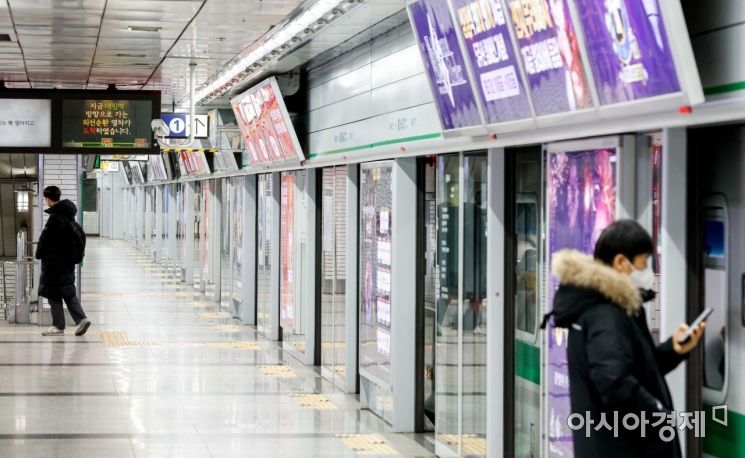
 On the 30th of last month, when subway operations were delayed due to a strike by Seoul Metro, the operator of the Seoul subway, citizens were waiting for trains at Sindorim Station in Guro-gu, Seoul. Photo by Jinhyung Kang aymsdream@
[Asia Economy Reporter Moon Hyewon]The government budget for next year did not include compensation for losses from free rides on urban rail transit, making a fare increase for the Seoul subway inevitable.
According to Seoul City on the 25th, the budget for the PSO (Public Service Obligation) compensation for losses of local government urban rail transit was ultimately excluded from next year's government budget, which passed the National Assembly plenary session the day before.
The PSO budget is allocated to compensate for costs incurred from free rides for the elderly, disabled, and other vulnerable groups.
The government has so far supported only Korail with the PSO budget based on Article 32 of the Railroad Industry Development Act. Last year, it provided 379.6 billion KRW, and this year, 384.5 billion KRW.
Although a budget of 397.9 billion KRW was submitted to the National Assembly for next year, the National Assembly Land, Infrastructure and Transport Committee on the 24th of last month passed a revised proposal adding 358.5 billion KRW for local government urban rail transit loss compensation, totaling 756.4 billion KRW.
However, in the plenary session, the government’s original proposal reflecting only Korail’s loss compensation, not the committee’s revision, was passed.
The basic fare for the Seoul subway has remained unchanged at 1,250 KRW since it was raised from 1,050 KRW in 2015, marking eight years without adjustment. Considering that bus fares have typically been raised every 3 to 4 years along with subway fares, the timing for adjustment has long passed.
Moreover, with the aging population, the number of free riders has increased annually, causing the average fare per person to fall to less than half of the cost. The fare loss per person surged from 494 KRW in 2019 to 1,015 KRW last year.
To make matters worse, due to COVID-19 reducing passenger revenue, Seoul Metro, which operates the Seoul subway, recorded a net loss of 586.5 billion KRW in 2019, 1.1137 trillion KRW in 2020, and 964.4 billion KRW last year. Free rides accounted for 29% (278.4 billion KRW) of last year’s deficit.
Local governments including Seoul City argue that since the free ride system for transportation-vulnerable groups was introduced in 1984 by presidential directive, the government should compensate for the loss.
Related local governments have repeatedly requested budget support from the government, but it has been rejected each time due to concerns over fiscal burden.
If the subway fare increase policy is finalized, city bus fares are also expected to rise together.
Subway and city bus fares have typically been raised simultaneously. In April 2007, both increased by 100 KRW, in February 2012 by 150 KRW, and in June 2015, the subway fare rose by 200 KRW while the bus fare increased by 150 KRW.
Since subway fares have been frozen for eight years and Seoul Metro’s losses have grown, there is speculation that the upcoming fare increase could be larger than the previous 100 to 200 KRW increments.
A city official said, "No specific plans or levels for public transportation fare increases have been decided yet," adding, "It will take at least six months to reach a final decision after consultations with related agencies such as Gyeonggi Province and bus companies, as well as public hearings."
© The Asia Business Daily(www.asiae.co.kr). All rights reserved.
![Clutching a Stolen Dior Bag, Saying "I Hate Being Poor but Real"... The Grotesque Con of a "Human Knockoff" [Slate]](https://cwcontent.asiae.co.kr/asiaresize/183/2026021902243444107_1771435474.jpg)















