Seoul Jung-gu Chairman Gil Ki-young of Jung-gu Council Issues Statement on 23rd Opposing "Reckless Budget Cuts Leading to Loss of Public Welfare" Press Release on 21st: "Council's Budget Review Authority Is a Serious Challenge - 'Budget Review Authority Is an Inherent Right Granted by Local Autonomy Law and Residents'"
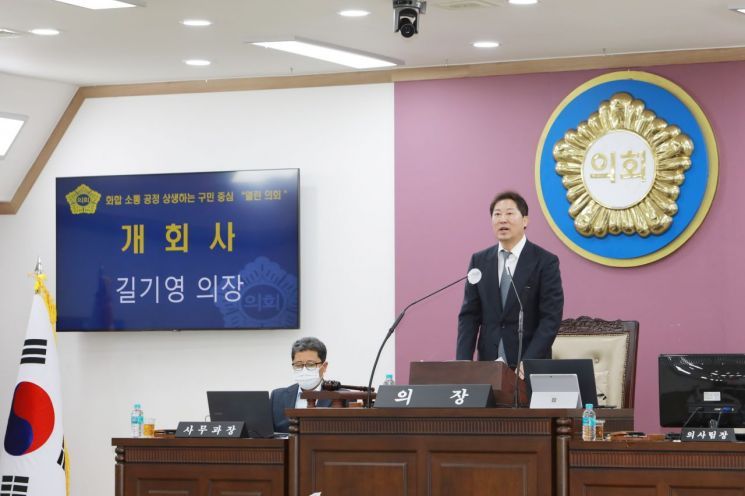
[Asia Economy Reporter Jong-il Park] Seoul Jung-gu (District Mayor Kim Gil-seong) and Jung-gu Council (Chairman Gil Ki-young) are drawing attention as they continue conflicts with sharp criticism regarding the 2023 budget cuts.
On the 20th, at the closing ceremony of the 275th regular session of the Jung-gu Council, Jung-gu expressed "deep regret" over the drastically cut 2023 main budget and unsubmitted agenda items, stating "the residents were completely disregarded." The total 2023 project budget of 575.6 billion KRW was finally revised and approved at 556.5 billion KRW. The general account (525.1 billion KRW) was cut by about 18.7 billion KRW, and the special account (50.5 billion KRW) was cut by 239 million KRW. The total cut amount was 19 billion KRW.
In response, on the 23rd, Gil Ki-young, Chairman of the Jung-gu Council, issued a statement titled "A Serious Challenge to the Budget Deliberation Authority of Jung-gu Council - 'The Council's Budget Deliberation Authority is an Inherent Right Granted by the Local Autonomy Act and Residents,'" criticizing the executive branch.
Chairman Gil criticized, "The Jung-gu Mayor should respect the careful decision-making of the Jung-gu Council, the representative body of the residents, and come forward for communication and dialogue."
Below is Chairman Gil’s statement
On the 21st, Jung-gu Office released a press statement titled "Irresponsible Budget Cuts Result in the Disappearance of Livelihood."
Under the banner of "One Jung-gu, Together Jung-gu," emphasizing harmony and communication, the 8th term Jung-gu Office showed a disrupted course at the closing ceremony of the 275th regular session after 30 days of legislative schedule. They criticized the council with harsh words, accusing it of holding the precious budget of residents hostage through so-called "irresponsible" cuts.
Furthermore, on the 22nd, a banner stating "Condemn Jung-gu Council for the Complete Cut of Resident Livelihood Budget" was displayed, criticizing the council and deceiving Jung-gu residents.
The mayor, starting the 8th term, likely put more effort and sincerity into next year’s budget, which is effectively the first year to begin core campaign projects. However, since the launch of the 8th term, the executive branch has frequently omitted explanations or cooperation with the council, a partner in governing the district, regarding major policy initiatives or project budgets. This made it very difficult for the council to gauge which policies were urgent and prioritized.
Additionally, the executive branch showed disrespect by excluding council members, representatives of residents, from resident participation events.
Amid heated public opinion among parents due to the ongoing media coverage of the "Direct Operation of Daycare Centers and Transfer of Elementary After-School Care to the Education Office," the council hosted a public hearing to gather parents’ opinions, but the executive branch did not attend. Later, the executive branch held a public hearing without inviting the council, showing a "let’s each go our own way" attitude, disregarding the council as a partner in district administration.
While respecting the election of Mayor Kim Gil-seong, chosen by residents with a narrow margin of 489 votes, his campaign promises and core projects are political products, not legally binding rules that everyone must follow.
In other words, it cannot be asserted that these fully represent the thoughts and intentions of all Jung-gu residents, and the council, representing all residents, is not obliged to unconditionally agree with the mayor’s core campaign promises or allocate budgets accordingly.
Nevertheless, the 2023 main budget is a precious resource to be used for the welfare of 120,000 residents and regional development. The council, considering the current economic recession and financial status?where Jung-gu was selected as one of the few financially unhealthy local governments nationwide?carefully reviewed priorities and made a difficult decision.
For example, 1) projects related to local festivals are difficult to see as urgent and necessary for residents under the difficult financial conditions,
2) some personnel expenses for the new industrial complex director, who was found to have no relevant experience during administrative audits, and some related projects should be budgeted based on future management performance,
3) regarding the budget for urban industry, traditional markets, and social economy directly linked to the livelihood economy, only 900 million KRW was cut out of the submitted 11.3 billion KRW. The executive branch’s claim that this would harm local economic revitalization is an absurd, self-serving attack,
4) the mayor’s core campaign project of urban development, a long-cherished project involving private participation, is deeply understood and supported by the council. However, given the prolonged high-interest stagflation and the worst construction market in 12 years, pushing the project recklessly could damage the local government’s financial soundness. The cuts were made considering these factors, and the project was an incomplete campaign promise that failed to thoroughly examine feasibility amid the anticipated recession,
5) while the mayor, who holds personnel authority, is free to hire staff, the claim that the council blocked the hiring of staff necessary for the mayor’s campaign projects by holding the budget hostage is groundless, as the council was not consulted and the budget was not secured beforehand.
Similar cases occurred during the 7th term, where new organizations were irresponsibly established and staff hired without securing budgets, causing confusion and conflict. The cuts were made to prevent recurrence, not to block the mayor’s projects. There are many competent existing officials, so it is unlikely that the projects will be hindered due to the absence of irresponsibly hired staff.
Some agenda items submitted by Jung-gu Office were not referred to standing committees, thus not even given a chance for review, but the factual truth is otherwise.
7) The ordinance on supporting transportation expenses for seniors in Jung-gu was initially a campaign promise by the mayor to add 50,000 KRW as a merit allowance (Impact Plus project). After being elected, the promise was changed without residents’ consent to replace it with transportation expenses, gradually increasing to 50,000 KRW during the term. As senior public opinion favored the Impact Plus project, the council delayed referring the ordinance to urge the original promise’s fulfillment, not to withhold it without reason.
8) The partial amendment to the ordinance on childbirth and childcare support in Jung-gu has been revised several times to expand support funds as part of birth encouragement policies, but the number of births has decreased. The council strongly urged the discovery of a new paradigm for birth encouragement through active public opinion gathering and expert consultation.
However, Jung-gu Office ignored the council’s opinion and unexpectedly submitted another ordinance amendment to expand childbirth and childcare support funds. The referral was delayed for necessary consultation and coordination, not withheld without reason.
As seen, our council thoroughly deliberated the 2023 main budget based on rationality and causality. However, the executive branch, through multiple media outlets, ignored the council’s increased budget proposals directly related to residents’ livelihoods, insisted all budgets prepared by the executive are valid and cuts are unacceptable, showing a political attitude devoid of concession and compromise. Now, they are attempting to nullify the council’s budget deliberation authority.
Although the budget cuts made by the council this time can be reflected through supplementary budgets planned for the first half of next year after sufficient consultation, the executive branch’s reaction, as if the council is obstructing the newly elected mayor, is hard to accept considering the long-standing administrative trust and common sense.
During the 6th and 7th terms, all damages caused by discord between the council and the office fell on residents. At a time when the council and office should unite to design Jung-gu’s future and focus their capabilities on regional development, the office is treating the council, a partner in cooperation, as an adversary, engaging in a wasteful conflict.
We hope that past cases serve as a lesson, that harsh words are withdrawn, and that the office comes forward for communication and dialogue. We expect the council and executive branch to advance into a future-oriented, developmental relationship based on mutual respect and communication to realize the common goal of residents’ happiness and welfare.
Meanwhile, since the start of the 8th term, internal conflicts have continued, including a dispute involving People Power Party member Gil Ki-young’s election as chairman and a temporary injunction application by People Power Party members, leading to discord with the Jung-gu Office executive branch. This suggests that the aftereffects of poor coordination between the council and office will be significant and warrant attention.
© The Asia Business Daily(www.asiae.co.kr). All rights reserved.
![Clutching a Stolen Dior Bag, Saying "I Hate Being Poor but Real"... The Grotesque Con of a "Human Knockoff" [Slate]](https://cwcontent.asiae.co.kr/asiaresize/183/2026021902243444107_1771435474.jpg)















