Japan's Consumer Prices Jump 3.7% in November, Highest in 40 Years
Core Inflation in Major Countries Remains Stubborn... FT "Will Trigger Interest Rate Hikes"
[Asia Economy Reporter Kwon Haeyoung] Japan's consumer prices rose 3.7% last month compared to a year earlier, marking the largest increase in 40 years. This is due to the depreciation of the yen and rising energy prices. As soaring inflation worldwide has yet to subside, concerns are spreading that major countries will continue to raise interest rates through next year.
According to major foreign media including Nihon Keizai on the 25th, Japan's November Consumer Price Index rose 3.7% year-on-year. This index excludes volatile fresh food but includes petroleum products, representing the largest increase since December 1981 (4.0%), when inflation hit the world due to the second oil shock in 1979.
Prices of food excluding fresh food rose 6.8%, and electricity charges surged 20.1%.
The Japanese government expects the annual (April 2022 to March 2023) consumer price inflation rate to reach 3.0%, the highest level in 32 years since 1990 (3.3%).
On the same day, Singapore also announced that its core inflation, excluding personal transport and accommodation, rose 5.1% year-on-year in November. This maintained the 5.1% increase for two consecutive months following October. Bloomberg reported, "Singapore's core inflation rate last month remained at the same level as before," adding, "The Monetary Authority of Singapore (MAS) expects core inflation to reach 3.5-4.5% next year." Core inflation excludes price fluctuations caused by seasonal factors or temporary shocks such as agricultural products, petroleum products, food, and energy. It is used as an indicator to understand the underlying trend of inflation.
As core inflation rates in major countries remain high, concerns are emerging that the inflation peak has not yet been reached. This leads to central banks raising interest rates, which could further worsen the global economy, already threatened by a potential recession next year.
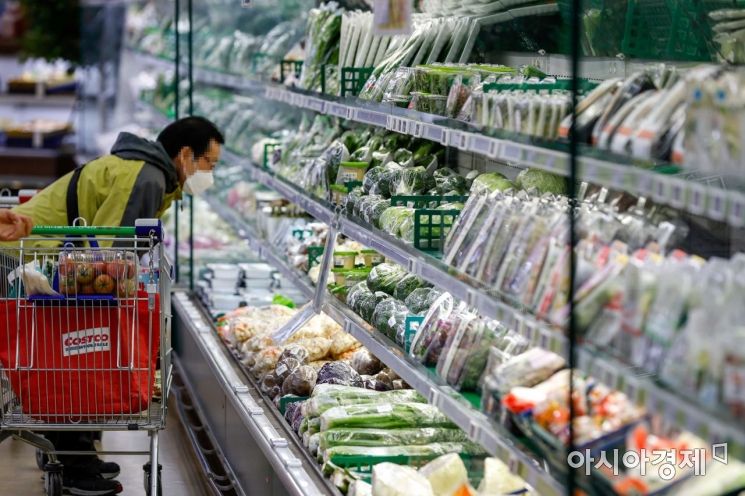 On the 11th, amid high inflation and ongoing economic slowdown, customers are shopping at the Nonghyup Hanaro Club Yangjae branch in Seocho-gu, Seoul. Photo by Jinhyung Kang aymsdream@
According to an analysis of its own statistics by the Financial Times (FT), last month core inflation rose month-on-month in more than half (55.5%) of 33 major countries. This far exceeds the proportion of countries with rising consumer prices (35.7%) and greatly surpasses the central banks' average inflation target of 2.0%. In South Korea, consumer prices rose 5.0% in November, showing a slowdown in the upward trend, but core inflation rose 4.8% for two consecutive months, reaching the highest level since February 2009 (5.2%) during the global financial crisis. The media outlet noted, "Core inflation continues to rise in many countries," and warned, "Global inflationary pressures risk triggering interest rate hikes in various countries."
In fact, Japan, where consumer price inflation hit a 40-year high on the same day, revised its monetary easing stance for the first time in 10 years. The Bank of Japan (BOJ), Japan's central bank, announced on the 20th that it would widen the fluctuation range of long-term interest rates, which had been maintained at 0-0.25%, to 0.5%. This effectively signals an interest rate hike due to the severe yen depreciation and rapid inflation. The market expects the BOJ to next abolish negative interest rates in spring next year and implement an interest rate increase.
The Nikkei reported, "This raises doubts about the BOJ's recent view that inflation is temporary," and added, "Experts expect the central bank to withdraw its large-scale economic stimulus measures."
© The Asia Business Daily(www.asiae.co.kr). All rights reserved.
![Clutching a Stolen Dior Bag, Saying "I Hate Being Poor but Real"... The Grotesque Con of a "Human Knockoff" [Slate]](https://cwcontent.asiae.co.kr/asiaresize/183/2026021902243444107_1771435474.jpg)















