Expansion of Substitute Holidays Next Year
Retail Sector Sales Growth Expected
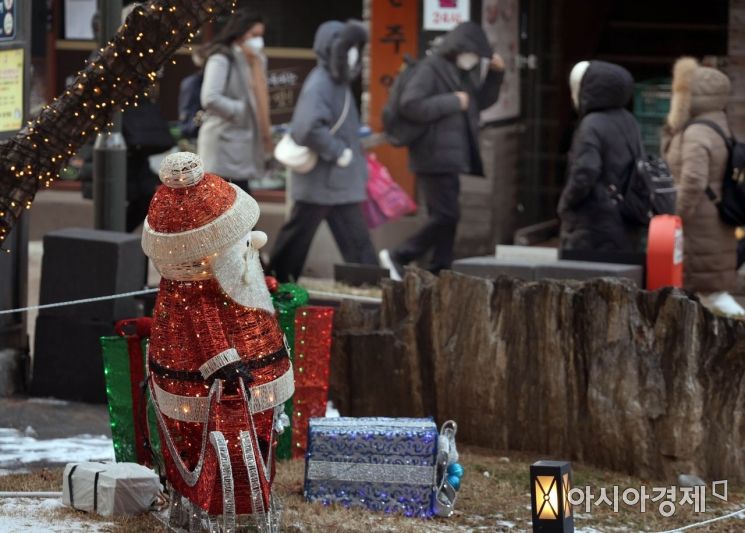 As the coldest subzero weather of the year continues, on the 23rd, just before Christmas, citizens and tourists dressed in thick clothing are passing by a Santa Claus figure installed in the garden of a hotel in Myeongdong, Seoul. Photo by Heo Younghan younghan@
The government’s decision to add Buddha’s Birthday (Seokga Tansinil) and Christmas as substitute holidays has brought a positive outlook to the distribution industry. Since weekend and holiday sales are higher than weekday sales in the distribution sector, the effect on boosting domestic demand is clear.
Earlier, on the 21st, Deputy Prime Minister and Minister of Economy and Finance Choo Kyung-ho announced at the '2023 Economic Policy Direction Joint Briefing' held at the Government Seoul Office, "We will add Buddha’s Birthday and Christmas to the list of substitute holidays to guarantee the right to rest for all citizens."
The 'Holiday Act,' which applies substitute holidays when public holidays fall on weekends, was enacted in July last year, but Christmas and Buddha’s Birthday were not included at that time.
Initially, substitute holidays were applied only to Lunar New Year, Chuseok holidays, and Children’s Day due to concerns that excessive increase in substitute holidays could burden companies. However, starting this year, the scope has been expanded to include Independence Movement Day, Liberation Day, National Foundation Day, and Hangul Day.
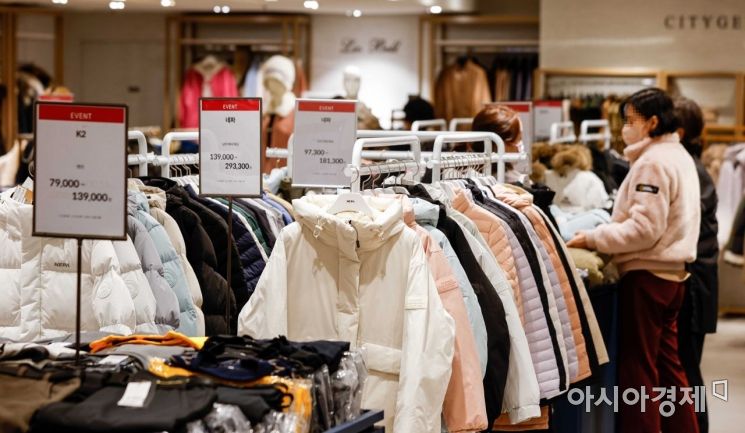 Customers are shopping at the Lotte Department Store Main Branch in Jung-gu, Seoul. Photo by Jinhyung Kang aymsdream@
The distribution industry is optimistic about the increased substitute holidays. In the past, many people traveled abroad during long holidays, but after the COVID-19 pandemic, a surge in revenge consumption has led to increased department store sales. Department stores are generally considered one of the sectors that benefit greatly from extended holidays and consumption stimulation measures. Department store sales on holidays are about twice as high as on weekdays.
Large supermarkets also expect sales recovery. According to Kyobo Securities, E-Mart’s usual weekday sales are around 30 billion KRW, while weekend sales are about 50 billion KRW. The sales difference is estimated to be around 20 billion KRW. Ultimately, the expansion of substitute holiday designation is expected to have a positive effect amid the economic slowdown by increasing consumption.
There is also research indicating that the designation of substitute holidays activates domestic demand and generates added value exceeding 1 trillion KRW.
According to a report titled 'Economic Ripple Effects of the Designation of Temporary Holidays on August 17' published by Hyundai Research Institute in 2020, the production inducement amount on a temporary holiday is estimated at 4.2 trillion KRW, and the added value inducement amount reaches 1.63 trillion KRW. This estimate assumes that the temporary holiday applies to half of the total population.
Senior Researcher Park Yong-jung of Hyundai Research Institute emphasized, "The public needs to consider and build consensus on the positive effects such as productivity improvement through rest, recovery of domestic demand, and revitalization of local economies," adding, "To maximize the positive effects of holidays, a prompt decision on the implementation date is required to give households and businesses enough time to plan."
© The Asia Business Daily(www.asiae.co.kr). All rights reserved.
![Clutching a Stolen Dior Bag, Saying "I Hate Being Poor but Real"... The Grotesque Con of a "Human Knockoff" [Slate]](https://cwcontent.asiae.co.kr/asiaresize/183/2026021902243444107_1771435474.jpg)

















