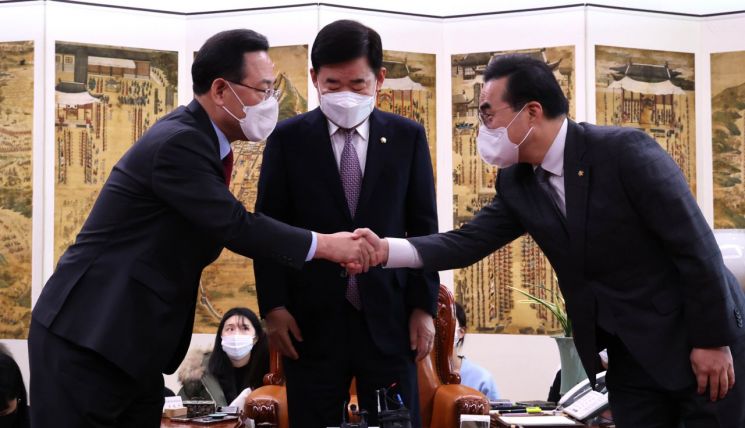
[Asia Economy Jeong Jaehyung, Economic and Financial Editor, Naju-seok Reporter] The ruling and opposition parties have agreed on next year's budget bill and related budget subsidiary bills and decided to process them collectively at the plenary session today (23rd) at 6 p.m. If the budget bill passes at the plenary session on the 23rd, it will be 21 days past the legal deadline for processing (December 2), earning the stigma of the 'longest delayed processing' since the enactment of the National Assembly Advancement Act in 2014. The budget reflects a compromise between the ruling party's push for corporate tax cuts and the opposition's demand for local currency, known as the so-called 'Lee Jae-myung budget.'
In particular, while the ruling and opposition parties reduced next year's budget by 4.6 trillion won compared to the government's proposal, they increased constituency budgets such as the local love gift certificates (local currency), which are considered Lee Jae-myung's policies, by about 500 billion won. For the local currency budget, 352.5 billion won was newly allocated, and the budget for public senior jobs, heating and cooling costs for senior centers, and grain support was increased by 95.7 billion won. The strategic crop direct payment project to stabilize rice prices was also increased by 40 billion won, making it difficult to avoid criticism that constituency budgets were secured.
The Presidential Office decided not to make any statement regarding the budget agreement. It is evaluated that although there is dissatisfaction with the agreement, it had to be reluctantly accepted. The difference between the opposition's 180 seats and the ruling party's 103 seats is that significant. The next general election is in April 2024.
Many people are suffering from high interest rates and high inflation, and it is a time when a 'complex crisis' could become a reality. Next year, Korea is expected to experience low growth in the 1% range, and a global economic recession is becoming a foregone conclusion.
Many of the government's proposals for next year's economic policy direction must be realized through the passage of bills. The three major reforms?labor, pension, and education?face strong opposition due to the many stakeholders involved. Over the course of about a year, with the help of the opposition, the government must achieve these reforms through concessions and compromises. While not undermining the essence of the policies it seeks to promote, the government must persuade the opposition for the sake of the national economy and future, make necessary concessions, and move forward. The abilities of the government and ruling party are now on trial.
© The Asia Business Daily(www.asiae.co.kr). All rights reserved.
![Clutching a Stolen Dior Bag, Saying "I Hate Being Poor but Real"... The Grotesque Con of a "Human Knockoff" [Slate]](https://cwcontent.asiae.co.kr/asiaresize/183/2026021902243444107_1771435474.jpg)















