KRISS-KAIST Develop Technology to Create Quantum Wells for Sending Single Electrons One by One
[Asia Economy Reporter Kim Bong-su] Domestic researchers have developed a technology that can significantly reduce the time and cost of developing quantum computing.
The Korea Research Institute of Standards and Science (KRISS) and the Korea Advanced Institute of Science and Technology (KAIST) announced on the 22nd that they have developed a new type of single electron source that can be used in quantum information technology. This technology is expected to accelerate the development of domestic quantum computing and quantum information technology by reducing research costs and time while achieving superior performance compared to existing methods.
A single electron source is a device that can emit electrons one by one using semiconductor devices. To implement the quantum states necessary for quantum information technology or quantum computing, it is essential to control such independent particles.
Until now, single electron sources have been developed to realize the definition of the unit of current, the ampere (Ampere), but research on quantum technology based on moving particles has mainly used single photons rather than single electrons. Existing single electron sources either use energy levels that are too high or too low, making it difficult to observe quantum phenomena or separate electrons and holes. A hole is a vacancy created by the absence of an electron where electrons should be, and it behaves like a positively charged electron.
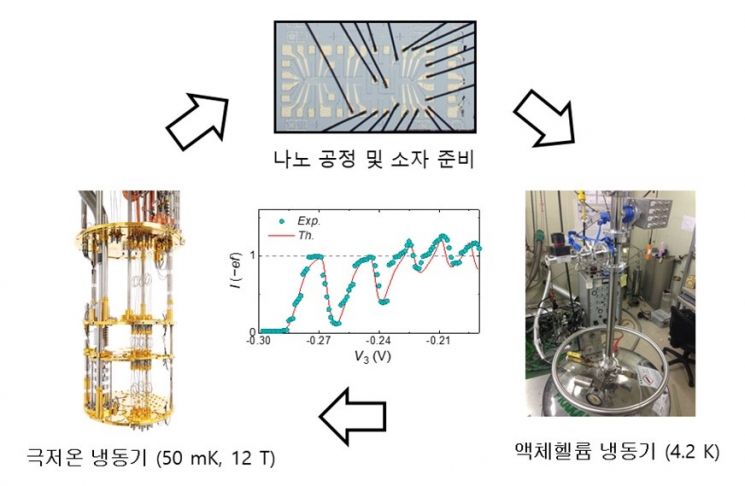
The newly developed single electron source operates by applying an electric field to a two-dimensional compound semiconductor to create a quantum well, then emitting electrons absorbed in the quantum well through an energy filter at regular time intervals to the desired channel. By combining the advantages of existing single electron sources, it can be used in quantum computing and quantum information technology without complex techniques or expensive equipment.
When a single electron source based on two-dimensional semiconductors is applied to quantum technology, it is relatively easier to control quantum states compared to quantum optics using single photon sources. Additionally, it offers excellent scalability and integrability, allowing multiple electron sources to be placed on a single wafer or dozens of qubits to be implemented in a small device area. Another advantage is that the industrial infrastructure for mass production is already in place. A qubit is the basic unit of information stored in fundamental quantum particles such as electrons and photons, used in quantum cryptography communication and quantum computing.
Byun Myung-ho, principal researcher of the Single Electron Quantum Device Team at KRISS, said, “This research result is an achievement that will significantly reduce the time and cost of domestic quantum computing and quantum information technology research,” and added, “Applying single electron sources to quantum computing will result in much faster computation speeds compared to quantum computing using superconductors or spins.”
The research team plans to build a qubit system, which is the core of quantum information technology, using the newly developed single electron source.
The results of this research were published last month in the international nanotechnology journal 'Nano Letters' (IF: 12.262).
© The Asia Business Daily(www.asiae.co.kr). All rights reserved.
![Clutching a Stolen Dior Bag, Saying "I Hate Being Poor but Real"... The Grotesque Con of a "Human Knockoff" [Slate]](https://cwcontent.asiae.co.kr/asiaresize/183/2026021902243444107_1771435474.jpg)















