Bank of Korea Financial Stability Report
Significant Expansion of PF Loans Highlights Risks
PF Projects Influence Sharp Decline in Housing Prices

[Asia Economy Reporter Seo So-jung] Although the market chill caused by the Legoland incident is gradually thawing, concerns are growing that liquidity risks could resurface if domestic or external shocks occur, as a significant portion of project financing (PF) securitized bonds are set to mature before the first half of next year. If the real estate market downturn worsens further, the capital ratios of financial institutions overall are expected to decline, leading to a surge in financial institutions falling below regulatory standards.
According to the Financial Stability Report released by the Bank of Korea on the 22nd, real estate exposure (risk exposure) has been rapidly increasing recently, especially in corporate finance, raising concerns about insolvency in real estate corporate finance such as construction and real estate loans and PF loans. As of the end of September this year, out of the total real estate finance exposure of KRW 2,696.6 trillion, real estate corporate finance accounted for KRW 1,074.4 trillion, marking a 17.3% increase compared to the same period last year. Recently, real estate-related corporate loans (construction and real estate) and PF (loans and securitized bonds) have rapidly expanded, mainly among non-bank financial institutions, and guarantees by guarantee institutions have increased since 2020, focusing on pre-sale and lease deposits.
Regarding corporate loans, influenced by the rising real estate prices and expanded housing supply since 2017, construction and real estate loans reached KRW 580.7 trillion as of the end of September. This represents a 15% increase compared to the same period last year, with significant growth centered on the non-bank sector. PF loans stood at KRW 116.6 trillion at the end of September, up 22.8% year-on-year, expanding significantly among non-bank sectors following the PF insolvency incident.
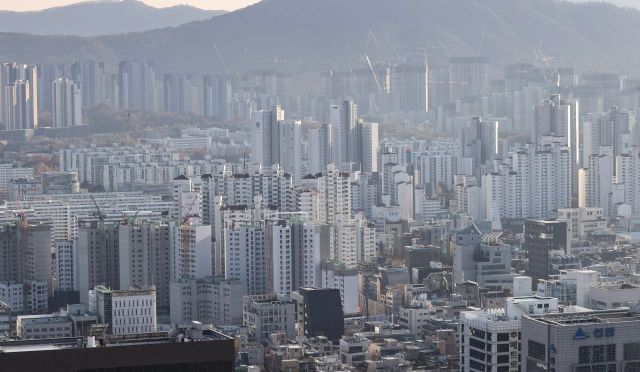
In particular, liquidity and credit risks in real estate corporate finance have become highly prominent due to consecutive interest rate hikes, a slowdown in the real estate market, and the occurrence of PF-related credit incidents. Following the Legoland incident, credit caution has increased, causing PF-asset-backed commercial paper (ABCP) rates to surge sharply, and issuance and refinancing have contracted significantly, increasing liquidity risks for securities firms and construction companies that provided purchase guarantees. The weighted average interest rate for PF-ABCP issuance and circulation soared from 2.2% at the end of March to 8.1% at the end of last month. Lee Jung-wook, Director of the Financial Stability Bureau at the Bank of Korea, stated, "Since October this year, thanks to government and Bank of Korea market stabilization policies, instability in the PF securitized bond market has gradually eased, but as a significant portion of PF securitized bonds are set to mature before the first half of next year, liquidity risks could re-emerge if domestic or external shocks occur."
Especially for PF loans, although delinquency rates are still lower than during the PF insolvency incident in 2011, they have been gradually rising since the end of last year, warranting caution. Loans to high-risk projects with high unsold inventory concerns and to non-apartment projects are expanding mainly among non-bank sectors such as savings banks and securities firms.
Regarding business guarantees, since public guarantee institutions bear the risk, the possibility of risk transmission to the financial system is low. However, if the real estate market deteriorates and guarantee institutions' subrogation payments increase, the government's fiscal burden could also grow. According to stress tests conducted by the Bank of Korea, assuming nationwide apartment prices fall by 30% over the next three years or more, capital ratios across most sectors would significantly decline, and the number of financial institutions falling below regulatory standards could increase substantially.
Director Lee pointed out, "In 2011, when the PF insolvency incident occurred, market interest rates were declining, but now they are rising. At that time, the decline in housing prices was gradual, but this year, the housing price decline has been steep. Since the extent of housing price decline determines the viability of PF projects, depending on the degree of future housing price declines, insolvency risks may arise."
The Bank of Korea emphasized, "In the short term, it is necessary to alleviate market uncertainty by timely liquidity supply to short-term funding markets to prevent temporary liquidity crunches from turning into credit risks for sound companies and financial institutions. In the long term, to ease the burden of unsold inventory, it is essential to stabilize the housing demand base through deregulation and to curb excessive risk-taking behavior by managing financial institutions' limits on real estate corporate finance."
© The Asia Business Daily(www.asiae.co.kr). All rights reserved.
![Clutching a Stolen Dior Bag, Saying "I Hate Being Poor but Real"... The Grotesque Con of a "Human Knockoff" [Slate]](https://cwcontent.asiae.co.kr/asiaresize/183/2026021902243444107_1771435474.jpg)
















