Significant Decline in Number of Employed Expected Next Year
Labor Reform Accelerated for Structural Improvement
Basic Employment Policy Plan to Be Established Around January Next Year
With the high interest rates and high inflation expected to significantly worsen the employment market next year, the government has launched a full-scale response through the 'Inter-Ministerial Job Task Force (TF).' The government plans to create private sector-led job creation measures to prevent manufacturing job mismatches and youth unemployment from accelerating the economic slowdown, while also accelerating labor reforms aimed at structural improvements.
The Ministry of Employment and Labor and the Ministry of Economy and Finance announced on the 22nd at 10 a.m. that they held the first meeting of the joint 'Job TF' involving related ministries at the Government Seoul Office. In addition to the Ministry of Economy and Finance and the Ministry of Employment and Labor, the TF included major participation from the Ministry of Health and Welfare, Ministry of the Interior and Safety, Ministry of Culture, Sports and Tourism, Ministry of Environment, Ministry of Science and ICT, and Ministry of SMEs and Startups. The first vice minister of the Ministry of Economy and Finance and the vice minister of the Ministry of Employment and Labor co-chaired the meeting, with first-level officials from the ministries participating, and monthly meetings will be held going forward.
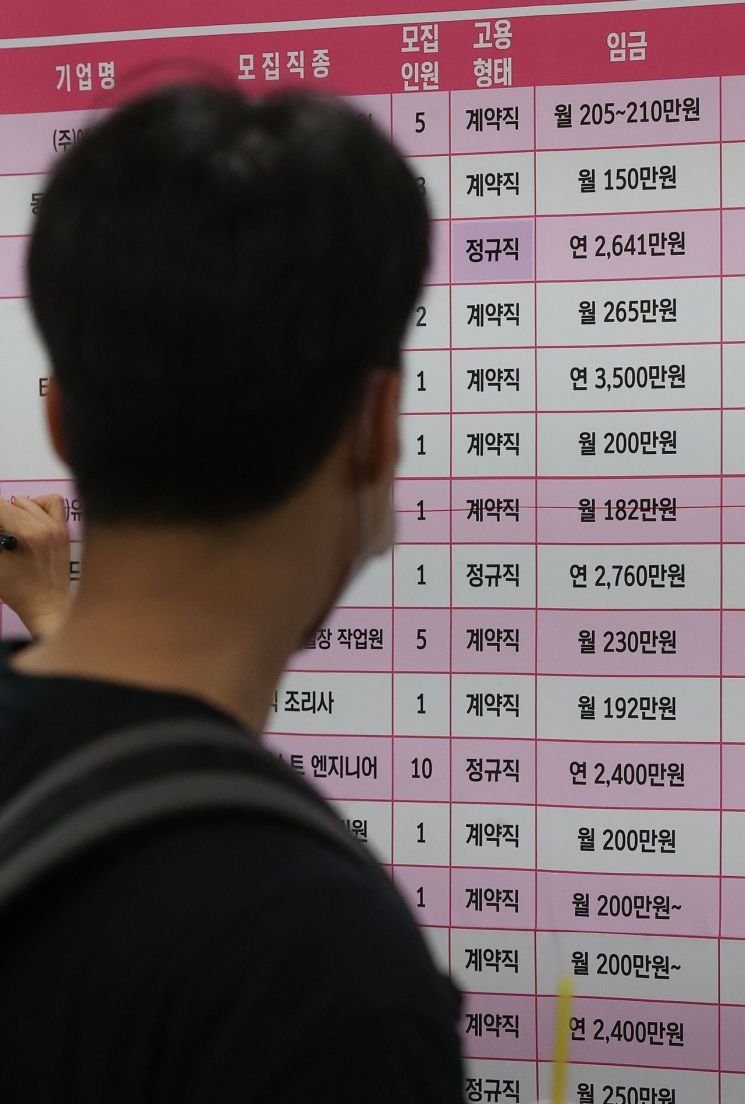
The government formed the inter-ministerial TF to address job issues because the employment market is expected to deteriorate significantly in the first half of next year. This year, employment indicators showed a favorable trend as consumption revived, but next year, due to high interest rates, high inflation, and economic slowdown, the increase in employed persons is expected to shrink considerably. The Ministry of Employment and Labor forecasts that the number of employed persons will increase by 100,000 next year, which is only about one-eighth of this year's figure (approximately 820,000).
In particular, the Bank of Korea is likely to maintain a high benchmark interest rate around 3.5% for a considerable period next year, and inflation is expected to remain in the 4% range until the first half of the year, making contraction in the real economy and employment market inevitable. Jung Kyung-hoon, Director of Labor Market Policy at the Ministry of Employment and Labor, said, "The job outlook for next year is expected to be 'low at the start and high at the end.' When interest rates rise, various economic ripple effects impact the real economy, and job uncertainty inevitably increases."
The approximately 200,000 monthly vacant jobs are also a problem. Vacant jobs refer to positions currently unfilled or that can be newly filled within one month, and a high vacancy rate indicates a severe recruitment difficulty. While the employment market is becoming increasingly difficult, sectors such as shipbuilding and the root industries are seeing an increase in vacant jobs, exacerbating mismatches. Director Jung emphasized, "It is important to quickly introduce external manpower for industries like shipbuilding," adding, "Supplying manpower to key industries allows labor and capital to combine and expand the economy."
The TF plans to expand the foundation for creating quality jobs to lead the private sector-driven employment market recovery and strengthen close employment service support so that suitable personnel can smoothly enter the created jobs. Support for demand recovery areas such as field-customized talent training and rapid entry support for foreign workers will also be expanded. The employment rates of vulnerable groups such as youth, women, and the elderly will be increased, and government job projects will be implemented early once the budget is approved by the National Assembly.
The government will also accelerate labor market structural reforms to fundamentally resolve the root causes of job mismatches. President Yoon Suk-yeol presided over the 12th Emergency Economic and Livelihood Meeting and the 1st National Economic Advisory Meeting the day before, emphasizing the need for reform by stating, "Improving the dual structure in the labor market, establishing a rational compensation system, and changing the exploitation system among labor unions are what truly respect the value of labor." Based on the discussions in the TF, the government plans to establish and announce the basic employment policy plan and detailed measures in January next year.
© The Asia Business Daily(www.asiae.co.kr). All rights reserved.
![Clutching a Stolen Dior Bag, Saying "I Hate Being Poor but Real"... The Grotesque Con of a "Human Knockoff" [Slate]](https://cwcontent.asiae.co.kr/asiaresize/183/2026021902243444107_1771435474.jpg)















