Government to Confirm 4th Space Development Promotion Plan at 22nd National Space Committee on 20th
Also to Create '50-Year Space Exploration Roadmap' with Long-Term Plans
[Asia Economy Reporter Kim Bong-su] The government is set to make full-scale investments in space development to expand South Korea's economic territory into space. The budget will be doubled within the next five years, with a goal to capture 10% of the global market by 2045.
On the afternoon of the 21st, the government held the 22nd National Space Committee meeting chaired by Prime Minister Han Duck-soo at the Government Seoul Office, where the 4th Basic Plan for Space Development Promotion was finalized.
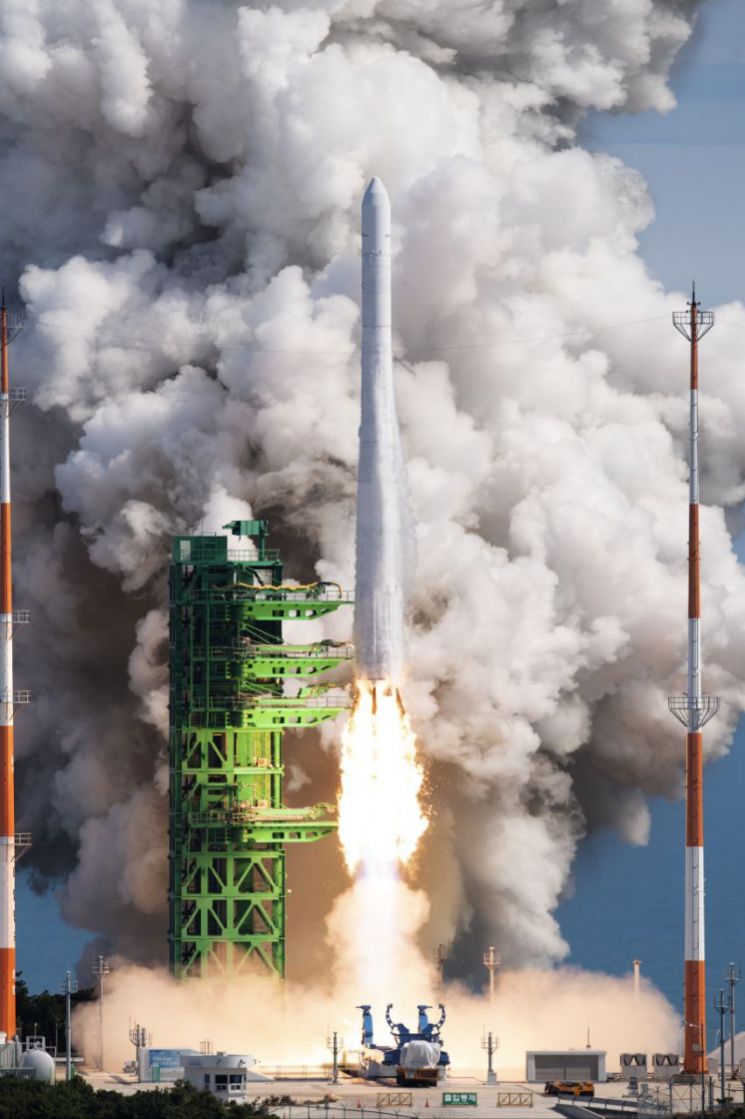
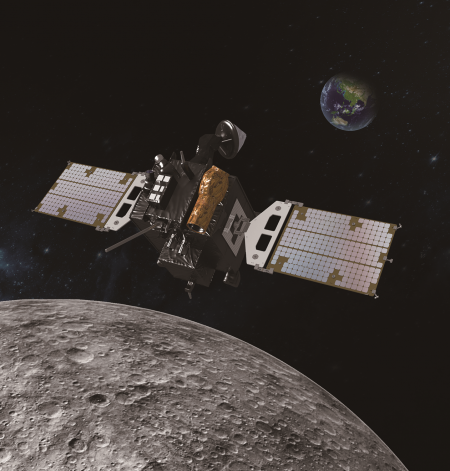
South Korea has demonstrated considerable technological capabilities in satellites and launch vehicles, successfully launching the first Korean independent launch vehicle, Nuri, in June, and the lunar exploration orbiter Danuri in August. However, space development has become industrialized in areas such as lunar exploration, resource development, satellite information utilization, and launch vehicle markets. With advancements in GPS services, ultra-high-speed communication networks, and space internet, space has become an essential field of the 4th Industrial Revolution. It also holds a critical position in national security, as seen in the Russia-Ukraine war. Nevertheless, South Korea's overall level of space technology, industry, and investment lags behind leading countries. As of 2020, South Korea's space industry accounts for only 1% of the global market. The space development investment budget is around 600 to 700 billion KRW, which is one-tenth of China's and one-thirtieth of the United States'.
In response to the advent of this new space and space economy era, President Yoon Suk-yeol announced a future space economy roadmap on the 28th of last month, directing a new space policy vision including Mars exploration by 2045, the 100th anniversary of Korea's liberation.
The 4th Basic Plan for Space Development Promotion passed on this day contains specific methods and timelines to achieve this roadmap. First, to realize South Korea's space economy, the government will promote a transition to 'Space Development 2.0 Policy.' While the previous 'Space Development 1.0' era focused on securing core space systems such as launch vehicles and satellites, developing satellite and launch vehicle technologies, and securing public-led research capabilities and infrastructure, the future will center on mid- to long-term space development missions such as lunar landing exploration and Mars exploration, expanding into space exploration and science. The actors will also expand to include private participation in the space industry.
Specifically, plans include securing unmanned transport capabilities in the 2030s, lunar landing exploration in 2032, and manned transport capabilities and Mars landing exploration by 2045. To this end, the space development investment budget will be doubled from 730 billion KRW last year to 1.5 trillion KRW by 2027 within five years. Through this, the share of the space industry in the global market is planned to expand from 1% in 2020 to 10% by 2045.
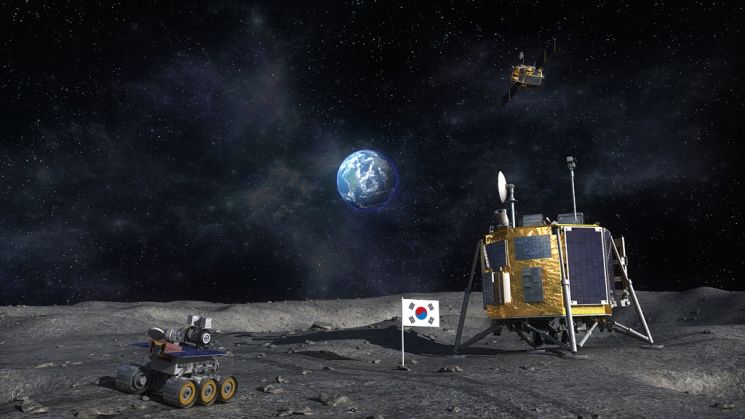
To achieve this, five long-term space development missions have been set: ▲Expansion of space exploration, ▲Completion of space transportation, ▲Creation of space industry, ▲Establishment of space security, and ▲Expansion of space science. Two main strategies include building a space economy foundation and securing advanced space technologies. To build the space economy foundation, creating a space industry ecosystem will be prioritized. The goal is to create an initial space industry and market through expanding public projects and transitioning to private sector leadership. To enhance companies' technological competitiveness, support for technological independence will be strengthened through transferring public technologies to the private sector and establishing certification systems, and support for startups throughout their entire lifecycle will be increased to broaden the base. In preparation for expanding private space activities, regulatory systems such as permits and approvals will be established, while industrial infrastructure such as space industry clusters will be expanded, and institutional support systems including the enactment of the Space Industry Act will be organized.
A leading governance system will also be established. Government budgets will be doubled by 2027, and the establishment of the Korea Aerospace Agency and the elevation of the National Space Committee will innovate the national space policy implementation system. A civil-military space cooperation system will be established, and the Space Development Promotion Institute will be founded to support policy and project planning and management. Space laws will be systematized by enacting the Space Basic Act and subordinate laws suitable for the expanding space economy. Space-specialized human resources will be cultivated. To expand future generations' space education at elementary, middle, and high school levels, space-related textbooks will be expanded and space prodigies will be discovered. For university-level specialized personnel training, space-focused research labs and future space education centers will be expanded. To support industry personnel, re-education and recruitment support for master's and doctoral levels will be provided, as well as support for utilizing highly experienced personnel and establishing industry-academia-research personnel training councils. A system will be created to reflect field demand in policies through annual supply-demand surveys and analyses.
Global leadership will also be pursued. South Korea will actively participate in international joint projects such as 'Artemis' and 'Moon-to-Mars,' led by the United States, and expand space technology and business cooperation with emerging and developing countries. To support private companies' overseas market entry, global network construction will be supported, and a whole-of-government cooperation system and strategy for international space cooperation will be prepared.
Space security systems will also be established. A space radio disaster response system will be set up, and surveillance, observation, and traffic management infrastructure will be expanded to respond to collisions and falls of space objects. At the same time, to strengthen security capabilities through space, space security assets and core technologies such as surveillance reconnaissance, maritime situational awareness, and communications will be continuously expanded.
Securing advanced space technologies is also a core strategy. In the launch vehicle and infrastructure sectors, a launch vehicle portfolio will be completed to meet diverse demands, ranging from next-generation launch vehicles to Nuri and small launch vehicles. The transfer of these technologies to the private sector will be promoted to create private services. Preliminary research on future technologies such as reusable launch vehicles and manned/unmanned transport ships will also begin. Launch infrastructure will be continuously expanded, from launch infrastructure for next-generation launch vehicles to launch pads for large-scale launches such as geostationary orbit. In the satellite and service sectors, the focus will shift from earth observation-centered satellite development to continuously expanding satellites capable of creating various services and industries, and gradually transitioning to private-led development and services. New satellite platforms such as technology verification and on-orbit services will be developed, and support for public services such as land management, agriculture, marine, and disaster through satellite utilization will be strengthened.
In the space exploration and science sector, the '50-Year Roadmap for Korean Space Exploration' will be established and promoted for systematic advancement of space exploration including the Moon and Mars. To secure leading space science capabilities, South Korea will actively participate in international joint space science infrastructure projects and promote space science innovation through space experiments using space stations and establishing multidisciplinary basic science research that will innovate future space activities.
Oh Tae-seok, 1st Vice Minister of the Ministry of Science and ICT, stated, "This 4th Basic Plan for Space Development Promotion was prepared as an expanded space policy to be promoted based on advanced space development capabilities through improvements in aerospace governance." He added, "Detailed implementation plans including timing and methods will be included in next year's implementation plan, and especially for the five major missions, separate execution plans will be established by sector to enhance policy execution capability."
© The Asia Business Daily(www.asiae.co.kr). All rights reserved.



















