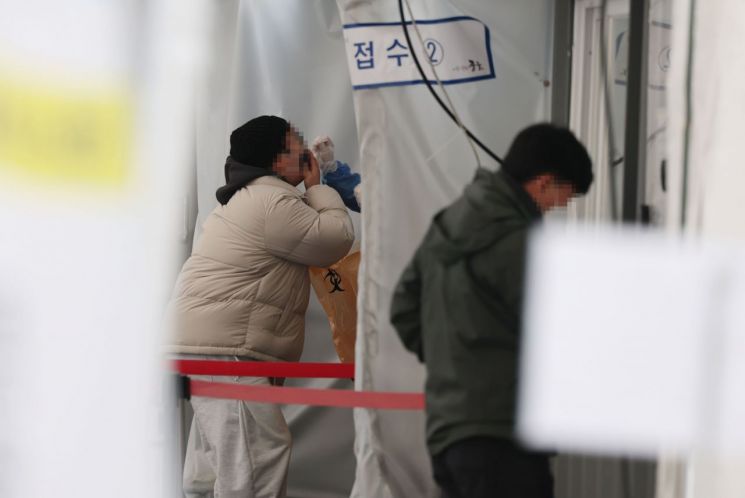
[Asia Economy Reporter Byun Seon-jin] There is a forecast that the dominant strain of the 7th wave this winter may change by January next year. The scale of the recent continuous increase in the spread of COVID-19 may not peak but could rise further.
According to the Central Disease Control Headquarters on the 22nd, the detection rate of BA.5, the dominant strain leading the re-outbreak this winter following the previous summer wave, recorded 52.0% in the second week of December (11th?17th). It fell from 60.5% the previous week, and it is widely expected that the detection rate will soon drop below 50%. The dominance of BA.5, which once peaked at 99% (first week of September), is gradually weakening.
Other variants are filling that gap. In particular, the spread speed of BN.1, a variant derived from BA.2.75, also known as ‘Kentauros,’ is remarkable. The detection rate of BN.1 increased to 20.6% from 17.4% the previous week. BN.1 was first detected in Korea on September 22 and has gradually expanded its presence with 7.6% in the third week of November, 7.7% in the fourth week, 13.2% in the fifth week, and 17.4% in the first week of December. Im Sook-young, the situation chief at the Central Disease Control Headquarters, analyzed, "The characteristic of BN.1 is that its immune evasion ability is somewhat increased compared to BA.2.75, so it can evade immunity.”
The 'BQ siblings' variants, which have become dominant in the U.S. and Europe, are also stirring. The detection rate of BQ.1 jumped more than twice from 3.8% the previous week to 7.7%. BQ.1.1 also rose to 5.8% from 4.4% the previous week.
Professor Kim Woo-joo of the Department of Infectious Diseases at Korea University Guro Hospital predicted, “If this trend continues, by early January, the combined presence of BN.1, BQ.1, and BQ.1.1 is expected to surpass BA.5,” adding, “The peak of the 7th wave may not even come during the Lunar New Year holiday period.”
This winter’s outbreak shows a pattern where multiple variants compete, unlike previous major waves led by a single variant such as Alpha, Delta, BA.1, or BA.5. Unlike previous waves that peaked 6 to 8 weeks after the initial outbreak and then declined, it is difficult to predict the peak this time, which also means reinfections of COVID-19 are more common. The reinfection rate in the first week of December (4th?10th) was 15.88%, up from 14.69% the previous week. One in six people is a reinfected case. The reinfection rate in the third week of October, just before the 7th wave, was 8.96%.
China’s relaxation of quarantine measures after ending its ‘Zero COVID’ policy is a variable that could increase the spread. Recently, the BF.7 variant has been spreading in Beijing and other areas, and its detection rate domestically also rose from 2.6% the previous week to 4.0%. The health authorities explained that they are conducting targeted quarantine measures at the entry stage for travelers from countries with high infection risk, including ▲strengthening the fever threshold (from 37.5℃ to 37.3℃) and ▲conducting PCR tests on companions of symptomatic individuals.
However, a health official stated, “This is a measure at the quarantine stage, not an entry restriction, so it is not targeting any specific country.”
© The Asia Business Daily(www.asiae.co.kr). All rights reserved.
![Clutching a Stolen Dior Bag, Saying "I Hate Being Poor but Real"... The Grotesque Con of a "Human Knockoff" [Slate]](https://cwcontent.asiae.co.kr/asiaresize/183/2026021902243444107_1771435474.jpg)















