Net Government Bond Purchases Surge from 70 Billion to 2.9175 Trillion Won
Increased Demand for Safe Assets Amid Aggressive Fed Rate Hikes
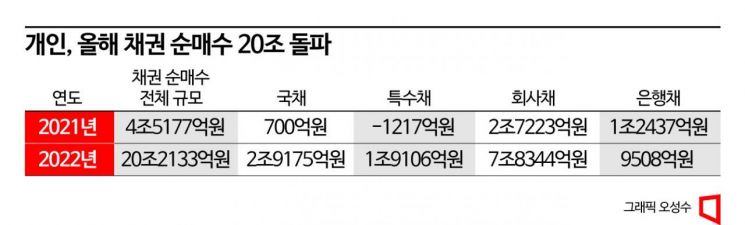
[Asia Economy Reporter Hwang Yoon-joo] This year, the net purchase volume of bonds by individuals surpassed 20 trillion won. This is attributed to the large demand seeking refuge in safe assets as the U.S. Federal Reserve (Fed) aggressively raised interest rates.
According to the Korea Financial Investment Association on the 21st, the net purchase volume of bonds by individuals this year reached 20.2133 trillion won, a sharp increase of 347.4% compared to last year (4.5177 trillion won). The buying trend was prominent in government bonds and special bonds, and demand for corporate bonds also surged. During the same period, the net purchase volume of government bonds increased from 70 billion won to 2.9175 trillion won, a rise of 4067.8%. Special bonds shifted from a net sale of 121.7 billion won to a net purchase of 1.9106 trillion won, while corporate bonds increased by 187.7%, from 2.7223 trillion won to 7.8344 trillion won. In contrast, bank bonds slightly decreased from about 1.2437 trillion won to 950.8 billion won.
An asset management company official explained, "The high-intensity tightening policy increased volatility in the stock market, and the situation changed to one where the bottom is unknown," adding, "With concerns about an economic recession emerging, funds flowed relatively safely into the bond market."
In particular, since the Fed began raising interest rates in March this year, the movement of funds from risky assets to safe assets became clear. The Fed continued an unexpected tightening stance, including four consecutive 'giant steps' (raising the benchmark interest rate by 0.75 percentage points at once). As a result, the U.S. benchmark interest rate surged from 0.5% in January to 4.5% in December. During the same period, South Korea's benchmark interest rate also jumped from 1.25% to 3.25%.
Following these changes, the KOSPI fell 21.9%, from 2,988.77 on January 3 to 2,333.29 on December 20. In contrast, government bond yields peaked around the fourth quarter. At the beginning of the year (January 3), the yields on 3-year and 10-year government bonds were 1.855% and 0.075%, respectively, rising to 4.548% (September 26) and 4.632% (October 21). Bond yields increased, and bond prices approached their bottom.
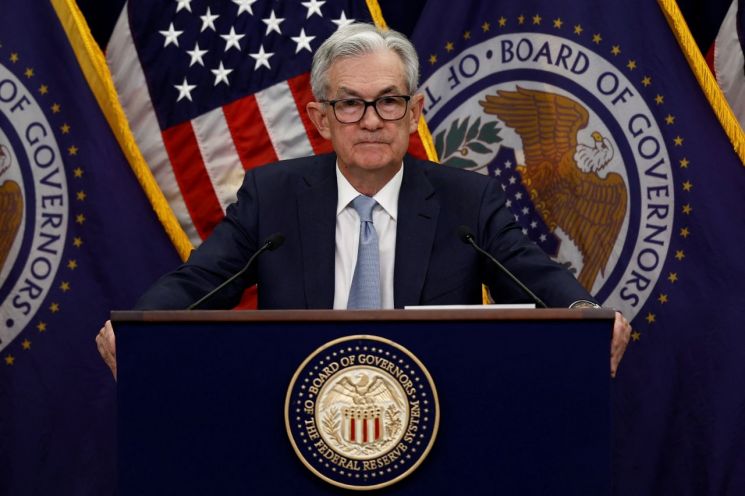
At the December meeting of the U.S. Federal Open Market Committee (FOMC), it was announced that the tightening stance would continue for some time, so demand for long-term bonds is expected to be maintained. This is due to growing concerns about an economic recession caused by the tightening policy. A Korea Financial Investment Association official said, "If the economic recession intensifies, companies will reduce investments, and funding in the bond market will decrease, leading to a decline in bond demand," adding, "Since there is limited room for further rate hikes, market interest rates will proactively fall, and preference for long-term bonds priced near the bottom will continue."
Meanwhile, changes in the Bank of Japan's Yield Curve Control (YCC) policy are analyzed to have little immediate impact on domestic terminal interest rates. The Bank of Japan recently decided to widen the fluctuation range of long-term interest rates from ±0.25% to ±0.50%. As a result, government bond yields closed higher across the board.
Kang Seung-won, head of the bond strategy team at NH Investment & Securities, analyzed, "Investors were looking for reasons to sell amid the recent sharp drop in bond yields, and the Bank of Japan's YCC policy change triggered a flood of sell orders," adding, "The impact on terminal interest rates in Korea and the U.S. will be minimal." He continued, "Inflation in the U.S. and Korea peaked in the third quarter and has turned downward, but Japan and Europe have not yet reached their inflation peaks," and added, "So far, tightening policies have been centered on the U.S. and Korea, but now Japan is also joining the tightening efforts."
© The Asia Business Daily(www.asiae.co.kr). All rights reserved.
![Clutching a Stolen Dior Bag, Saying "I Hate Being Poor but Real"... The Grotesque Con of a "Human Knockoff" [Slate]](https://cwcontent.asiae.co.kr/asiaresize/183/2026021902243444107_1771435474.jpg)
















