Economic Difficulties to Intensify in the First Half of Next Year
[Asia Economy Reporters Sunmi Park and Boryeong Geum] Deputy Prime Minister and Minister of Economy and Finance Choo Kyung-ho forecasted that the slowdown of South Korea's economy is progressing faster than expected, with economic difficulties concentrated in the first half of next year. Exports, which have supported the Korean economy so far, are also feared to grow by only ‘0%’ next year.
On the morning of the 19th, at the ‘2023 Economic Policy Direction Party-Government Council’ held at the National Assembly, Deputy Prime Minister Choo stated, "Due to the global economic recession next year, our economy is also expected to experience a slowdown in growth." He evaluated that South Korea’s economy is still maintaining growth above potential levels, relatively low inflation compared to major countries, and a quantitatively favorable employment situation.
However, he noted that uncertainties from major countries’ interest rate hikes that began earlier this year remain, and as difficulties in the real economy intensify, volatility in financial markets is expected to continue for some time, which could hamper South Korea’s economy. Deputy Prime Minister Choo forecasted that high inflation will persist for a while and the increase in the number of employed persons will significantly slow down due to base effects.
He said, "The government has prepared the 2023 economic policy direction focusing on four key areas with an even more urgent awareness next year to overcome the crisis and achieve economic re-leap," adding, "While prioritizing price stability for the time being, we will operate the macroeconomy stably through a tight policy mix that comprehensively considers risks related to finance, corporations, and real estate." On this day, the People Power Party requested the government to manage the macroeconomy stably through proactive measures, given the considerable risks expected for the domestic economy next year.
At the meeting, the party and government agreed that the economy should be managed next year with the goal of achieving a per capita gross national income (GDP) of $40,000 by 2027, the last year of the Yoon Suk-yeol administration. They plan to focus on the ‘five major reforms’ in pensions, labor, education, finance, and services.
Sung Il-jong, the policy chief of the People Power Party, explained, "We will actively support the 2023 economic policy results to materialize quickly through the budget and other means," and added, "Since this is the first economic plan operated under President Yoon Suk-yeol’s administration, we emphasized smooth progress to lay the cornerstone for the era of $40,000 national income."
There was also a forecast that South Korea’s exports will increase by only 0.5% next year, marking the end of the export boom enjoyed over the past two years. A larger decline is expected in the electrical and electronic sectors, including semiconductors and displays, which have large export volumes.
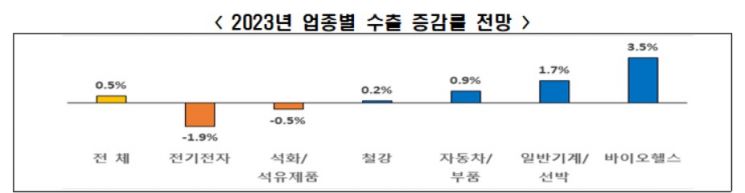
On this day, the Federation of Korean Industries commissioned market research firm Mono Research to conduct a ‘2023 Export Outlook Survey’ targeting major export industries. Responding companies on average expected exports next year to increase by only 0.5% compared to this year. The export growth rate forecast by sector for next year is ▲Electrical and Electronics (-1.9%), ▲Petrochemicals and Petroleum Products (-0.5%), ▲Steel (+0.2%), ▲Automobiles and Auto Parts (+0.9%), ▲General Machinery and Shipbuilding (+1.7%), and ▲Biohealth (+3.5%).
While 60.7% of companies expected exports to increase next year, 39.3% anticipated a decline. Companies forecasting a decrease cited weakened export competitiveness due to sustained high raw material prices (45.7%), economic downturns in major export destinations (33.9%), and logistics difficulties such as rising maritime and air freight costs (10.2%) as main factors.
28.0% of responding companies expected export profitability to worsen, a higher proportion than the 18.7% who anticipated improvement. Factors contributing to worsening export profitability included rising raw material prices such as crude oil and minerals (54.7%), increased import costs due to exchange rate rises (14.3%), and higher interest expenses from interest rate hikes (11.9%).
Companies expecting export declines next year said they are considering cost reductions in factory operations and selling and administrative expenses (35.6%), employment adjustments such as hiring freezes (20.3%), and postponement or reduction of investments (15.3%) as strategies to cope with export sluggishness. Yuh Hwan-ik, head of the industrial division at the Federation of Korean Industries, advised, "Since the export growth that has driven Korea’s economic growth since COVID-19 is expected to stagnate, the government needs to make every effort to create an environment to improve export performance by expanding tax support related to raw material imports and preventing export logistics disruptions for Korean companies."
© The Asia Business Daily(www.asiae.co.kr). All rights reserved.
![Clutching a Stolen Dior Bag, Saying "I Hate Being Poor but Real"... The Grotesque Con of a "Human Knockoff" [Slate]](https://cwcontent.asiae.co.kr/asiaresize/183/2026021902243444107_1771435474.jpg)















