Reform of University Basic Competency Diagnosis Evaluation to be Announced Early Next Year
General Financial Support for All Universities Except Those in Management Crisis or Without Institutional Evaluation Certification
Abolishment of Faculty Securing Rate When Adjusting Department Quotas Within Admission Quotas
Regional Universities Allowed to Establish Departments Using Deficit and Transfer Seats Except in Advanced Fields
Permission for Leasing School Buildings and Land, Relaxation of Adjunct Faculty Utilization Ratio
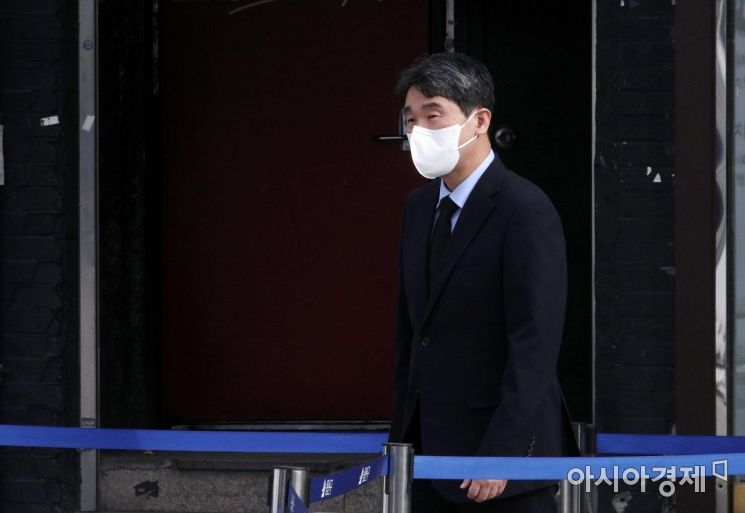 Lee Ju-ho, the newly appointed Deputy Prime Minister and Minister of Education, visited the joint memorial altar for the victims of the Itaewon disaster set up at Noksapyeong Station Park in Yongsan-gu, Seoul, on the 7th to pay his respects. With his appointment on this day, all 18 ministerial positions in the Yoon Seok-yeol administration were filled 181 days after its launch. Photo by Kim Hyun-min kimhyun81@
The Yoon Suk-yeol administration has initiated educational reform starting with the 'higher education' sector. The four major requirements established during the period when universities were rapidly emerging will be restructured, and the university basic competency diagnosis system, which had been criticized for ranking universities, will be abolished.
On the 16th, the Ministry of Education held the 3rd University Regulation Reform Council and the 9th University Basic Competency Diagnosis System Improvement Council to discuss regulatory reform and evaluation system restructuring plans reflecting these changes.
Complete Overhaul of University Competency Diagnosis Evaluation, Relaxation of Four Major Requirements
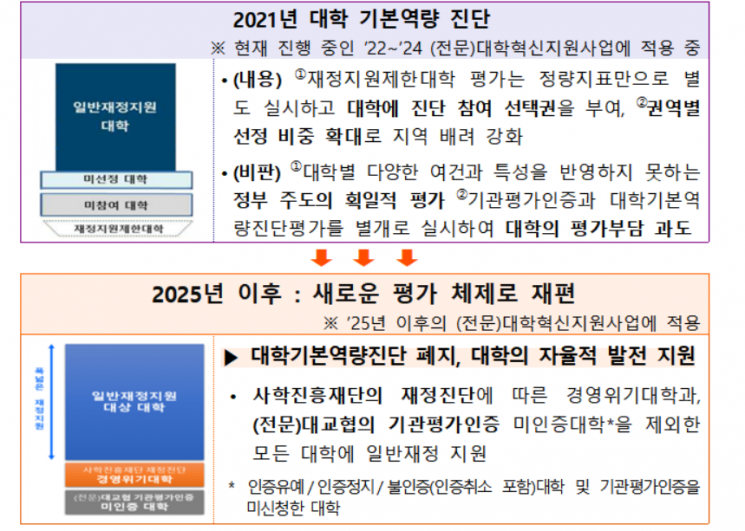
The Ministry of Education plans to abolish the 'University Competency Diagnosis Evaluation,' which selects general financial support recipients every three years, and prepare a draft restructuring plan within the year. Starting from the 2025 academic year, general financial support will be provided to all universities except those in financial crisis. Until now, the diagnosis evaluation was a government-led, uniform, and mandatory process, conducted separately from institutional accreditation, which imposed a heavy burden on universities and was criticized for stigmatizing universities not selected for financial support. General financial support will be provided to all universities except those in financial crisis as determined by the Private School Promotion Foundation’s financial diagnosis and universities failing institutional accreditation by the Korea Council for University Education.
The four major requirements (campus buildings, campus land, faculty, and basic property for profit) will also be thoroughly revised. Criteria for adjusting department quotas will be liberalized, and the requirement to maintain faculty securing rates when creating or abolishing departments will be removed. The building area standards will be relaxed, and leasing of campus buildings and land will be permitted.
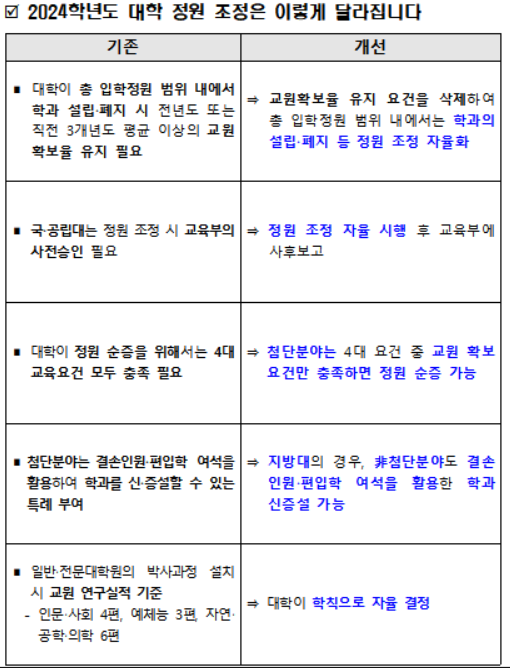
University quota adjustments will be significantly liberalized starting next year. Within the admission quota range, departments can be newly established, merged, or abolished regardless of faculty securing rate requirements. In advanced fields, quotas can be increased as long as faculty securing requirements are met, and regional universities will be allowed to establish new departments using deficit quotas or transfer student vacancies beyond advanced fields. Faculty securing rate and building facility standards required for establishing professional graduate schools will also be relaxed. The Ministry of Education plans to notify universities of the '2024 Student Quota Adjustment Plan' within this month.
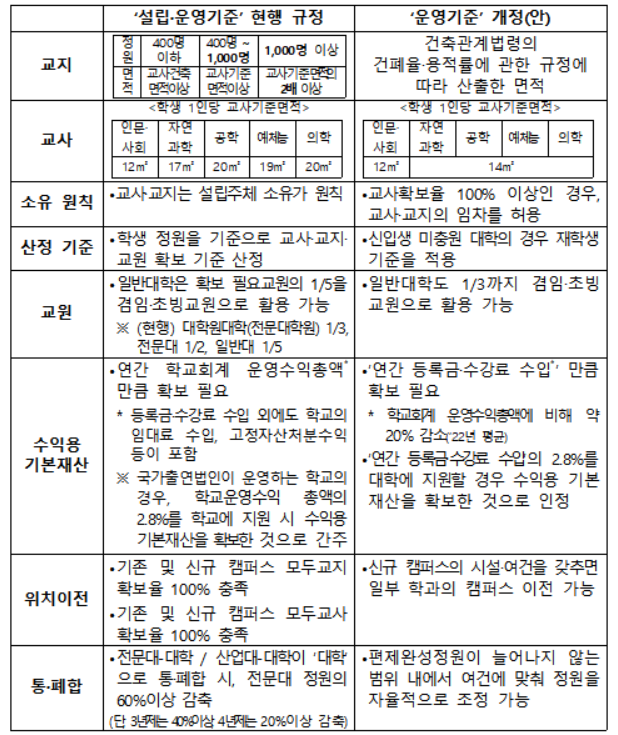
Facility standards will be relaxed to adapt to environmental changes such as online classes and cooperation among local governments, businesses, and universities. The standard area for natural sciences, engineering, and arts fields will be adjusted to 14㎡, excluding humanities and social sciences (current standard area 12㎡). Universities that meet facility standards (100% building securing rate) will be allowed to lease campus buildings and land when acquiring additional facilities. The allowable ratio for employing adjunct and invited faculty in general universities will be expanded from the current one-fifth to one-third to enable the involvement of field experts in lectures.
The ratio for securing basic property for profit will change from the current 'annual total school accounting operating revenue' to 'annual tuition and fee income.' When relocating campuses, both existing and new campuses were required to secure 100% of campus land and buildings, but going forward, only some departments may relocate if facilities and conditions are met. The criteria requiring quota reductions when universities and junior colleges merge will be removed to promote university consolidation. These changes to university establishment and operation regulations will be announced for legislative notice by the end of this month.
Lee Ju-ho, Deputy Prime Minister and Minister of Education, said, “The comprehensive revision of the university establishment and operation regulations and the restructuring plan for the university evaluation system discussed this time are the first signals of the Ministry of Education’s university regulatory reform.” He added, “Through continuous and intensive regulatory reform, we will spare no support so that universities facing crisis due to declining school-age populations can autonomously develop according to their own conditions and characteristics.”
The Deputy Prime Minister stated, “Universities found to have serious misconduct such as accounting fraud or data manipulation will be strictly punished, and judicial measures will be taken through prosecution and investigation requests. Strong sanctions such as contract termination of university financial support projects, suspension of support, restriction of project fund benefits, and limitation of national scholarship support will be applied to strengthen university accountability alongside expanding autonomy.”
Authority over Regional Universities Transferred to Local Governments
At the National Task Review Meeting held the previous day, Lee Ju-ho announced plans to transfer budget and regulatory authority over regional universities, previously held by the Ministry of Education, to local governments. He emphasized, “Good education should be accessible regardless of where one lives, and regional universities must become hubs of regional innovation. We will boldly transfer the centralized authority of the Ministry of Education to local governments and dismantle regulations.” The abolition of the Higher Education Policy Office, which the Ministry of Education had maintained for over ten years, and the establishment of a separate Regulatory Reform Bureau starting next year are also part of the educational reform efforts.
In early childhood, elementary, and secondary education, the integration of kindergartens and daycare centers will be promoted starting next year, and digital textbooks and AI tutors will be introduced from 2025. The plan aims to improve basic academic skills through customized education. The Deputy Prime Minister said, “Now is the era when bringing artificial intelligence (AI) and digital technology into learning environments enables personalized education. Through digital textbooks and AI tutors, we will guarantee basic academic skills for all children, and teachers will focus on creativity and character development to awaken dormant classrooms.”
© The Asia Business Daily(www.asiae.co.kr). All rights reserved.
![Clutching a Stolen Dior Bag, Saying "I Hate Being Poor but Real"... The Grotesque Con of a "Human Knockoff" [Slate]](https://cwcontent.asiae.co.kr/asiaresize/183/2026021902243444107_1771435474.jpg)


















