[Asia Economy Reporter Jeong Hyeon-jin] Retail sales and industrial production, which indicate U.S. consumption and production, declined faster than market expectations last month, intensifying concerns about an economic recession. Although Jerome Powell, Chairman of the U.S. Federal Reserve (Fed), confirmed that "there is still a long way to go" and that monetary tightening will continue, the market expects a Fed pivot to be inevitable as signs of economic cooling appear.
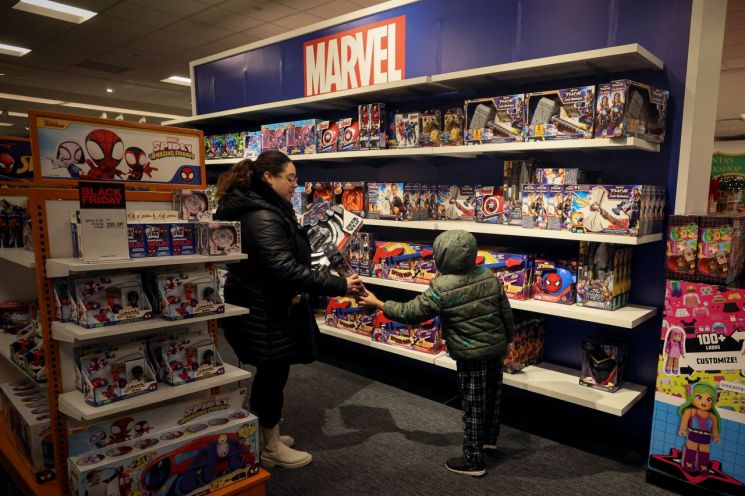
According to Bloomberg and others on the 15th (local time), the U.S. Department of Commerce announced that November retail sales fell by 0.6% compared to the previous month. This is the largest decline in 11 months since December last year (-2.0%), and the decrease was greater than the expert forecast (-0.2%) compiled by Bloomberg. Core retail sales, excluding gasoline and automobiles, also decreased by 0.2% compared to the previous month.
Despite the biggest shopping events of the year such as Black Friday and Cyber Monday last month, retail sales plummeted. This is interpreted as a significant reduction in American consumer spending due to the Fed's aggressive interest rate hikes.
On the same day, U.S. industrial production for November decreased by 0.2% compared to the previous month. Manufacturing production also declined by 0.6% in November, marking a decrease for the first time in five months since June. Manufacturing production in the New York and Philadelphia regions, announced by regional Federal Reserve Banks, weakened more than market expectations, and in Philadelphia, new orders declined for seven consecutive months, falling to the lowest level since April 2020, Bloomberg reported.
Foreign media such as Bloomberg and The Wall Street Journal (WSJ) evaluated these declines in consumption and industrial production as the result of the Fed's efforts to curb inflation through benchmark interest rate hikes. Sal Guatieri, Senior Economist at BMO Capital Markets, forecasted, "Households still have excess savings and are benefiting from wage increases, but if the Fed continues to raise rates, these two tailwinds (retail sales and industrial production) will fade next year."
Although economic uncertainty in the U.S. has greatly expanded, the labor market still appears strong. The U.S. Department of Labor reported that new unemployment claims for the week of December 4?10 dropped sharply by 20,000 from the previous week to 211,000. This was significantly below the expert forecast of 232,000 compiled by Bloomberg.
This is interpreted as showing that the U.S. labor market overheating has not cooled despite the Fed's aggressive rate hikes. Bloomberg analyzed that although layoffs are occurring one after another in white-collar jobs such as big tech companies and financial firms, a worker-favorable market is maintained in most other sectors.
Concerns are growing in the market that despite the strong labor market, frozen consumption and production will lead to an economic recession. These economic indicators, along with Powell's declaration the previous day that aggressive benchmark rate hikes will continue next year, have heightened market worries. Powell strongly indicated his intention to maintain the monetary tightening stance by saying, "There is still some way to go," while noting that the labor market remains very overheated.
Quincy Crosby, Chief Global Strategist at LPL Financial, said, "The tug-of-war between the Fed and the market is clearly in the market's favor. The recession is not temporary," and predicted, "The Fed will be pressured to move (to cut rates) before 2024."
© The Asia Business Daily(www.asiae.co.kr). All rights reserved.
![Clutching a Stolen Dior Bag, Saying "I Hate Being Poor but Real"... The Grotesque Con of a "Human Knockoff" [Slate]](https://cwcontent.asiae.co.kr/asiaresize/183/2026021902243444107_1771435474.jpg)















