"It’s not a problem solved just by guaranteeing freight prices"
[Asia Economy Reporter Park Sun-mi] It has been claimed that this year's two strikes by the Cargo Solidarity Union caused approximately 10.4 trillion KRW in direct and indirect losses to the Korean economy.
On the 15th, the Korea Economic Research Institute (KERI) stated in its report titled "Economic Costs of Cargo Solidarity Strikes and the Extension and Expansion of the Safe Freight Rate System" that the two strikes this year resulted in direct damages amounting to 5.8 trillion KRW across sectors such as automobiles, steel, petrochemicals, cement, and tires. When including indirect economic losses, the total loss reached 10.4 trillion KRW, equivalent to 0.52% of the Gross Domestic Product (GDP). Additionally, it was estimated that due to the Cargo Solidarity strikes, investment decreased by 0.32%, exports by 0.25%, and employment by 0.17% respectively.
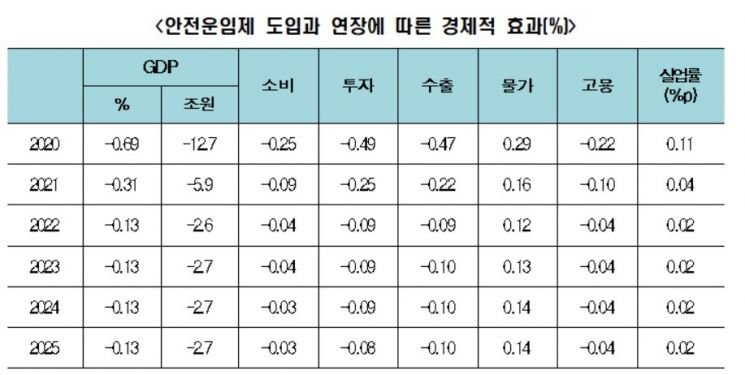
KERI also assessed the economic impact of extending the sunset clause of the Safe Freight Rate System for three years. If the 2022 freight rate increase were to continue for three years, it could cause an economic cost of 2.7 trillion KRW annually (0.13% of GDP), totaling 8.1 trillion KRW over three years. Employment is likely to decrease by 0.04% annually, and exports by 0.1% annually if the sunset extension is implemented.
Meanwhile, the cumulative economic cost of implementing the Safe Freight Rate System over the past three years (2020?2022) was estimated at 21.2 trillion KRW. In particular, in the first year of the system's introduction in 2020, freight rates increased sharply by more than 12%, resulting in economic losses amounting to 12.7 trillion KRW, which corresponds to 0.69% of GDP.
If the sunset extension of the Safe Freight Rate System is combined with an expansion of its application scope, the annual economic cost is expected to range from a minimum of 21.5 trillion KRW to a maximum of 21.9 trillion KRW (1.04% to 1.07% of GDP). The estimated cumulative economic cost over three years could reach 65.3 trillion KRW. Furthermore, exports are projected to decline by 0.90% to 0.94% annually, and employment by 0.33% to 0.34% annually.
Cho Kyung-yeop, head of the Economic Research Division at KERI, emphasized, “While the traffic safety improvement effects of the Safe Freight Rate System are unclear, the economic costs are quite significant, thus it does not help industrial competitiveness at all. Traffic safety should be secured through laws, systems, and traffic culture, which is the proper approach, and guaranteeing freight prices does not solve the problem.”
© The Asia Business Daily(www.asiae.co.kr). All rights reserved.
![Clutching a Stolen Dior Bag, Saying "I Hate Being Poor but Real"... The Grotesque Con of a "Human Knockoff" [Slate]](https://cwcontent.asiae.co.kr/asiaresize/183/2026021902243444107_1771435474.jpg)















