When Drafting the Amendment to Music Copyright Fee Collection Regulations
Han Eum Jeo Hyeop Leads Excluding OTT and Broadcasters
"All Stakeholders Must Participate in the Process"
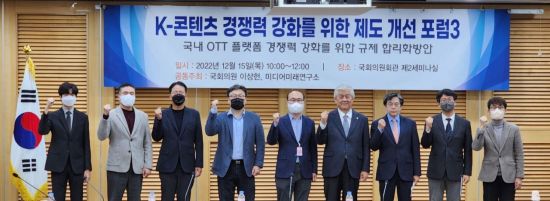 At the 'Forum on Rationalizing Regulations to Strengthen the Competitiveness of Domestic OTT Platforms' held on the 15th at the National Assembly Members' Office Building, co-hosted by National Assembly member Sangheon Lee and the Media Future Research Institute, attendees are taking a commemorative photo.
[Asia Economy Reporter Minyoung Cha] Conflicts over appropriate music copyright fees are intensifying between the online video service (OTT) industry and the Korea Music Copyright Association (Hanumjeohyeop). As a result, there are calls for the Ministry of Culture, Sports and Tourism and other relevant authorities to take the lead in improving the system and for the establishment of a social consensus body that brings together stakeholders.
On the 15th, Lee Sangheon, a member of the Democratic Party of Korea, and the Media Future Research Institute held the "Forum on Institutional Improvement for Strengthening K-Content Competitiveness" at the National Assembly Members' Office Building Seminar Room 2, under the theme "Regulatory Rationalization Measures to Strengthen Domestic OTT Platform Competitiveness."
Recurring Disputes Between Media Industry and Music Copyright Holders
Jeon Eungjun, a lawyer at Law Firm Lin, highlighted recent disputes related to music copyright (neighboring rights), noting that conflicts between broadcasters, IPTV, OTT, and music copyright holders in the media industry are repeatedly occurring. He pointed out that when these disputes escalate to lawsuits, courts tend to focus passively on whether actions are "legal or illegal" based on outdated standards, without a deep understanding of the OTT and media industries.
A representative case is the lawsuit filed by LG Uplus and KT, which operate OTT services, against the Ministry of Culture, Sports and Tourism over the cancellation of approval for the "Music Copyright Usage Fee Collection Regulation" amendment. Hanumjeohyeop set a usage rate of 1.5% of sales for OTT video transmission services in the amendment. For cable TV operators (SO), the rate was set at 0.5% of total broadcasting revenue, and for IPTV, 1.2% of sales. The amendment submitted by Hanumjeohyeop was approved by the Ministry of Culture, Sports and Tourism. The plaintiffs argued that the approval decision exceeded discretionary authority and violated the principle of equality, but the court ruled in October that the amendment was legal and dismissed the plaintiffs' claims.
Regarding this, Lawyer Jeon stated, "It is questionable whether it is appropriate for the plaintiff OTT operators to bear the burden of proving the abuse or deviation of discretion under the general principles of discretionary decision cancellation. If it were a damages case based on copyright infringement, the copyright holder, Hanumjeohyeop, should prove the reasonableness of the usage fee rate."
Earlier, a similar dispute arose between the three IPTV providers and Hanumjeohyeop regarding music usage fees. The plaintiffs argued that there was insufficient rationale to explain the gap between the higher IPTV music usage fee rate (1.2%) compared to SO (0.5%). Although the court ruled against the IPTV operators, Lawyer Jeon pointed out that this was due to adherence to outdated standards. There were also disputes over broadcasting usage fees (management rates) between broadcasters KBS, MBC, and Hanumjeohyeop.
"Stakeholders Must Collaborate from the Start of Collection Regulation Amendments"
So, how should appropriate usage fee rates be determined? Lawyer Jeon suggested, "Direct negotiations on usage fees between the collective management organizations and users should take place from the approval process stage of the collection regulations. In other words, the participation of OTT stakeholders should be institutionally guaranteed so that copyright holders and OTT operators can negotiate usage fees directly."
OTT operators also called for improvements, stating that Hanumjeohyeop, the copyright collective management organization for music copyright holders, repeatedly fights with media platform companies in similar ways. Hanumjeohyeop has also pursued criminal lawsuits. In September, Hanumjeohyeop submitted a complaint to the Yeongdeungpo Police Station in Seoul against OTT operators, together with the UK music copyright management organization PRS. Although the police found no intent to infringe, Hanumjeohyeop requested a supplementary investigation from the Seoul Southern District Prosecutors' Office after the decision not to prosecute.
Jang Junyoung, Executive Director at Coupang, said, "Hanumjeohyeop targets vulnerable operators for individual negotiations or negotiates first with financially strong overseas operators and then creates collection regulation amendments based on that. They demand other operators comply with the regulations, and if an individual operator refuses, it leads to lawsuits." He explained that in the game created by Hanumjeohyeop's 'collection regulation amendment,' operators have no choice but to follow the rules reluctantly. He also pointed out that, similar to the broadcasting industry's 'blackout' (transmission suspension), there is a possibility that the final consumers could suffer damages in the OTT sector during this process.
Labor Hwan, Team Leader at Wavve, added, "We held collective negotiations every other day for two weeks, but even the authoritative interpretation issued by the Ministry of Culture, Sports and Tourism was denied by Hanumjeohyeop, leading to a breakdown in negotiations. Hanumjeohyeop is also frequently filing criminal complaints. The Ministry of Culture, Sports and Tourism, which manages the collective, needs to introduce re-approval systems and impose sanctions."
The Korea Copyright Commission, a public institution under the Ministry of Culture, Sports and Tourism responsible for copyright-related tasks, is also struggling to mediate opinions among stakeholders. Kim Hyechang, Head of the Korea Copyright Commission, said, "The problem is the significant difference in perspectives between rights holders and users regarding copyright fees. We agree on the need for a channel where stakeholders can gather and discuss."
Professor Jeon Beomsu of Hanyang University’s Department of Information and Future Society noted, "As the domestic media market integrates into the global market, it is important to consider whether it is appropriate to separate domestic and global markets or to find realistic solutions by integrating them. There is also the issue of identity confusion regarding whether OTT can be connected similarly to other media in terms of copyright."
© The Asia Business Daily(www.asiae.co.kr). All rights reserved.
![Clutching a Stolen Dior Bag, Saying "I Hate Being Poor but Real"... The Grotesque Con of a "Human Knockoff" [Slate]](https://cwcontent.asiae.co.kr/asiaresize/183/2026021902243444107_1771435474.jpg)















