Busan City, Best Efforts Over 5 Years Since Conditional Selection for 2017 World Heritage Tentative List
[Asia Economy Yeongnam Reporting Headquarters Reporter Dong-guk Lee] The city of Busan’s “Heritage of Busan, the Refuge Capital during the Korean War,” which has been promoted since 2015, was approved at the World Heritage Subcommittee meeting held by the Cultural Heritage Administration on the 8th, finalizing its registration on the UNESCO World Heritage Tentative List.
This is a remarkable achievement five years after being conditionally selected for the tentative list in December 2017, with conditions including “addition of heritage reflecting refugee life” and “establishment of a comprehensive preservation management plan.”
During this time, the city, in cooperation with the Busan Research Institute and related experts through a research collaboration project for registration promotion, has accumulated data while conducting value discovery and individual studies of the heritage. Simultaneously, it has been carrying out cultural heritage registration, designation, and elevation for the preservation and management of the heritage.
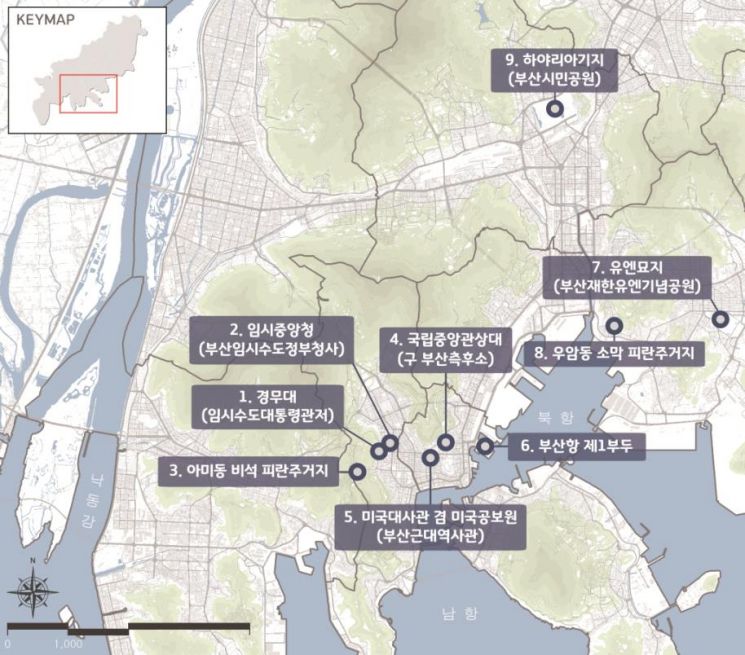
The “Refuge Capital Busan Heritage” is distributed throughout the city and consists of a total of nine individual heritage sites: five architectural heritage sites and four place-type heritage sites. In Seo-gu (3), these include ▲ Gyeongmudae (Temporary Capital Presidential Residence), ▲ Temporary Central Government Building (Busan Temporary Capital Government Office), and ▲ Amidong Monument Refugee Residence; in Jung-gu (3), ▲ National Central Meteorological Observatory (former Busan Signal Station), ▲ U.S. Embassy and U.S. Information Service (Busan Modern History Museum), and ▲ Busan Port Pier 1; in Busanjin-gu (1), ▲ Hayaria Base (Busan Citizens Park); and in Nam-gu (2), ▲ UN Cemetery and ▲ Woam-dong Small Refugee Residence.
For registration as a UNESCO World Heritage, various requirements are necessary, but fundamentally, the heritage must be recognized for its Outstanding Universal Value (OUV) according to the registration guidelines, and the establishment of protection zones and buffer zones for the heritage’s preservation is required.
Accordingly, through the domestic procedure of the Cultural Heritage Administration’s Cultural Heritage Committee World Heritage Subcommittee review, the “Heritage of Busan, the Refuge Capital during the Korean War” was recognized as an exceptional living evidence that was urgently utilized under the urgent circumstances of the Korean War, the first war of the 20th-century Cold War period, maintaining its function as a refuge capital for 1,023 days. This result also acknowledges the efforts and determination of the citizens of Busan and the city for heritage preservation.
Busan City has revealed the registration value and uniqueness of the refugee heritage through various research projects and data investigations. It laid the basic foundation for legal preservation management of the heritage through the elevation of Gyeongmudae to a nationally designated cultural property (historic site) in 2018, registration of Woam-dong Small Refugee Residence as a nationally registered cultural property, registration of Amidong Monument Refugee Residence as a Busan registered cultural property in 2022, designation of the former U.S. Military Officers’ Club in Busan Citizens Park as a Busan designated cultural property, and application for elevation of the former Busan Signal Station to a nationally designated cultural property (historic site).
In particular, Busan Port Pier 1, evaluated as a core heritage among the refugee capital heritage, was at risk of destruction during the North Port redevelopment project over the past five years. However, through consultations between Busan City and the Busan Port Authority (BPA) for heritage preservation, the originally planned road was rerouted, and the reclamation plan was changed to preserve the pier’s original form.
Busan Port Pier 1, owned by the Busan Port Authority, has also had an application submitted for registration as a Busan registered cultural property to Jung-gu, the local jurisdiction.
Above all, the heritage of Busan as the refugee capital is highly valuable as the first domestic case of promoting registration of modern heritage located within an urban area for UNESCO World Heritage registration. It is also regarded as a significant opportunity for the preservation of excellent modern heritage in Korea that had been neglected until now.
Following the Cultural Heritage Administration’s decision to register on the tentative list, after subsequent procedures, the heritage will be officially confirmed for registration at the UNESCO World Heritage Center and managed as part of the World Heritage Tentative List. However, for full UNESCO World Heritage registration, there remain numerous domestic and international procedures such as selection for the priority registration list, preliminary examination, and selection of registration candidates and targets. Therefore, continuous supplementary research, efforts, and interest are required to meet the registration criteria.
Lee Byung-jin, Vice Mayor of Busan and chairman of the Busan World Heritage Committee, who participated as the Busan side presenter in the Cultural Heritage Administration’s tentative list re-examination, stated, “Despite the rapidly progressing redevelopment and development trends, it is necessary for Busan City and its citizens to unite and protect the nine heritage sites that vividly testify to the traces and memories of history overcoming the pain of war and moving toward an era of peace.” He added, “We will strive for successful registration and, beyond the registration procedures, actively promote various citizen participation activities such as citizen academies, cultural heritage night tours, and citizen excursions, as well as education for future generations, to continuously build public consensus and create opportunities to keep promoting Busan as the refugee capital.”
© The Asia Business Daily(www.asiae.co.kr). All rights reserved.
![Clutching a Stolen Dior Bag, Saying "I Hate Being Poor but Real"... The Grotesque Con of a "Human Knockoff" [Slate]](https://cwcontent.asiae.co.kr/asiaresize/183/2026021902243444107_1771435474.jpg)
















