Indication of Potential Expansion in Investment Scale
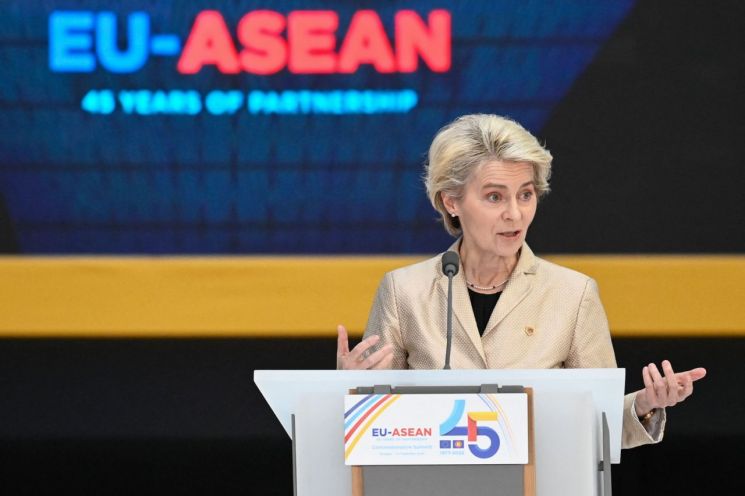
[Asia Economy Reporter Jo Yujin] The European Union (EU) has declared that it will invest 10 billion euros (approximately 14 trillion KRW) in infrastructure development and other projects in Southeast Asian countries by 2027. This move marks the beginning of efforts to counter China's massive economic initiative, the Belt and Road Initiative, which extends its reach into the EU's own region by connecting the Eurasian continent.
On the 14th (local time), Ursula von der Leyen, President of the European Commission, announced this plan as part of the EU's Global Gateway initiative during the EU-ASEAN (Association of Southeast Asian Nations) summit held in Brussels, Belgium.
The Global Gateway, meaning "gateway to the world," is the EU's version of the Belt and Road Initiative, established to stabilize supply chains connected between the EU and countries worldwide and to promote trade. According to this plan, financial institutions, EU member state governments, and the private sector aim to invest 300 billion euros in infrastructure construction outside Europe by 2027. The EU has been actively discussing the Global Gateway with countries influenced by China's Belt and Road Initiative, starting with a summit with Africa earlier this year.
The EU explained that the investment in ASEAN will be used for energy, transportation, digital development, trade promotion, and building sustainable "value chains," adding that it will support the green economic transition of Southeast Asian countries.
After the summit, President von der Leyen hinted at the possibility of increasing the investment scale during a joint press conference with the Philippines, Cambodia, and others. The joint declaration adopted at the summit also included commitments to further strengthen economic cooperation between the EU and ASEAN. The declaration stated, "We will promote sustainable and inclusive trade and investment," aiming to foster resilient, efficient, environmentally, economically, and socially sustainable global supply chains. However, the free trade agreement (FTA) between the EU and ASEAN, which has been discussed for over a decade, was only mentioned as a long-term goal.
The EU currently has FTAs with Vietnam and Singapore, and is seeking negotiations with Indonesia, the largest economy in ASEAN, as well as Malaysia, the Philippines, and Thailand.
Earlier, the G7 also began promoting infrastructure investment plans to counter the Belt and Road Initiative, starting with Africa. In this year's joint declaration, the G7 emphasized global partnerships as a key agenda, declaring the "Build Back Better World" initiative to develop infrastructure in regions where China is expanding its influence, including Africa.
The Build Back Better World initiative is led by U.S. President Joe Biden. President Biden stated, "The G7's Build Back Better World project will be fairer than the Belt and Road Initiative," directly targeting the Belt and Road. The initiative aims to invest 40 trillion dollars (approximately 47 quadrillion KRW) in developing countries such as those in Africa by 2035. The U.S. is already conducting 10 investment projects in African countries including Ghana and Senegal.
Meanwhile, the EU's joint declaration also contained indirect pressure messages toward China, which is involved in territorial disputes with some Southeast Asian countries over the South China Sea. Regarding the Korean Peninsula issue, the declaration expressed concern over North Korea's repeated launches of intercontinental ballistic missiles (ICBMs) and ballistic missiles, urging North Korea to halt these launches and refrain from nuclear tests. It also reaffirmed support for the international community's efforts toward the "complete, verifiable, and irreversible denuclearization (CVID)" of the Korean Peninsula.
Regarding the war in Ukraine, the declaration stated, "Most member states strongly condemn the war in Ukraine and emphasize that it is causing tremendous humanitarian suffering and exacerbating existing vulnerabilities in the global economy."
© The Asia Business Daily(www.asiae.co.kr). All rights reserved.