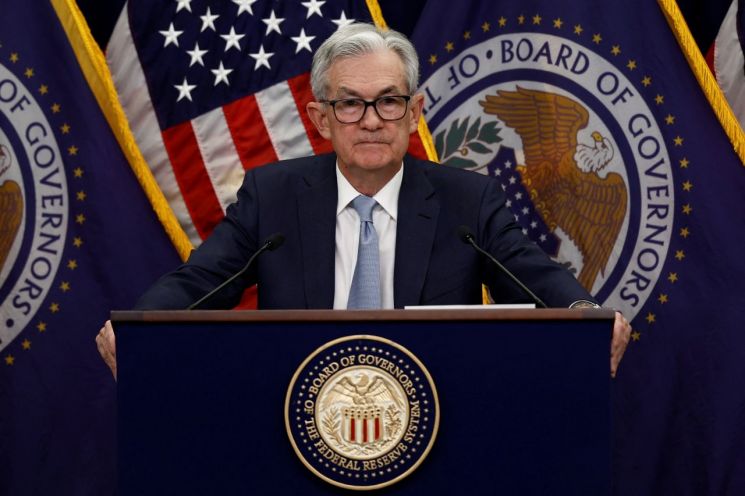
[Asia Economy New York=Special Correspondent Joselgina] "We are not considering a rate cut until we are confident that inflation will come down to the 2% target."
Jerome Powell, Chair of the U.S. Federal Reserve (Fed), which has slowed the pace of interest rate hikes by reducing the size of increases, confirmed the policy stance that tightening will continue next year. He clearly drew a line on the possibility of rate cuts in 2023, stating that it is not being considered yet.
At a press conference held immediately after the December Federal Open Market Committee (FOMC) regular meeting on the 14th (local time), Chair Powell said, "Our goal is to achieve the 2% inflation target through sufficient tightening policies."
At this final FOMC meeting of the year, the Fed raised the federal funds rate by 0.5 percentage points from the previous 3.75-4.0% to 4.25-4.5%. As initially announced, the Fed stepped back from the unusual four consecutive giant steps (0.75 percentage point hikes) and began to slow the pace of tightening.
On this day, Chair Powell explained the background of the pace adjustment, saying, "It takes time for the full effect of rate hikes to impact the economy. That is why we decided on a 0.5 percentage point increase, which is slower than 0.75 percentage points." However, he emphasized, "(A 0.5 percentage point hike) is still historically high. It means there is a long way to go."
He said, "We have been tightening, but it is still not enough," and evaluated that "it is appropriate to raise rates further until we reach a sufficiently restrictive level to achieve the 2% target." He added, "Much more evidence is needed to be confident that inflation is continuously declining," and assessed that "broad inflationary pressures remain across goods and services."
This 0.5 percentage point hike was a decision expected by the market. Chair Powell had hinted at slowing the pace as early as December at the previous meeting, and recent inflation indicators confirmed signals that the worst phase has passed. This is interpreted as cautious voices within the Fed gaining strength, emphasizing the need to avoid unnecessary recession by evaluating the cumulative effects of tightening. The consumer price index (CPI) for November, released the day before, rose 7.1% year-on-year, below the market expectation of 7.3%, supporting hopes for a peak in inflation. This was the lowest monthly increase since December last year.
However, Chair Powell also made it clear that slowing the pace does not mean a 'easing' policy. When asked whether the dot plot's projection of a 5.1% rate by the end of next year signals no rate cuts in 2023, he said, "We are not considering rate cuts yet," emphasizing that "historically, early easing has not been good."
Regarding the size of rate hikes next year, he responded, "How high and how long rates are maintained is more important than how much they are raised," adding, "The size of hikes will be decided based on economic conditions." When asked if the Fed will raise rates by 0.25 percentage points while monitoring the situation, he said, "We have not decided," but mentioned, "We will slow the pace."
While acknowledging that inflation indicators such as the CPI have been steadily declining recently, he also expressed concerns about the overheated labor market, service sector, and wage inflation pressures. Regarding revising the 2% inflation target, he drew a line, saying, "I have never considered that."
In the dot plot released that day, the Fed raised the median rate forecast for next year to 5.1%. This is interpreted as a message to maintain rates at a higher level for a longer period while slowing the pace of tightening. The median rate for next year in the dot plot rose by 0.5 percentage points from 4.6% presented in September to 5.1%. The rate for the following year was also raised from 3.9% in September to 4.1%.
Along with this, the U.S. GDP growth rate for this year was projected at 0.5%. The growth forecast for next year was adjusted from 1.2% in September to 0.5%. The unemployment rate for next year was revised from 4.4% to 4.6%. The personal consumption expenditures (PCE) price index, the Fed's preferred inflation gauge, was expected to be 5.6% this year and 3.1% next year. Previously in September, the projections were 5.4% and 2.8%, respectively.
With the Fed's rate decision on this day, the interest rate gap between South Korea (3.25%) and the U.S. widened to 1 to 1.25 percentage points. This is close to the largest ever U.S.-Korea rate inversion margin (1.50 percentage points). Concerns about foreign capital outflows and depreciation of the Korean won have been raised.
Since the Fed began its rate hike cycle by raising rates by 0.25 percentage points in March this year, it has continued tightening with hikes of 0.5 percentage points in May, 0.75 percentage points in June, July, September, and November.
In the afternoon on this day, the New York stock market fell sharply after the FOMC statement was released, giving up previous gains. Although the 0.5 percentage point hike was anticipated early, the dot plot's final rate exceeding market expectations appears to have been the background for the decline. As of 3:35 p.m., just before market close, the Nasdaq index was down 1.15% compared to the previous session.
© The Asia Business Daily(www.asiae.co.kr). All rights reserved.
![Clutching a Stolen Dior Bag, Saying "I Hate Being Poor but Real"... The Grotesque Con of a "Human Knockoff" [Slate]](https://cwcontent.asiae.co.kr/asiaresize/183/2026021902243444107_1771435474.jpg)
















