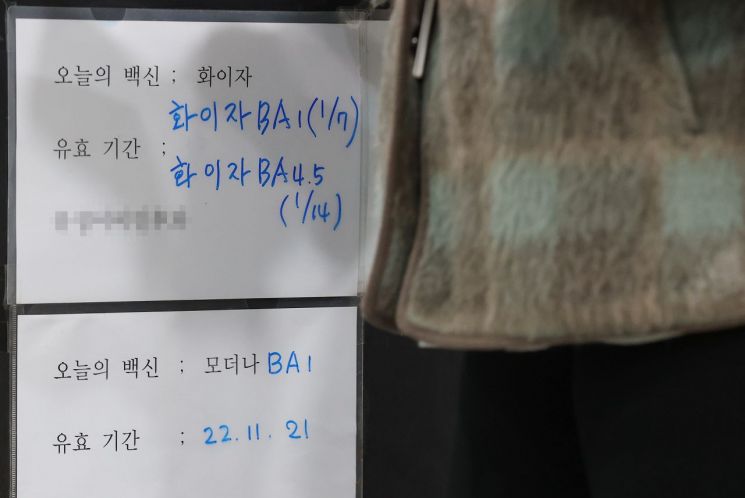
[Asia Economy Reporter Byeon Seon-jin] With the winter resurgence of COVID-19, both new confirmed cases and reinfections are increasing. Health authorities believe that the rise in the detection rate of the Omicron sublineage BN.1 is partly responsible. However, they also expect that the currently administered BA.1 and BA.4/5 variant-based updated vaccines will be effective in preventing infection and have urged people to get vaccinated.
According to the Central Disease Control Headquarters (CDCH) on the 14th, the average daily number of new COVID-19 cases in the first week of December was 58,958, an 11.2% increase from the previous week. The effective reproduction number (Rt) remained above 1 for eight consecutive weeks at 1.04. An Rt above 1 indicates the spread of the epidemic. The weekly average number of severe cases among hospitalized patients was 444, and the number of deaths was 51. While severe cases decreased by 4.9% compared to the previous week, deaths increased by 6.2%.
Reinfection cases are on the rise. As of the fifth week of November, the estimated proportion of reinfection cases was 14.7%, up from 13.29% the previous week. Among the total cumulative infected individuals, those infected two or more times account for 3.1%. Among Omicron sublineages, BA.5 accounted for 60.5%, down from 67.8% the previous week, while the detection rate of BN.1 rose to 17.2% from 13.2%. BN.1, a sublineage of BA.275, also known as the "Centaurus variant," has gradually expanded its presence with detection rates of 7.6% in the third week of November, 7.7% in the fourth week, and 13.2% in the fifth week.
Im Suk-young, head of the CDCH Situation Management Team, commented on the recent increase in BN.1 detection rates, stating, "We believe this is partly influencing the rise in domestic confirmed cases." However, she added, "Compared to other variants like BQ.1 and BQ.1.1 seen in the US and Europe, the increase in BN.1 is at a lower level, so we judge that the speed of BN.1's increase will not be as fast as the existing BA.5."
Health authorities believe that although BN.1 shows somewhat increased immune evasion, the currently administered updated vaccines will continue to be effective in preventing infection and severe illness. Hwang Kyung-won, vaccination planning team leader at the COVID-19 Vaccination Response Promotion Team, said, "Since BN.1 is a subvariant of BA.2.75, which is an Omicron variant, we expect the currently administered bivalent vaccines to be sufficiently effective," adding, "We are continuously monitoring the vaccine effectiveness related to this and will promptly analyze and disclose any additional research findings."
© The Asia Business Daily(www.asiae.co.kr). All rights reserved.
![Clutching a Stolen Dior Bag, Saying "I Hate Being Poor but Real"... The Grotesque Con of a "Human Knockoff" [Slate]](https://cwcontent.asiae.co.kr/asiaresize/183/2026021902243444107_1771435474.jpg)
















