Q4 Operating Profit Expected to Turn Positive
Surge in Japanese Tourists Key Factor
Jeju Air Tops with 200,000 Japanese Passengers in November
[Asia Economy Reporter Yoo Hyun-seok] Jeju Air and Jin Air are expected to turn a profit for the first time among low-cost carriers (LCCs). This is attributed to their prompt increase in flights, especially to Japan, where the number of travelers is rapidly growing.
On the 14th, securities firms projected Jeju Air and Jin Air's operating profits for the fourth quarter to be 800 million KRW and 2.7 billion KRW, respectively, marking a turnaround to profitability compared to the same period last year. Their sales are expected to increase by 268.60% and 174.49%, reaching 324 billion KRW and 217.4 billion KRW, respectively.
If Jeju Air and Jin Air record operating profits in the fourth quarter, it will be their first profit since the first quarter of 2019. Due to COVID-19, LCCs' performance plummeted for about three years. During this period, LCCs struggled to survive by raising funds through perpetual bonds and rights offerings. In fact, the possibility of turning a profit began to appear from the third quarter as governments eased quarantine measures and travelers increased. However, due to exchange rates and high jet fuel prices, LCCs still posted losses in the third quarter.
The biggest reason for the strong fourth-quarter performance is the expansion of overseas routes, which were previously centered on Southeast Asia, to include Japan. From October 11, the Japanese government reinstated visa-free entry. Coupled with the weak yen, the number of travelers to Japan surged sharply. Consequently, airfares to Japan also rose significantly, more than doubling compared to pre-COVID levels. This is because demand is high while the number of flights is significantly reduced compared to before COVID-19. Additionally, fuel surcharges increased. The industry expects airfares to continue soaring into the first half of next year.
The increase in travelers to Japan has also rapidly boosted the number of international passengers. In September, the number of international passengers transported by nine domestic airlines, including Korean Air, Asiana Airlines, Jeju Air, and Jin Air (based on nationwide airports), was 1,214,966, which rose to 1,636,493 in October and 2,072,634 in November. Among these, passengers on Japan routes increased from 135,583 in September to 364,939 in October and 746,164 in November. While Japan route passengers accounted for only 11.16% of total international passengers in September, this share rose to 36% in November.
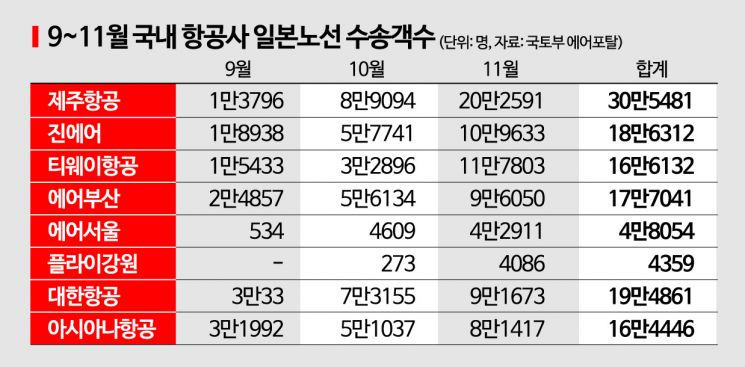
Among these, Jeju Air and Jin Air are standing out on the Japan routes, with Jeju Air being particularly dominant. Jeju Air's number of passengers on Japan routes, which was only 13,796 in September, increased to 89,094 in October and nearly doubled to 202,591 in November. Jin Air's Japan passenger numbers also rose sharply, jumping from 18,938 to 109,633 during the same period. The total number of passengers from September to November was 305,481 for Jeju Air and 186,312 for Jin Air.
This trend is expected to continue. This month, Jeju Air operates 178 round-trip flights per week to Japan, followed by T'way Air with 105 flights and Jin Air with 95 flights. The number of LCC flights exceeds those of major carriers such as Korean Air (88 flights) and Asiana Airlines (59 flights).
The outlook is also bright, as the peak season has just begun and will continue until February next year. Seong Woo-un, a researcher at Korea Investment & Securities, said, "Japan is such an important route that it accounts for more than half of operating profits at times," adding, "An earnings surprise is expected, centered on LCCs."
© The Asia Business Daily(www.asiae.co.kr). All rights reserved.
![Clutching a Stolen Dior Bag, Saying "I Hate Being Poor but Real"... The Grotesque Con of a "Human Knockoff" [Slate]](https://cwcontent.asiae.co.kr/asiaresize/183/2026021902243444107_1771435474.jpg)















