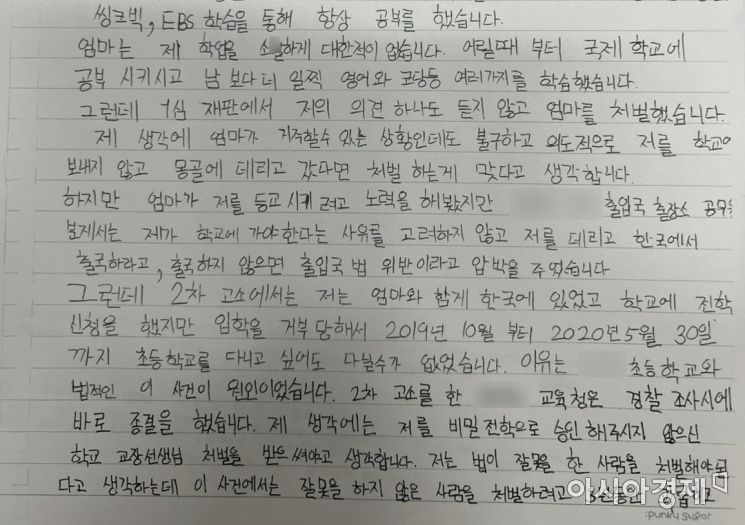
 Petition written by Lee In-hye (alias, 13), a Korean national, appealing the not guilty verdict on the charge of violating the Child Welfare Act (neglect) against her Mongolian mother (39)
[Asia Economy Reporter Kim Daehyun] A Mongolian mother who was unable to send her Korean daughter to elementary school for a month due to visa issues was put on trial for "neglecting her daughter's education," but the Supreme Court ultimately acquitted her. ▶Refer to Asia Economy's September 22 article 'Foreign Mother with Korean Daughter Accused of Child Abuse in Korea [Struggles of Raising Migrant Children]'.
According to the court on the 14th, the Supreme Court's First Division (Presiding Justice Park Jeonghwa) upheld the lower court's verdict of not guilty on May 30th for Ms. A (39, female), a Mongolian woman indicted for violating the Child Welfare Act (neglect).
Previously, Ms. A gave birth to Lee Inhye (a pseudonym), a Korean national, in 2008 with a Korean man. After their divorce, she took sole responsibility for raising her daughter and remarried a Mongolian man in 2016. They also had a second child.
Ms. A experienced conflicts with the homeroom teacher and school when Inhye was in the 5th grade of elementary school. These issues arose from pointing out bullying and educational discrimination within the school and requesting a petition letter for her husband's visa issuance. In May 2019, mother and daughter left for Mongolia, submitting a field trip application citing "family visa application" as the reason. Ms. A was in a situation where she had to renew a short-term general (C-3-1) visa because the government had not issued the 'Child Rearing (F-6-2) visa' granted to migrants raising children alone since 2018.
However, when the stay in Mongolia exceeded the approved period on the application, the school reported Ms. A for "not sending Inhye to school for about 30 days." Inhye returned and attended school again after the second semester started, but the prosecution indicted Ms. A.
At the first trial, the homeroom teacher testified, "The defendant caused a disturbance at the community center, saying 'there were rats in the rice received.' The defendant, who has a sense of victimization and delusions, definitely needed treatment." The first trial judge said, "The defendant is somewhat hostile, right? I wonder why the sense of victimization arose," and added, "She was a somewhat difficult parent, right?" Even the defense attorney, who should prioritize the defendant's interests, said, "Communication doesn't work even with me. She changed several lawyers."
The first trial sentenced Ms. A to a fine of 5 million won, stating, "It appears that she left for Mongolia to resolve the re-entry issue of a Mongolian man unrelated to her daughter's education. She refused contact from school officials trying to confirm the student's safety."
Ms. A appealed, saying, "The homeroom teacher's stories about mental illness and disturbances at the community center are groundless. The first trial court treated me as a 'hostile person' without proper verification and rejected my request to summon Inhye as a witness."
Inhye appeared as a witness in the appellate court and said, "There was no neglect of education," and appealed, "I hope my mother is not punished." Ms. A made her final statement, saying, "Koreans say I am hostile if I talk a lot, and stupid if I don't talk. Please see foreigners as humans, not aliens."
The appellate court acquitted her. It noted, "The defendant, as a biological mother, had continuous interest in education," highlighting that during the stay in Mongolia, Inhye attended a native English academy and completed study materials, and was also sent to international and alternative schools in Korea.
In particular, the court emphasized, "There could have been sufficient other reasons for the delayed re-entry. Even if the main purpose of departure was the entry of the husband and other family members, it cannot be concluded that this is unrelated to the child's education." The court explained that enabling the whole family to live together in Korea aligns better with the fundamental principle of the Child Welfare Act that "children should grow up happily in a stable family environment for complete and harmonious personality development." It was revealed that even the homeroom teacher had warned before departure that "leaving the child alone could constitute neglect under the Child Welfare Act."
The Supreme Court also unanimously dismissed the prosecution's appeal. Ms. A told this publication, "The investigative agency dragged the case to the Supreme Court to punish me, causing suffering for over three years with my daughter. Although I received 2 million won in criminal compensation (due to acquittal), the pain will not disappear immediately," and expressed gratitude, saying, "Unlike the first trial, the second trial and Supreme Court judged without prejudice against foreigners."
© The Asia Business Daily(www.asiae.co.kr). All rights reserved.
![Clutching a Stolen Dior Bag, Saying "I Hate Being Poor but Real"... The Grotesque Con of a "Human Knockoff" [Slate]](https://cwcontent.asiae.co.kr/asiaresize/183/2026021902243444107_1771435474.jpg)

















