Korean Semiconductor Academy to Begin Operations Next Year
Industry-Led Talent Development in Full Swing
Regional Universities Collaborate to Build Joint Campus
Declining Student Numbers Require Solutions
"Need to Consider Overseas Recruitment for Master's and PhD Levels"
[Asia Economy Reporter Kim Pyeonghwa] To address the essential challenge of manpower shortages for strengthening competitiveness in the semiconductor industry, both the government and the private sector are actively producing practical talent by establishing new demand-driven education systems. Semiconductor industry insiders welcome these efforts. There is also advice that, in the mid-to-long term, efforts should be made to cultivate high-level talent and attract overseas professionals.
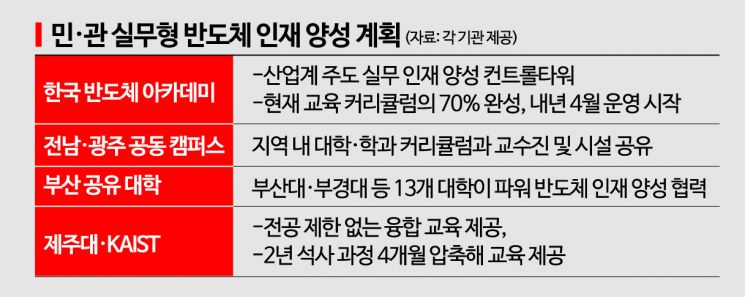
According to the semiconductor industry on the 13th, the industry-led manpower training control tower, the "Korea Semiconductor Academy," will begin full-scale operations at the end of April next year. This institution for manpower training, which appeared in the semiconductor superpower achievement strategy announced by the government last July, is now taking shape. It takes more than four years to produce semiconductor talent through universities. The Semiconductor Academy is a facility aimed at directly training practical talent in the industry within a short period. Currently, 70% of the education curriculum has been completed, and detailed tasks such as requesting corporate cooperation and securing instructors are underway. Going forward, education programs will be operated in multiple fields such as design, equipment, components, and packaging, with plans to produce more than 3,600 personnel over the next five years.
Local governments nationwide are also presenting new manpower training plans by forming allied fronts with nearby universities. Jeonnam and Gwangju have launched a semiconductor talent training committee this month while promoting a semiconductor specialized complex attraction project. The committee plans to build a joint campus that shares faculty and educational facilities by gathering various semiconductor curricula from multiple universities and departments in the region. Busan also plans to develop semiconductors as a regionally specialized industry. To this end, 13 local universities including Pusan National University and Pukyong National University will create joint education courses and introduce shared universities. They will engage in comprehensive cooperation, including training power semiconductor talent and educating employees of related companies.
In academia, efforts are underway to break down major boundaries and accelerate talent cultivation. Jeju National University will open a semiconductor convergence major for students in their second year or above starting from the first semester next year. This program is based on semiconductor physics and provides major knowledge and practical education, and it is characterized by being open to anyone regardless of their existing major. The Semiconductor Design Education Center at the Korea Advanced Institute of Science and Technology (KAIST) compresses a two-year master's program in semiconductor design education into four months and awards micro-degrees. It accepts not only students majoring in electronics and related fields but also graduates from humanities, and recently 62 people have completed this education.
The semiconductor industry believes that such manpower supply can be helpful on the ground. As the semiconductor manpower shortage gradually intensifies, deploying practical talent can help alleviate the shortage. According to a future new growth industry manpower supply and demand perception survey released by the Korea Employers Federation last month, 45% of all semiconductor companies are suffering from manpower shortages. The Korea Semiconductor Industry Association stated that as of last year, the total number of personnel in the semiconductor industry sector was 176,509, and approximately 127,000 new semiconductor personnel will be needed by 2030.
In the mid-to-long term, there is also advice to consider cultivating high-level talent at the master's and doctoral levels and attracting overseas personnel to enhance industrial competitiveness. Lee Changhan, Vice Chairman of the Korea Semiconductor Industry Association, said, "The number of domestic students is decreasing, and the proportion of those pursuing master's and doctoral degrees is also declining, increasing the need for high-level talent," adding, "In fields that continuously require manpower, including semiconductors, overseas personnel will also be needed in the future, so systems such as immigration policies must be established." The Federation of Korean Industries also stated in a report this month that the openness of the domestic labor market is the lowest among the Organization for Economic Cooperation and Development (OECD) countries and that the utilization of excellent overseas talent in promising industries such as semiconductors should be increased.
© The Asia Business Daily(www.asiae.co.kr). All rights reserved.

















