Foreign Minister Park Jin Holds Video Conference with Wang Yi on the 12th
Tight Communication on Bilateral Leaders' Exchanges Including Xi Jinping's Visit to Korea
[Asia Economy Reporter Yoo In-ho] In the diplomatic talks between South Korea and China, the two countries still showed differing views on the North Korean issue.
While the South Korean government expressed concerns over North Korea's missile provocations, the Chinese side did not make any official remarks about North Korea, making it highly likely that China will not participate in sanctions against North Korea following its 7th nuclear test and additional missile launches.
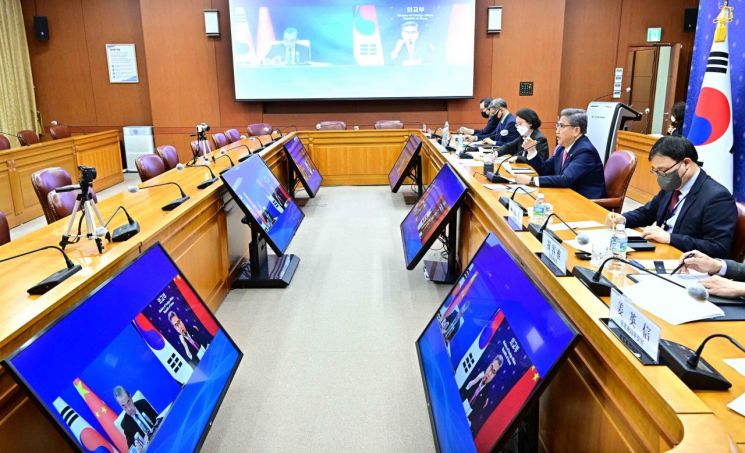
According to the Ministry of Foreign Affairs on the 13th, Foreign Minister Park Jin and Chinese State Councilor and Foreign Minister Wang Yi held a video conference for about 1 hour and 15 minutes the previous afternoon, agreeing to maintain close communication to sustain the momentum of exchanges between the two heads of state, including Chinese President Xi Jinping's visit to South Korea.
This meeting is significant as it marks the first activation of the channel between the foreign ministers after China established President Xi Jinping’s third term regime through the 20th Party Congress in October and the South Korea-China summit in November laid the groundwork for future bilateral relations.
The South Korea-China foreign ministers' meeting was held about four months after Minister Park’s face-to-face meeting in Qingdao in August.
The talks broadly covered South Korea-China relations, the Korean Peninsula issue, regional and international affairs.
Both ministers evaluated that the summit held during last month’s G20 summit was an important milestone opening a new era of South Korea-China cooperation based on mutual respect, reciprocity, and shared interests.
They also agreed to closely cooperate to smoothly implement follow-up measures according to the development direction of bilateral relations agreed upon by the two leaders.
During the South Korea-China summit, President Xi and President Yoon Suk-yeol agreed on the necessity to activate high-level exchanges and communication through various channels for the healthy and mature development of bilateral relations.
Ministers Park and Wang agreed to accelerate high-level exchanges at various levels, including mutual visits by foreign ministers, the ‘2+2’ deputy minister-level foreign and defense security dialogue between the two countries’ foreign and defense authorities, strategic dialogues between deputy foreign ministers, the Committee for Promoting Cultural Exchanges, and 1.5-track (semi-official and non-governmental) dialogues.
They also agreed to expedite consultations for adopting the ‘Joint Action Plan for Future Development of South Korea-China Relations’ between the two foreign ministries, which was agreed upon during the August foreign ministers’ meeting in Qingdao.
However, it is reported that the two sides failed to find common ground on the North Korean issue. Minister Park expressed concern over North Korea’s provocations and emphasized that it is a ‘shared interest’ between South Korea and China to closely cooperate more than ever to ensure North Korea refrains from further provocations, including nuclear tests, and returns to the path of denuclearization talks.
However, Minister Wang only stated a principled position that China will play a constructive role regarding the Korean Peninsula issue without mentioning North Korea.
The Chinese Ministry of Foreign Affairs’ announcement did not specify detailed discussions on the North Korean issue, only stating that “both sides exchanged views on the situation on the Korean Peninsula and international issues of common concern.”
There was no mention in the Chinese announcement about follow-up summits between the two heads of state, including President Xi’s visit to South Korea.
Additionally, the two ministers agreed to actively cooperate to achieve tangible and practical cooperation results in various fields such as expanding supply chain communication, promptly resuming official negotiations on the South Korea-China Free Trade Agreement (FTA) for services and investment, increasing flights, expanding people-to-people exchanges, and revitalizing cultural content exchanges.
Furthermore, the two ministers agreed that there are broad shared interests in responding to various global issues such as economic recovery and climate change, and agreed to maintain close communication and cooperation in related fields.
Minister Wang stated, “We want to uphold the great direction of neighborly friendship with South Korea, strengthen strategic communication, focus on cooperation and common prosperity, and promote the healthy and stable development of China-South Korea relations.”
According to the Chinese announcement, Minister Wang criticized a third country, the United States, during the meeting.
Minister Wang emphasized that the U.S. actions related to the ‘CHIPS and Science Act’ and the ‘Inflation Reduction Act’ (IRA) significantly harm the legitimate rights and interests of various countries, including China and South Korea.
He said, “The United States has once again proven itself not as a builder but as a destroyer of international rules,” and added, “All countries should stand up to oppose outdated thinking and unilateral hegemonic behavior that go against globalization, and uphold and practice true multilateralism.”
© The Asia Business Daily(www.asiae.co.kr). All rights reserved.
![Clutching a Stolen Dior Bag, Saying "I Hate Being Poor but Real"... The Grotesque Con of a "Human Knockoff" [Slate]](https://cwcontent.asiae.co.kr/asiaresize/183/2026021902243444107_1771435474.jpg)
















