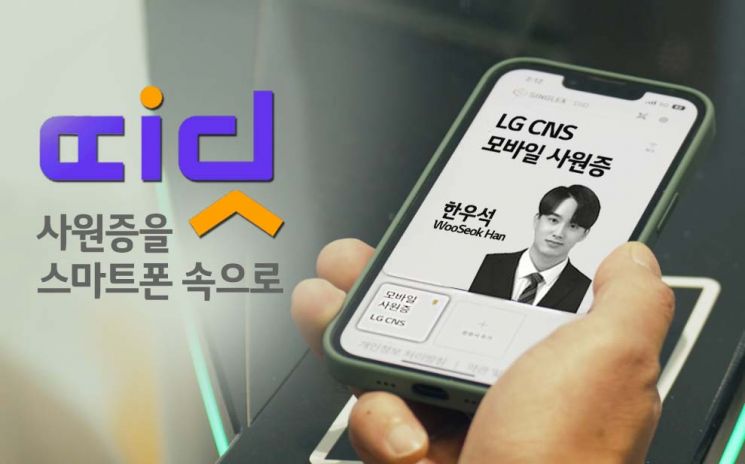
[Asia Economy Reporter Seungjin Lee] LG CNS announced on the 13th that it has officially launched the mobile employee ID card ‘DdidTM’ applying blockchain technology and started the service for its internal employees.
The mobile employee ID card ‘Ddid’ replaces the existing plastic card-type employee ID functions. Using Ddid, employees can easily authenticate with their smartphones at all gates within the company, make payments at cafeterias and cafes, access fitness centers, and other places requiring identity verification. LG CNS plans to soon provide additional features such as multifunction printer usage, commuting bus boarding, issuance of various certificates like employment verification and withholding tax receipts, and electronic contract signing.
The mobile employee ID incorporates blockchain DID (Decentralized ID) technology. DID is a mobile identity and credential authentication technology that implements the concept of ‘Self-Sovereign Identity’ to protect privacy. Unlike the traditional method of storing personal information such as public certificates on a central server of a third party, DID manages information by distributing it across personal devices like smartphones. This means returning ownership of information to individuals and enabling decentralization of personal data.
DID follows the fundamental concept of blockchain technology. Instead of authenticating transaction records on a central server, all users’ transaction records are distributed and stored in ‘blocks,’ and these blocks are linked in a chain recorded on a public ledger. Transactions are authenticated by comparing the records on this chain, which is the essence of blockchain technology.
Users of the mobile employee ID directly own their identity information on their smartphones. When using services requiring identity verification, only the essential information is provided for authentication. For example, for gate access, among various information stored in the mobile employee ID such as employee number, resident registration number, phone number, email, photo, and card ID linked to salary account, only the employee number is provided to verify whether the person is an LG CNS employee.
This method can be used in all mobile IDs applying DID technology and is fundamentally immune to hacking or personal information leakage. In case of smartphone loss, all permissions can be suspended through a report.
LG CNS successfully completed the construction of the Ministry of the Interior and Safety’s ‘mobile driver’s license’ applying DID technology in July this year. The mobile driver’s license built by LG CNS is the only mobile ID officially issued by the government. It can be used for identity verification at government offices and financial institutions.
LG CNS also built a mobile government employee ID early last year. The ‘mobile government employee ID’ is used for identity verification for access to government buildings and use of 25 work systems including the work portal for central government officials of the Republic of Korea.
LG CNS plans to first apply the mobile employee ID ‘Ddid’ at its headquarters to verify blockchain technology performance and then expand the service to external clients. In addition to blockchain, LG CNS is actively utilizing its Magok office as a testbed by first applying new digital transformation (DX) technology-based services such as metaverse, AI, cloud, and digital twin internally.
Baemin, Executive Director of Security and Solution Business Division at LG CNS, emphasized, “We will expand Ddid as a blockchain-based digital identity verification service to guarantee individuals’ rights to manage and utilize their information while creating various services that enhance convenience in daily life.”
© The Asia Business Daily(www.asiae.co.kr). All rights reserved.
![Clutching a Stolen Dior Bag, Saying "I Hate Being Poor but Real"... The Grotesque Con of a "Human Knockoff" [Slate]](https://cwcontent.asiae.co.kr/asiaresize/183/2026021902243444107_1771435474.jpg)
















