Announcement of 'Regulatory Impact Assessment for SMEs' Results
Review and Revision of Newly Established and Strengthened Regulations by Ministries
Benefits for Over 38,000 Companies and Small Business Owners
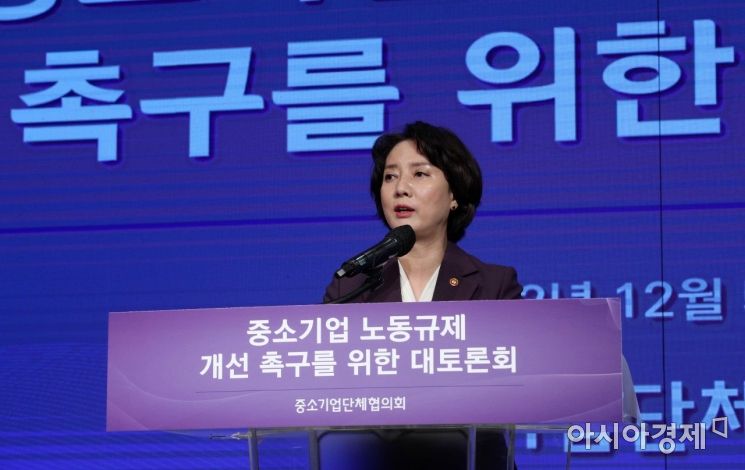
[Asia Economy Reporter Kim Bo-kyung] The Ministry of SMEs and Startups has improved 23 regulations through this year's regulatory impact assessment for small and medium enterprises (SMEs), reducing annual regulatory costs by 73 billion KRW.
The Ministry of SMEs and Startups announced on the 12th that it reviewed 885 newly established or strengthened regulations from various ministries through this year's SME regulatory impact assessment, submitted modification opinions on 34 of them, and improved 23 regulations.
The SME regulatory impact assessment is a system where the Ministry of SMEs and Startups reviews the impact on SMEs when government ministries establish or strengthen regulations, preventing the legislation of unreasonable or excessively burdensome regulations in advance.
According to the regulatory cost analysis by the Regulatory Impact Assessment Team of the Korea Institute for Startup & Entrepreneurship Development for the 23 improved regulations this year, it is expected to reduce regulatory costs by approximately 72.9 billion KRW annually for about 38,000 SMEs, venture companies, and small business owners.
Separately, it is also expected to resolve management uncertainties for about 870,000 SMEs and small business owners through ▲simplification of administrative procedures ▲improvement of administrative disposition standards ▲postponement of regulation application timing ▲clarification of regulatory content.
For example, through the regulatory impact assessment, the Ministry of SMEs and Startups preemptively blocked the introduction of a permit renewal system for manufacturers of firearms, swords, and explosives, as well as for those installing explosive storage facilities. The number of beneficiary companies was estimated at about 690.
In this industry, besides disqualification judgments for workers, regular safety inspections and checks are conducted after the permit is issued, so the field opinion was that there is little need to introduce a renewal system. Overseas, there is no renewal system for manufacturers of firearms and similar products either.
Another example is the extension of the expiration date of the waste disposal charge system while increasing fairness by subdividing the charge reduction brackets and adjusting the imposition rates to reflect reality.
Since companies bear additional costs by paying waste disposal charges in addition to outsourced waste disposal costs, the field opinion reflected the need to expand or subdivide the current reduction criteria. The number of beneficiary companies reached about 29,000.
Minister Lee Young of the Ministry of SMEs and Startups stated, "We plan to continue supporting the improvement of the business environment by actively conducting SME regulatory impact assessments to ensure that newly established or strengthened regulations by each ministry do not become a significant burden on companies."
© The Asia Business Daily(www.asiae.co.kr). All rights reserved.
![Clutching a Stolen Dior Bag, Saying "I Hate Being Poor but Real"... The Grotesque Con of a "Human Knockoff" [Slate]](https://cwcontent.asiae.co.kr/asiaresize/183/2026021902243444107_1771435474.jpg)















