[Asia Economy Sejong=Reporter Dongwoo Lee] Experts have recommended reforming the management unit for extended working hours from the current 'week' to a maximum of 'year' to allow workers and companies to autonomously choose their working hours. They also proposed changing the seniority-based wage system, represented by the step system, to a job- and performance-centered wage system.
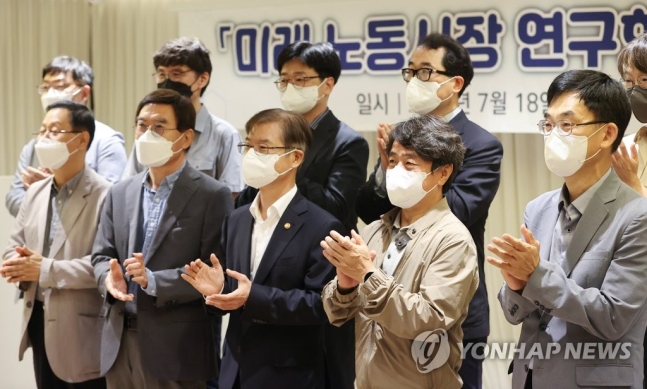
The Future Labor Market Research Group announced this government recommendation at the President Hotel in Jung-gu, Seoul, on the 12th. The research group was launched on July 18 with 12 professors to discuss labor reform tasks to propose to the government. Since the research group's recommendations are expected to be adopted as government policy, the announcement is likely to form the broad framework of the Yoon Suk-yeol administration's 'labor reform,' one of its three major reform tasks.
Subdivision of Extended Working Hours Management Units
The research group stated regarding working hours, "By expanding the autonomous choice rights of labor and management, work efficiency should be increased, and sufficient rest should be ensured to reduce the total amount of working hours." They explained that the current '52-hour workweek system' (basic 40 hours, maximum extended 12 hours) should be reformed, and the management unit for extended working hours should be changed from the current 'week' to 'month, quarter, half-year, year.'
The research group proposed proportionally reducing the total amount of extended working hours to alleviate the burden of long continuous working hours that may arise as the management unit lengthens. Currently, the extended working hours of 12 hours per week amount to 52 hours per month. They suggested allowing 140 hours per quarter (90% of the monthly unit), 250 hours per half-year (80%), and 440 hours per year (70%) of extended working hours.
To prevent long working hours and ensure sufficient rest, the research group also proposed that employers provide workers with 11 consecutive hours of rest between working days. Additionally, the research group recommended expanding the settlement period for the selective working hours system to within three months across all industries so that workers can freely choose their working days and commuting times.
From Seniority-Based Wage System to Job- and Performance-Centered System
Regarding wages, the research group argued that institutional improvements are necessary so that workers can be fairly evaluated and compensated based on job and performance rather than seniority. The group pointed out, "Many domestic companies use the seniority system, where wages automatically increase with each passing year, as the main wage determination method. This restricts new hiring opportunities, negatively affects the employment retention of middle- and older-aged workers, and causes wage gaps between men and women."
They added, "The government should improve the system to allow labor and management to autonomously and rationally choose wage systems suited to their situations and support the design of wage systems for many small and medium-sized enterprises that currently lack them."
Regarding wage systems, the research group proposed ▲ supporting the establishment of wage systems for SMEs and workers ▲ supporting the reform of wage systems by industry ▲ supporting the spread of fair evaluation and compensation ▲ exploring institutional reforms related to wage systems for continued employment of workers aged 60 and above ▲ preventing abuse of inclusive wages ▲ establishing a win-win wage committee.
The Ministry of Labor plans to review the tasks contained in the recommendation and announce a concrete implementation plan, including legislative schedules, by the end of this year or early next year.
© The Asia Business Daily(www.asiae.co.kr). All rights reserved.
![Clutching a Stolen Dior Bag, Saying "I Hate Being Poor but Real"... The Grotesque Con of a "Human Knockoff" [Slate]](https://cwcontent.asiae.co.kr/asiaresize/183/2026021902243444107_1771435474.jpg)















