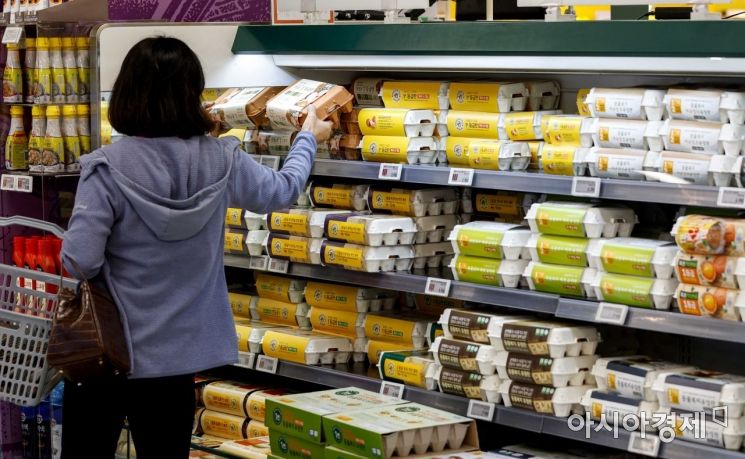
[Asia Economy Sejong=Reporter Son Seon-hee] The price of a carton of eggs (30 eggs) has once again approached the 7,000 won range. As avian influenza (AI) spreads during the winter season, egg prices have shown a clear upward trend for three consecutive months. With prices rising across the board and growing concerns about price instability even for eggs, a staple food on the tables of ordinary people, the government is considering importing eggs from overseas again.
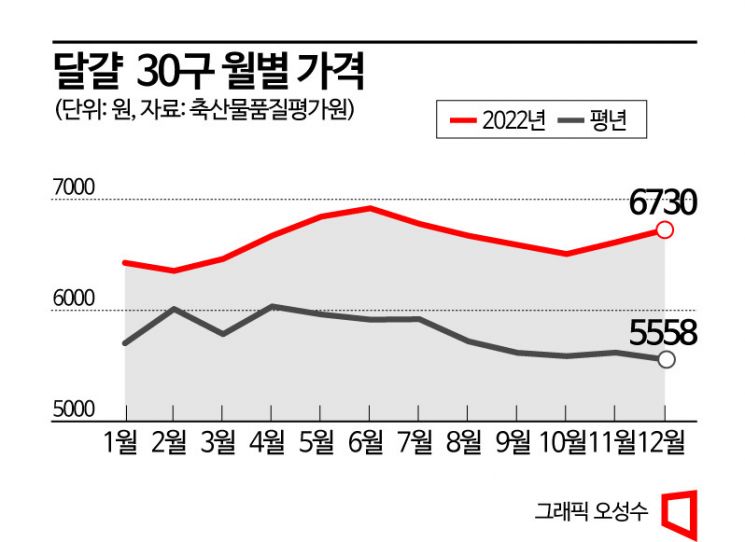
According to the Livestock Products Quality Evaluation Institute on the 12th, the average price of eggs in December (based on 30 special-grade eggs) was 6,730 won, which is more than 1,000 won higher than the average of 5,558 won. Egg prices, which had soared to 6,920 won in June, gradually fell to 6,508 won in October but have risen again by more than 200 won in just two months.
The period when egg prices, which had been stabilizing, started to rise again coincides with the winter AI outbreak season. According to the Ministry of Agriculture, Food and Rural Affairs, since the first AI confirmed case at a poultry farm in Yecheon-gun, Gyeongbuk Province in October, a total of 37 confirmed and suspected cases (36 confirmed, 1 under inspection as of 5 p.m. on December 9) have occurred.
In particular, a total of 96 cases (80 confirmed, 16 under inspection) have been reported among wild birds, which are identified as the main culprits spreading AI as they move from place to place. This year, the number of migratory birds increased by about 17% compared to last year, causing the number of AI detections to surge about fourfold. The government has so far applied a culling radius of 500 meters when AI occurs at poultry farms, but recently expanded this radius to 2 kilometers in some areas such as Muan and Hampyeong in Jeonnam Province, where the risk has increased.
The problem is that the peak AI risk period is still ahead. Park Jeong-hoon, Director of the Quarantine Policy Bureau at the Ministry of Agriculture, Food and Rural Affairs, explained, "December to January is the period when the most winter migratory birds arrive, so the risk is expected to increase further," adding, "Analysis of last year and the year before shows that 66% of all AI cases occurred during this period."
If this trend continues, egg prices are expected to rise to the 7,000 won range soon. Jeong Jae-hwan, Director of Livestock Management, said, "If egg prices exceed 7,000 won, the burden on consumers becomes too great, so we are considering importing fresh eggs." In the past, eggs from the United States were imported in 2017 and last year, but this year, the government is considering diversifying import sources to include not only the U.S. but also Europe and Japan.
However, the government believes the situation is somewhat different from the ‘egg crisis’ that occurred two years ago. During the winter of 2020-2021, the culling radius was very wide (3 km) when AI occurred, which led to an actual shortage in egg supply and price increases. This year, however, the impact of rising production costs is significant, making it difficult to guarantee that importing eggs will stabilize prices. Director Jeong explained, "There is no shortage of supply in the market," adding, "Since all production costs, including feed prices, are rising, prices cannot drop sharply like in previous years even if supply remains unchanged or increases."
© The Asia Business Daily(www.asiae.co.kr). All rights reserved.
![Clutching a Stolen Dior Bag, Saying "I Hate Being Poor but Real"... The Grotesque Con of a "Human Knockoff" [Slate]](https://cwcontent.asiae.co.kr/asiaresize/183/2026021902243444107_1771435474.jpg)
















