Yang Yi-won-young Requests Opposing Debate
"Fuel Costs Not Reflected in Electricity Rates, Deficit Snowballing"
People Power Party Condemns Democratic Party... "Power Market Paralysis, Great Chaos"
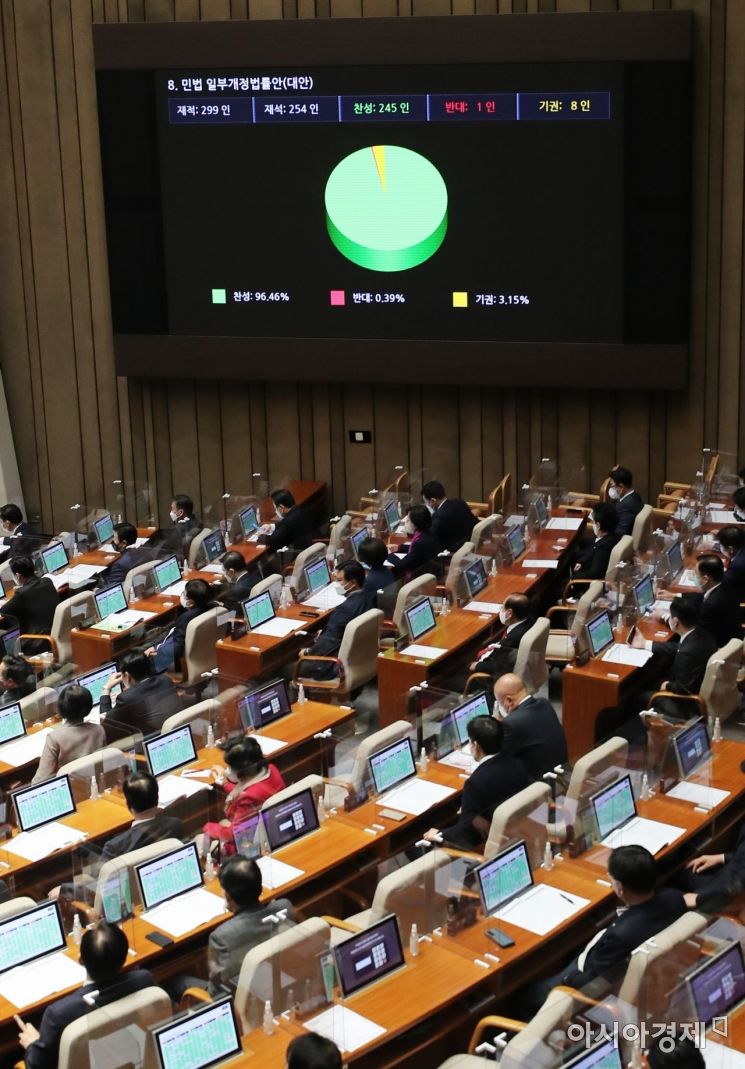 On the 8th, the "Partial Amendment to the Civil Act," which stipulates the unification of the use of full age, was passed in the plenary session of the National Assembly with 245 votes in favor, 1 against, and 8 abstentions out of 254 members present. Photo by Yoon Dong-joo doso7@
[Asia Economy Reporter Hyunju Lee] The partial amendment to the Korea Electric Power Corporation Act (KEPCO Act), which would have raised the issuance limit of Korea Electric Power Corporation bonds (KEPCO bonds) from the current double to five times, was rejected at the National Assembly plenary session on the 8th. This was due to a large number of Democratic Party lawmakers opposing and abstaining from voting, prompting the ruling party to immediately protest and issue a statement.
In the plenary session vote that day, the partial amendment to the KEPCO Act was rejected with 89 votes in favor, 61 against, and 53 abstentions out of 203 members present.
The bill aimed to prevent KEPCO from facing management difficulties. Currently, KEPCO is operating at a loss, and if the large net loss is reflected in the reserves, under current law, KEPCO will no longer be able to issue corporate bonds.
Yang I-won-young, a Democratic Party lawmaker with a background in environmental organizations, requested to speak in opposition that day, stating, "The reason KEPCO has resorted to issuing corporate bonds is because the soaring fuel costs have not been reflected in electricity rates, causing the deficit to balloon like a snowball," urging the rejection of the bill.
She pointed out, "As the deficit accumulates, the scale of corporate bond issuance grows, and to repay the increased interest, more corporate bonds are issued, creating a vicious cycle. KEPCO's interest expenses will ultimately be borne by the public through electricity rate hikes." She especially noted, "Rolling over corporate bonds cannot get KEPCO out of the deficit swamp. KEPCO's financial crisis will also affect the issuance of corporate bonds by other public enterprises."
When the bill, which had passed the committee stage through an agreement between ruling and opposition party floor leaders, was rejected in the plenary session, the ruling party issued a statement criticizing, "We condemn the Democratic Party's behavior of turning even bills promoted through bipartisan agreement into political battles."
Han Mu-kyung, the ruling party floor leader of the Industry, Trade, Small and Medium Enterprises Committee, which oversees the bill, immediately held a press conference, stating, "Due to the Democratic Party's opposition today delaying the amendment of the KEPCO Act, KEPCO will be unable to make timely payments for electricity purchases, risking a major chaos that could paralyze our entire electricity market," and added, "We hope the opposition party will actively cooperate with a responsible attitude as partners in national governance."
Han said, "By around January next year, KEPCO could be on the brink of bankruptcy," and pledged to reintroduce the bill and submit it to the plenary session again.
© The Asia Business Daily(www.asiae.co.kr). All rights reserved.
![Clutching a Stolen Dior Bag, Saying "I Hate Being Poor but Real"... The Grotesque Con of a "Human Knockoff" [Slate]](https://cwcontent.asiae.co.kr/asiaresize/183/2026021902243444107_1771435474.jpg)















