Analysis of Newly Registered Properties by Kaizyu in the Last 3 Months
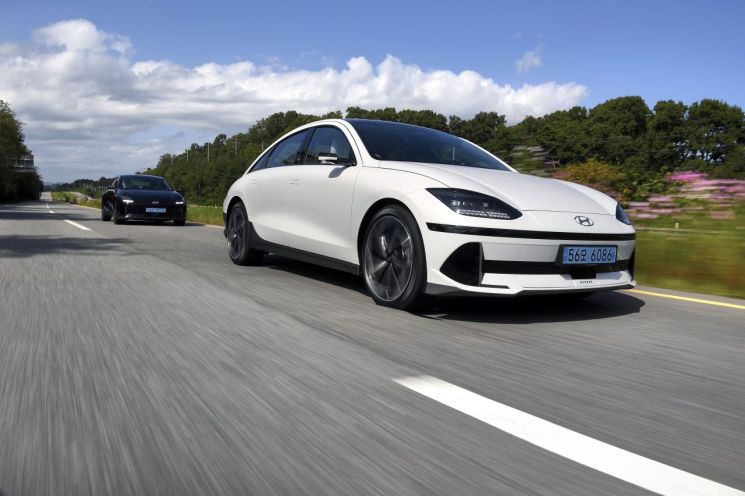
[Asia Economy Reporter Choi Daeyeol] Hyundai Motor's first sedan-type dedicated electric vehicle, the Ioniq 6, has been newly registered nearly 10,000 units in just over three months since its launch. It has sold the most among both domestic and foreign electric vehicles. More than one-third of the sales volume consists of commercial vehicles such as taxis and rentals, driving the overall sales.
According to an analysis of the Ministry of Land, Infrastructure and Transport registration status by Kaizyu Data Research Institute on the 8th, the new registrations of the Ioniq 6 from September to November this year totaled 9,640 units. In November alone, 4,139 units were newly registered. Compared to domestic electric vehicles considered as comparable models, such as the Hyundai Ioniq 5 or Kia EV6, this is more than twice as many.
By usage, private cars accounted for 6,233 units, or 64.7%. Taxis accounted for 1,822 units (18.9%), and rental cars reached 1,582 units (16.4%). This means that about one out of every three newly sold cars was sold as a commercial vehicle.
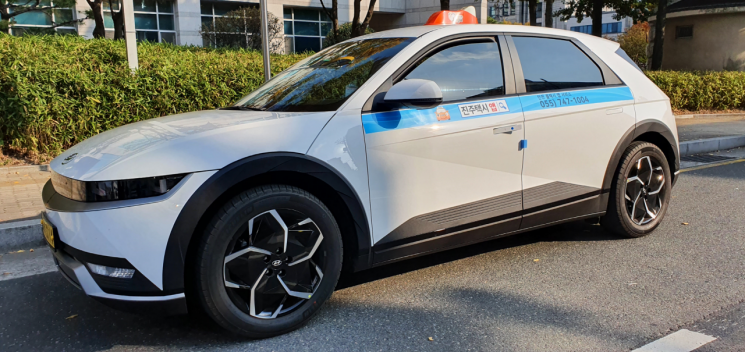 Electric taxi Ioniq 5 operating in a local government area. While the Ioniq 5 has a dedicated commercial model, the Ioniq 6 does not have a separate commercial model.
 The Ioniq 6 attracted attention even before its launch, with more than 37,000 orders placed on the first day of pre-orders alone. It caught eyes with its rare design, top-level aerodynamic performance among mass-produced cars, and electric consumption efficiency. Before the launch, Hyundai Motor’s President Jang Jae-hoon set domestic sales targets at 12,000 units for this year and 50,000 units for next year. At the current pace, it is expected that these goals will be comfortably achieved.
Regarding the company’s quick delivery of commercial vehicles such as taxis, opinions among consumers are divided. While it means the vehicle becomes common on the streets, in the current situation where delivery backlogs have continued for several months, the delivery for general consumers inevitably gets delayed. On the other hand, an advantage is that various defects can be quickly identified through long driving histories from the early stages of mass production models.
Taxis receive larger electric vehicle subsidies because their longer driving distances compared to private cars result in greater emission reduction effects. They also incur lower maintenance costs and are not subject to day restrictions. Consequently, the competition for delivery is fierce. In Seoul, as of this date, the electric vehicle subsidy planned for taxis this year is for 3,000 units, but nearly 3,800 units have already applied to receive the subsidy. The remaining delivery quantity is 149 units, less than 5% left.
© The Asia Business Daily(www.asiae.co.kr). All rights reserved.
![Clutching a Stolen Dior Bag, Saying "I Hate Being Poor but Real"... The Grotesque Con of a "Human Knockoff" [Slate]](https://cwcontent.asiae.co.kr/asiaresize/183/2026021902243444107_1771435474.jpg)












