Korean Highest Score Drops 15 Points from Last Year
Evaluation Institute: "Korean High-Difficulty Questions Had Weak Discriminatory Power"
Math Discriminatory Power Increases, Raising Concerns Over Disadvantages for Liberal Arts Students
English Grades 2 and 3 Decrease, Science and Social Studies Exploration Score Gaps Narrow

[Asia Economy Reporter Han Jinju] In the 2023 College Scholastic Ability Test (CSAT), the math section was as difficult as last year's 'bul-sunung' (extremely difficult test), increasing its discriminative power. There are a total of 3 perfect scorers this year.
According to the CSAT scoring results announced on the 9th by the Korea Institute for Curriculum and Evaluation, the highest standard scores in Korean and math dropped compared to last year. The highest standard score in Korean was 134 points, 15 points lower than last year (149 points). The highest standard score in math was 145 points, 2 points lower than last year (147 points). There are a total of 3 perfect scorers, all of whom took the science inquiry section. Among them, 2 are current students and 1 is a repeat test taker.
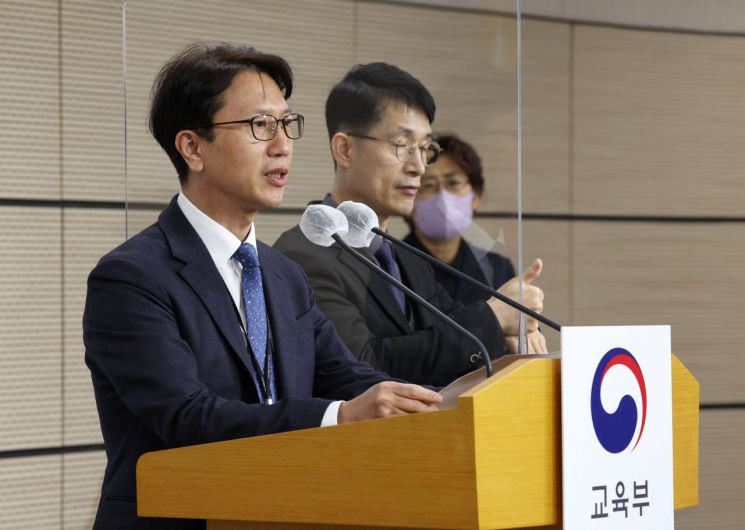 Lee Gyumin, President of the Korea Institute for Curriculum and Evaluation, is briefing on the grading results of the 2023 College Scholastic Ability Test at the Government Complex Sejong on the 8th.
 [Photo by Yonhap News]
This year, the gap between the highest standard scores in Korean and math widened to 11 points. Lee Gyumin, president of the Korea Institute for Curriculum and Evaluation, explained, "It is practically difficult to accurately measure the difficulty differences of elective subjects and reflect them in scores to completely resolve the advantages and disadvantages caused by subject selection. We strive to minimize the gap between the highest standard scores among subjects, but this year the gap was relatively large."
The cutoff for grade 1 was 126 points in Korean and 133 points in math, which are 5 and 4 points lower than last year, respectively. In English, the percentage of grade 1 scorers increased slightly to 7.83% compared to last year (6.25%). However, the percentages for grade 2 (18.67%) and grade 3 (21.75%) decreased compared to last year's 2nd grade (21.64%) and 3rd grade (25.16%).
The score gap between the highest standard score and the grade 1 cutoff in Korean narrowed from 18 points last year to 8 points this year, indicating very low discriminative power. There were also criticisms that the difficulty adjustment failed as the Korean section was easier than in the June and September mock tests.
Moon Youngju, head of the CSAT division at the institute, explained, "Last year, there were many opinions that the Korean section was too difficult, so this year, in the process of finding an appropriate difficulty level, the function to distinguish top students in high-difficulty questions weakened, resulting in a relatively easy highest score."
Regarding the civic group's claim that 8 math questions exceeded the current high school curriculum level, Moon Youngju stated, "Having difficult questions and violating the curriculum are different issues. Even content included in the curriculum can be presented with varying difficulty levels, and there was no violation of the curriculum. The curriculum basis for each question will be disclosed tomorrow."
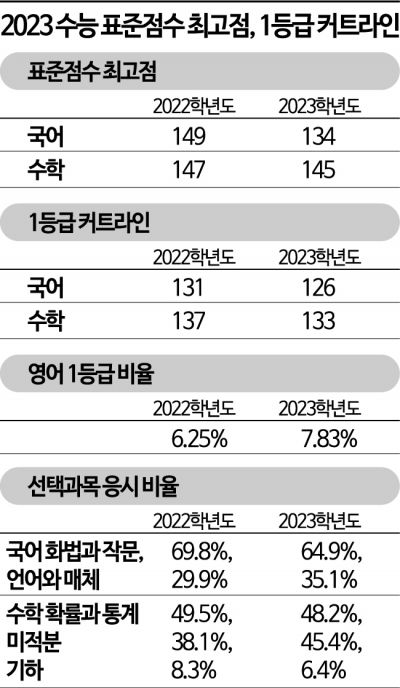
According to the CSAT scoring results, the percentage of students who received grade 1 was slightly lower than last year in both Korean (4.01%) and math (4.20%). The number of students who achieved the highest standard score in Korean (371) increased 13 times compared to last year (28), while in math (934), it decreased to one-third of last year's number (2702).
Lim Seongho, CEO of Jongro Academy, explained, "Although the highest standard score decreased, making the test easier on average, the drop in the grade 1 cutoff means that discriminative power was secured for top students. Korean was easy, but math's 'killer questions' functioned normally, making it difficult for top students."
Since last year, the CSAT has been integrated for humanities and sciences, but schools still operate by dividing students into humanities and sciences. With the increased discriminative power in math, the 'science dominance' and cross-application from humanities to sciences are expected to be more prominent than last year.
Moon Youngju, head of the CSAT division, said, "It is difficult for the institute to respond on how the CSAT results will be used in university admissions. The CSAT system was announced four years ago, and current high school freshmen are studying accordingly. Even if there are unreasonable points or problems, the system cannot be suddenly changed."
In the inquiry section, the average score gap between the highest scores in social studies and science decreased to 1 point from last year's 5 points, which had caused controversy over advantages and disadvantages. The highest scores in social studies with high selection rates were 72 points for Life and Ethics, 67 points for Korean Geography, and in science inquiry, Chemistry I, Biology I, and Earth Science I scored 75, 72, and 73 points respectively. Chemistry I (75 points) had the highest score in science inquiry, and Politics and Law (74 points) had the highest in social studies. The lowest highest scores were Earth Science II (67 points) and East Asian History (65 points). Discriminative power in math and inquiry sections is expected to be higher among top students than in previous years.
Kim Byungjin, director of the Etoos Education Evaluation Research Institute, explained, "The discriminative power of math increased compared to last year, and the previously difficult social studies secured certain discriminative power, which will be a major variable in regular admissions. Students who chose calculus, geometry, and science inquiry last year may face restrictions when applying to humanities departments. Also, the decrease in English grade 2 and 3 scorers may have some impact."
 On the 17th, the day of the 2023 College Scholastic Ability Test, examinees are waiting for the exam to start at the testing site set up at Gyeongbok High School in Jongno-gu, Seoul. Photo by Jinhyung Kang aymsdream@
This year, the percentage of repeat test takers was 31%, the highest since the current CSAT system was introduced in 2005. The number of CSAT test takers was 447,669, a decrease of 469 from last year. Current students decreased by 10,409 to 308,284 (68.9%), while graduates and GED holders increased by 9,940 to 139,385 (31.1%).
CEO Lim said, "With the sharp increase in repeat test takers, their dominance is expected this year, and cross-application between sciences and humanities is likely to occur more significantly than last year."
Entering the second year of the integrated CSAT, with cross-application emerging as a variable, test takers need to carefully analyze university-specific converted standard scores and converted scores to devise admission strategies.
Kim Changmuk, a counselor at Kyungshin High School, advised, "Last year, universities such as Sungkyunkwan University, Chung-Ang University humanities departments, and Dongguk University adjusted converted standard scores to reduce advantages and disadvantages between social and science inquiries, making it less favorable for students crossing from sciences to humanities. Although CSAT scores are finalized, university converted scores are still evolving, and since converted standard scores must be released to confirm, students should wait for early admission results and review various data to gauge their chances."
© The Asia Business Daily(www.asiae.co.kr). All rights reserved.
![Clutching a Stolen Dior Bag, Saying "I Hate Being Poor but Real"... The Grotesque Con of a "Human Knockoff" [Slate]](https://cwcontent.asiae.co.kr/asiaresize/183/2026021902243444107_1771435474.jpg)

















