Significant Gap Between Ruling and Opposition on Reduction Amount
Democratic Party Proposes Over 5 Trillion vs Government and Ruling Party Favor 3 Trillion Reduction
Differences Persist on Corporate Tax and Capital Gains Tax
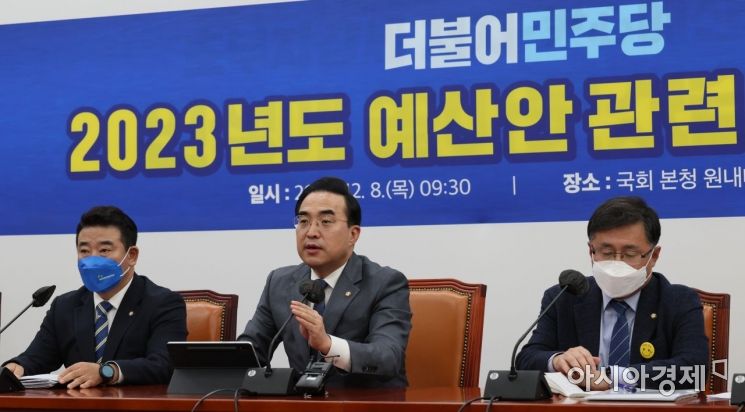 Park Hong-geun, floor leader of the Democratic Party of Korea, holds a '2023 Budget Proposal Press Conference' at the National Assembly on the 8th. Photo by Yoon Dong-joo doso7@
[Asia Economy reporters Naju-seok and Park Joon-yi] The Democratic Party of Korea warned on the 8th that it would submit a unilateral amendment focused on budget cuts as negotiations on next year's budget bill have reached a deadlock. The Democratic Party notified that the withdrawal of ultra-rich tax cuts and securing the livelihood budget are their 'final proposals.' While agreements have been reached on income tax and comprehensive real estate tax related to tax laws, issues regarding corporate tax and capital gains tax on stocks remain at an impasse.
Park Hong-geun, the floor leader of the Democratic Party, canceled the originally scheduled policy coordination meeting at the National Assembly that day and held an emergency press conference, warning, "If the government and ruling party ultimately reject our Democratic Party's 'final proposal' of 'withdrawing ultra-rich tax cuts and securing the maximum possible reduction to significantly increase the livelihood budget,' we clearly state that we have no choice but to submit a 'unilateral amendment.'"
Park said, "Negotiations continued late into last night, but due to the government's 'recklessness' and the ruling party's 'foot-dragging,' it is difficult to take even a single step forward," adding, "In negotiations between the floor leaders and policy committee chairs of both parties, the government insists that this budget reflects unique characteristics of revenue and expenditure different from previous years and almost refuses to acknowledge the National Assembly's constitutional right to reduce the budget."
Typically, the National Assembly secures budget through reduction reviews of the government's budget proposal and then increases the budget for projects deemed necessary. Since the right to review budget reductions lies with the National Assembly and the right to approve increases lies with the government, the budget is reviewed through a process requiring government approval for the budget secured by reductions. Park said, "During the five years of the Moon Jae-in administration, when the main budget was smaller, the National Assembly reduced an average of 5.1 trillion won excluding simple accounting transfers," adding, "Considering such common precedents, it is highly questionable whether the current government and ruling party are truly willing to process the budget bill." Earlier, Joo Ho-young, floor leader of the People Power Party, explained at an emergency committee meeting, "This time, since the scale of government bond issuance has been drastically reduced, there is no agreement as they say it is impossible to cut more than 3 trillion won."
Park also stated that they will take care of ▲basic pension combined for couples ▲support for restoring financial services for the underprivileged ▲support for socially vulnerable groups ▲local love gift certificates ▲public rental housing ▲renewable energy ▲agricultural support budgets.
Regarding the timing of submitting a unilateral amendment in case of negotiation failure, he said, "Although the legal deadline was missed, it is difficult for the public to accept missing even the regular session deadline," adding, "After today's and tomorrow's party meetings, and tomorrow's supreme council and floor opinions, we may finally submit a unilateral amendment tomorrow morning." Since the current budget system requires government approval for increases, the Democratic Party has prepared a unilateral amendment to cut the budget for problematic projects in the budget bill.
Park Jung, the Democratic Party's budget and accounts special committee secretary, explained, "During negotiations, we made significant concessions on the Blue House opening budget, accepted the government's proposals on nuclear power and new renewable energy, did not cut the Board of Audit and Inspection's budget, and reduced the Presidential Office budget to a minimum," adding, "The government and ruling party are not accepting demands related to the scale of cuts or livelihood issues such as local love gift certificates."
Regarding tax laws, some agreements have been reached through negotiations between secretaries of the Planning and Finance Committee, but significant differences remain on key issues.
.
Shin Dong-geun, the Democratic Party's Planning and Finance Committee secretary, confirmed that regarding earned income tax, "We accepted the government's position to expand the bracket where the minimum tax rate of 6% applies from 12 million won to 14 million won." Regarding the comprehensive real estate tax, he said, "We corrected the excessive disadvantage faced by low-priced two-homeowners compared to high-priced single homeowners and maintained the principle of imposing heavy taxation on owners of three homes," adding, "We proposed raising the standard for single homeowners to 1.2 billion won and lowering the tax rate, while increasing the fair market value ratio from 60% to 80%." Accordingly, two-homeowners, including those in regulated areas, are excluded from the heavy taxation target.
However, there remains a large gap between the ruling and opposition parties on corporate tax and capital gains tax on stocks, and discussions are ongoing at the floor leader level. Shin explained, "Regarding corporate tax, the ruling party wants to gradually lower the top rate to 22% for companies with operating profits over 300 billion won, but we insist on not accepting anything below 25%." Regarding capital gains tax on stocks, he criticized, "We discussed a phased reduction considering that if the stock transaction tax is lowered to 0.15%, it would be unbearable, but the government and ruling party are only interested in raising the capital gains tax threshold from 1 billion won to 10 billion won." Inheritance and gift tax are expected to be discussed further next year.
© The Asia Business Daily(www.asiae.co.kr). All rights reserved.
![Clutching a Stolen Dior Bag, Saying "I Hate Being Poor but Real"... The Grotesque Con of a "Human Knockoff" [Slate]](https://cwcontent.asiae.co.kr/asiaresize/183/2026021902243444107_1771435474.jpg)
















