Dollar Liquidity Reduction Decreases Capital Inflows to Emerging Markets
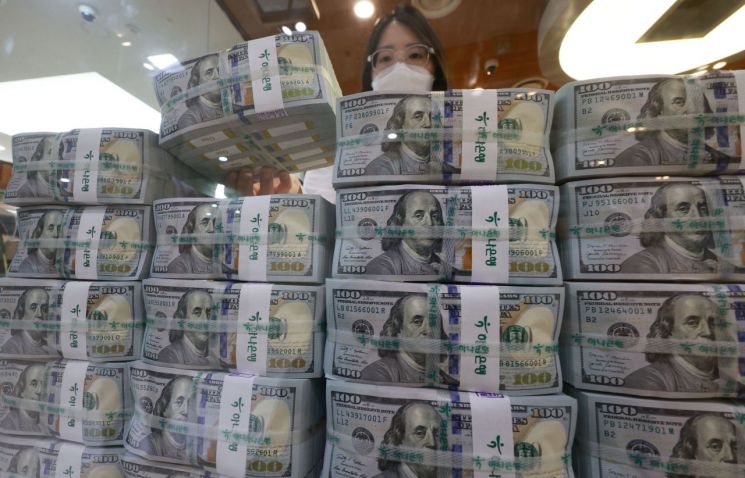 Employees organizing US dollars at the Counterfeit Response Center of Hana Bank Headquarters in Euljiro, Jung-gu, Seoul [Image source=Yonhap News]
The Bank of Korea forecasted that if dollar liquidity worsens further due to the quantitative tightening by the U.S. Federal Reserve (Fed), it could become difficult to procure foreign currency funds domestically.
On the 8th, the Bank of Korea explained in its Monetary and Credit Policy Report, "Global U.S. dollar liquidity has recently contracted due to the Fed's monetary policy tightening and other factors."
According to the Bank of Korea, since the second quarter of this year, U.S. money supply (M2) and the Fed's balance sheet (B/S) have decreased, and the amount of dollar funds raised by non-bank borrowers such as governments, corporations, and non-bank financial companies outside the U.S. has also shrunk.
As U.S. monetary tightening reduces the supply of dollars, liquidity conditions in the U.S. Treasury market are also deteriorating. This is because the Fed's quantitative tightening has reduced the fundamental demand for Treasury purchases, and the continued outlook for policy rate hikes has led major investors to sell Treasuries, weakening the demand base.
The Bank of Korea explained, "In a situation where liquidity in the U.S. Treasury market has worsened, if shocks such as a sudden surge in global dollar demand occur, the dollar fund intermediation function using banks' holdings of Treasuries may deteriorate, which could act as a factor that contracts the overall offshore dollar funding market."
Since the second quarter, global banks' cross-border dollar credit supply has also turned to a decline, centered on European banks. If dollar credit supply shrinks and dollar-denominated liabilities exceed assets, rising dollar funding costs could lead to an expansion of dollar liquidity risks for European banks.
The Bank of Korea analyzed that the reduction in dollar liquidity could act as a factor that decreases capital inflows to emerging markets or increases capital outflows.
Dollar liquidity flows into the domestic market through the banking sector via domestic banks' external borrowings, foreign bank branches' external borrowings, and swap fund supply by overseas banks linked to domestic bond investments, and in the non-banking sector, mainly through corporate foreign currency bond issuance.
The Bank of Korea explained that so far, capital inflows into the domestic market through both banking and non-banking sectors have continued, so the impact of the global contraction in U.S. dollar liquidity is limited.
In the banking sector, external borrowings have generally increased, centered on domestic banks, maintaining favorable external borrowing conditions backed by high external creditworthiness.
However, in the non-banking sector, although a net issuance trend of securities centered on public enterprises has continued, issuance conditions are showing signs of deterioration, such as a sharp rise in foreign currency bond spreads for some companies due to issues related to Gangwon-do real estate project financing (PF) asset-backed commercial paper (ABCP).
The Bank of Korea stated, "It is necessary to be cautious that domestic foreign currency funding conditions may worsen as the Fed's quantitative tightening continues and the global U.S. dollar liquidity contraction intensifies."
© The Asia Business Daily(www.asiae.co.kr). All rights reserved.
![Clutching a Stolen Dior Bag, Saying "I Hate Being Poor but Real"... The Grotesque Con of a "Human Knockoff" [Slate]](https://cwcontent.asiae.co.kr/asiaresize/183/2026021902243444107_1771435474.jpg)
















