Bio, Battery, and Display Site 'Hong Gil-dong'
Rich DB... Self-Learning of Text, Tables, and Images
Capacity Reduced by 63% and Speed Increased by 40%
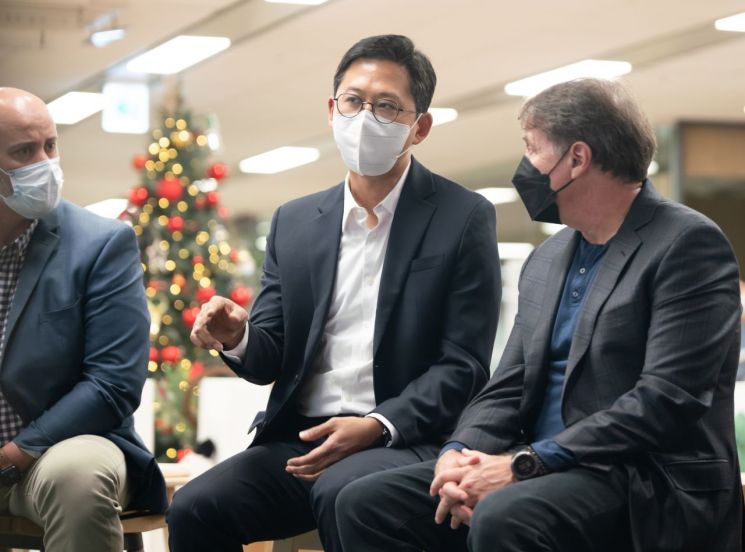 Baek Gyeong-hoon, Head of LG Artificial Intelligence (AI) Research Institute (center), is seen talking with Paul Hennessy, CEO of Shutterstock, who visited the research institute (right). (Photo by LG)
[Asia Economy Reporter Moon Chaeseok]
#A problem solver that predicts neoantigens killing cancer cells inside patients' bodies has emerged. There is no need for humans to conduct experiments on the nearly infinite number of possible cases. Who achieved this? It is LG's super-large-scale artificial intelligence (AI) 'Exaone'.
On the 8th, LG Group shared these technological research achievements under the theme of 'Challenges and Innovations for Developing Expert AI' at the online 'LG AI Talk Concert' commemorating the 2nd anniversary of its AI Research Institute. The focus is on revealing cases where the rich database (DB) and learning capabilities accumulated over two years have been practically applied in LG Group's core businesses such as bio, electric vehicle batteries, and displays.
The most notable contribution of Exaone during the research presentation was the introduction of a personalized vaccine neoantigen AI model in the bio field. Previously, optimal vaccine candidate substances or compounds that could change the industry landscape were found or simulated by humans one by one, which took a lot of time and cost.
The researchers developed an AI model that predicts neoantigens inducing the death of cancer cells. It utilized patients' genetic information and mutation data of cancer cells. It was explained that the performance was higher than other prediction models. A research institute official said, "It will significantly shorten the development period of personalized anticancer vaccines."
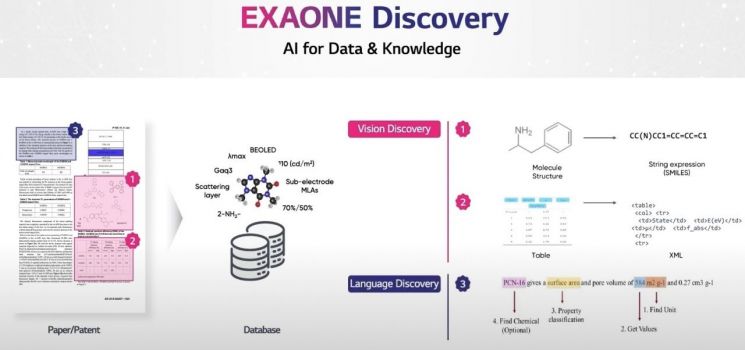 LG's ultra-large AI 'Exaone' is building a foundation for solving complex problems by learning from specialized documents such as papers and patents. (Source: LG)
Achievements related to the next-generation battery, the 'lithium-sulfur battery electrolyte,' also stand out. An AI model was implemented to find electrolyte compounds optimized for lithium-sulfur batteries. Lithium-sulfur batteries use lithium sulfide as the cathode material and are reported to increase capacity about five times compared to conventional lithium-ion batteries.
Exaone also contributed to discovering high-efficiency light-emitting materials for OLEDs, considered the future growth engine of the display business. Exaone is structured to predict the performance of next-generation OLED light-emitting materials. It is currently verifying highly promising candidate substances. The demand for 'light-emitting materials' is high, as evidenced by the recent proposal to the government for international research and development (R&D) on foldable OLED core materials for the first time in 32 years by the Display Materials Subcommittee, which consists of 18 major domestic display material companies, and the Korea Display Industry Association. Exaone has supported this effort.
The AI's unique function of extensively reviewing and database-building professional literature such as papers was maximized. Exaone is equipped with technology that autonomously learns and databases not only texts like papers and patents but also formulas, tables, and images. There is also an expectation that it will enable 'innovation' by expanding the scope and speed of new drug and new material development. Recently, it was announced at the US AI conference 'NeurIPS' that the technology for database-building chemical data outperforms existing models by more than 100 times.
Exaone's active role is expected to continue. It achieved results that reduce usage capacity while increasing inference speed compared to the Exaone released last year. According to the research institute, GPU usage was reduced by 63% compared to last year's Exaone, while inference speed increased by 40%. Accuracy was improved beyond 'SOTA (State-of-the-art),' meaning the world's best.
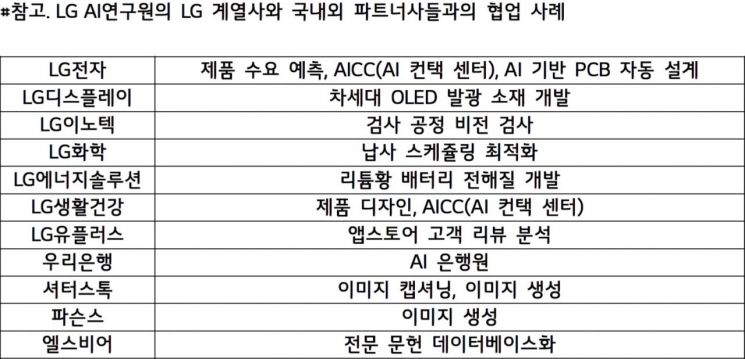 Collaboration cases between LG Artificial Intelligence (AI) researchers, LG affiliates, and domestic and international partners. (Source: LG)
Platforms such as 'Universe (language)' and 'Atelier (creation),' which can be used by non-experts, were also unveiled. The pace of industry-academia cooperation is also accelerating. The research institute is already jointly researching generative AI technology with 'Parsons,' one of the world's top three design schools, and 'Shutterstock,' a global creative platform company. They plan to expand collaboration targets and areas.
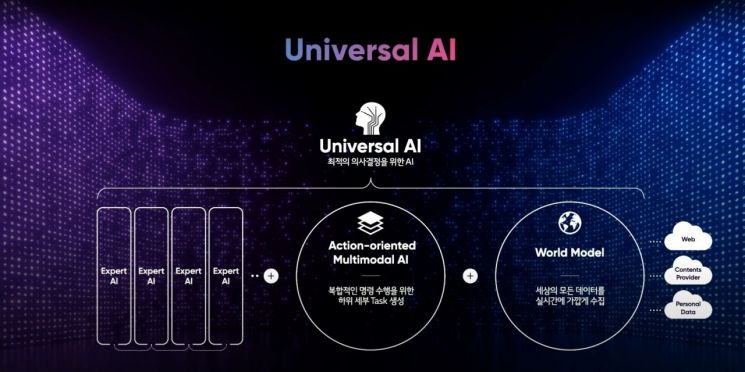
Research Director Baek Hoon Cha said, "The role of 'expert AI' that LG aims for is to cooperate with humans to solve humanity's challenges and create 'new customer value that did not exist before.' We are conducting research with the goal of implementing 'universal AI,' expert AI that utilizes the world's knowledge in real-time to solve complex real-world problems and assist optimal decision-making."
Since CEO Koo Kwang-mo took office, LG has identified 'AI' as one pillar of the group's future business portfolio. To promote technological innovation and talent acquisition, it plans to invest 3.6 trillion won in AI and data research and development over five years.
© The Asia Business Daily(www.asiae.co.kr). All rights reserved.
![Clutching a Stolen Dior Bag, Saying "I Hate Being Poor but Real"... The Grotesque Con of a "Human Knockoff" [Slate]](https://cwcontent.asiae.co.kr/asiaresize/183/2026021902243444107_1771435474.jpg)


















