Recent Profit-Taking Sales Appear... Slight Adjustment
Reopening Expectations Suggest Continued Strength for Now
[Asia Economy Reporter Kwon Jaehee] Stocks related to China are fluctuating amid expectations of easing China's zero-COVID policy. Not only cosmetics-related stocks but also duty-free, casino, and travel sectors have generally been on the rise, although recently there has been a slight correction due to profit-taking. Experts predict that China-related stocks will continue to show strength for the time being.
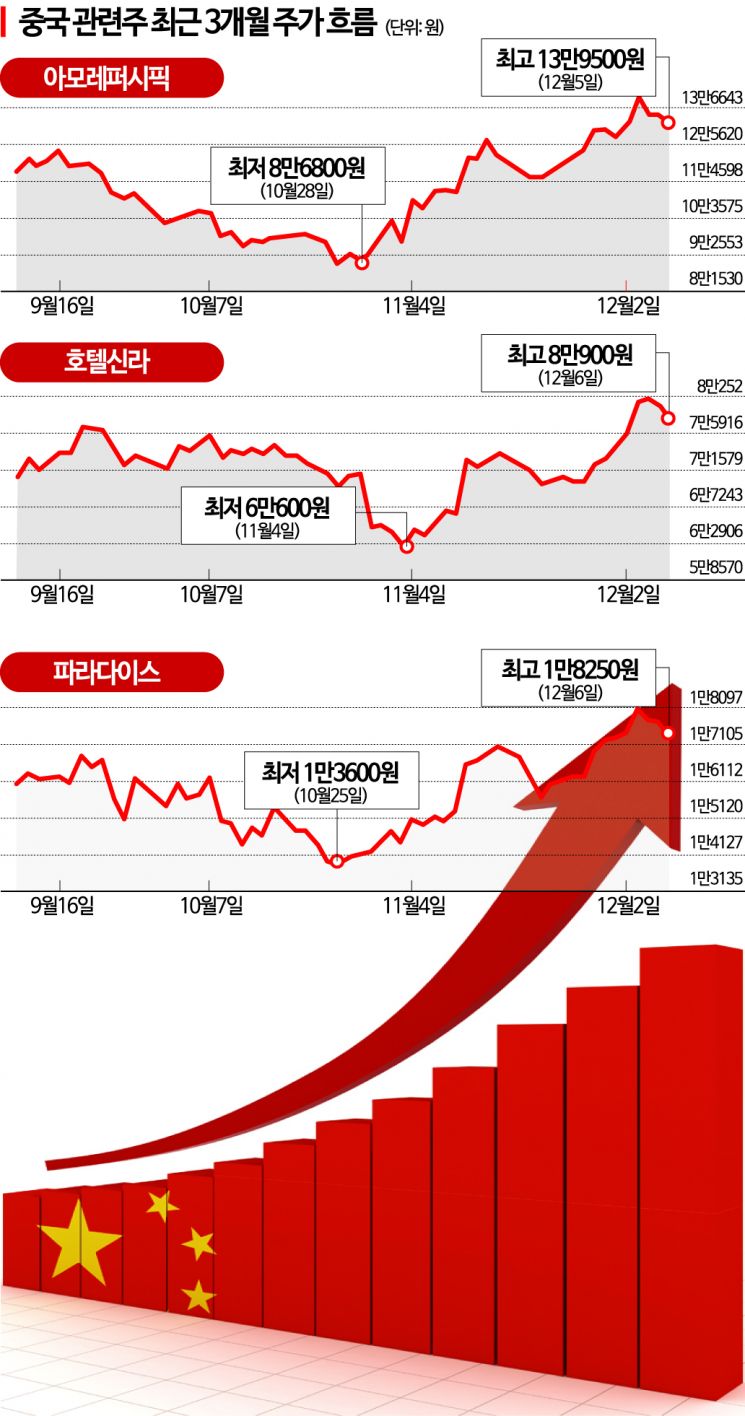
According to the Korea Exchange on the 8th, as of 9:05 a.m., Amorepacific was trading at 135,500 KRW, up 0.37% from the previous trading day. Since hitting a low of 86,800 KRW on October 28, the stock has steadily risen, reaching a high of 139,500 KRW on the 5th of this month. It closed lower over the past two trading days, which is interpreted as a result of profit-taking. LG Household & Health Care traded at 678,000 KRW, down 2.16% from the previous day. It has steadily risen from a low of 499,500 KRW on October 28 to a peak of 720,000 KRW on the 5th of this month.
Duty-free related stocks such as Hotel Shilla and Shinsegae have also surged sharply in a short period recently, followed by slight corrections due to profit-taking. Hotel Shilla recorded this year's lowest point at 60,600 KRW on the 4th of last month but closed at 79,300 KRW the day before. After steadily rising for seven trading days, it turned to a slight decline. As of 9:07 a.m. on the day, it recorded 77,800 KRW, down 1.89%. Shinsegae, which rose 3.36% from the previous day, was trading at 227,500 KRW at the same time, down 1.30%.
Travel and casino-related stocks are also strong. Norangpungseon continued its upward trend for five consecutive trading days, and Hanatour and Paradise have risen about 22% and 30%, respectively, from this year's lows.
As blank protests, which began as collective resistance to strict quarantine measures, spread, Chinese authorities are hastening to ease these measures. This is because the zero-COVID policy has recently failed to curb the rapid increase in confirmed cases. Additionally, the prolonged zero-COVID policy has adversely affected the Chinese economy, which is cited as a reason for the Chinese government's shift toward easing quarantine policies.
Lee Jae-sun, a researcher at Hyundai Motor Securities, said, "Due to the domestic demand slump caused by China's strict quarantine policies, it is becoming increasingly difficult to defend growth," and analyzed, "China's easing of quarantine measures will be a positive factor for Korean companies, for which China accounts for 7.5% of overseas demand."
In the securities industry, it is expected that stocks related to China's reopening (resumption of economic activities) will remain strong for the time being. In particular, there is a high possibility that the Chinese government will abolish the zero-COVID policy around March next year, when the National People's Congress is held. It is forecasted that the easing of regulations will proceed in the order of PCR test regulation relaxation, regional lockdown easing, and relaxation of entry and movement restrictions. Jeon Jong-gyu, a researcher at Samsung Securities, said, "It is clear that China's quarantine policy has shifted to gradual reopening," and analyzed, "The Lunar New Year in January and the National People's Congress in March next year will be important turning points."
© The Asia Business Daily(www.asiae.co.kr). All rights reserved.
![Clutching a Stolen Dior Bag, Saying "I Hate Being Poor but Real"... The Grotesque Con of a "Human Knockoff" [Slate]](https://cwcontent.asiae.co.kr/asiaresize/183/2026021902243444107_1771435474.jpg)















