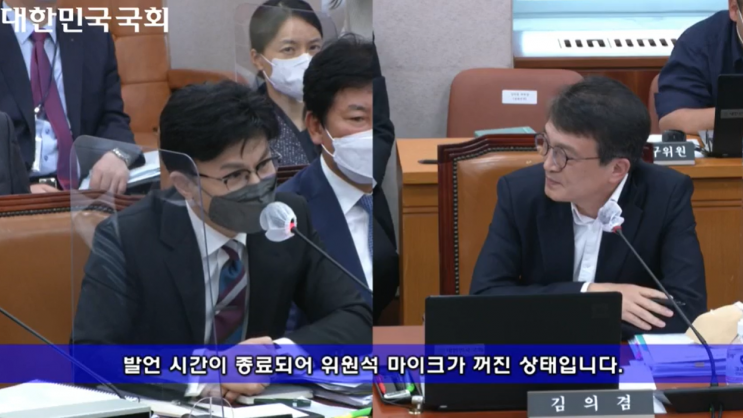
 On October 24th, during the comprehensive audit of the National Assembly's Legislation and Judiciary Committee, Minister of Justice Han Dong-hoon is responding to a question from Kim Eui-gyeom, a member of the Democratic Party of Korea. Photo by National Assembly Broadcast Screen Capture.
[Asia Economy Reporter Choi Seok-jin, Legal Affairs Specialist] Interest is gathering on whether Kim Eui-gyeom, a Democratic Party lawmaker who raised the so-called 'Cheongdam-dong drinking party' allegations and has been criminally sued and faced a civil lawsuit demanding 1 billion KRW in damages by Minister of Justice Han Dong-hoon, can evade responsibility through the parliamentary immunity granted to lawmakers.
In the legal community, opinions coexist. Some believe parliamentary immunity will apply this time as well, considering the constitutional intent to guarantee immunity to lawmakers and the Supreme Court precedents that have relatively broadly recognized immunity. Others argue that, given the source and content of the tip-off and Kim lawmaker's fact-checking efforts, this case falls outside the scope of parliamentary immunity.
Legal experts foresee that whether Kim lawmaker was somewhat aware that the tip-off content might be false and what fact-checking procedures he undertook before revealing the allegations will be crucial. There is also a prospect that the court may present more specific standards regarding the scope of parliamentary immunity through this case.
Personal Punishment Exemption... Excluding Casual or Insulting Remarks
Article 45 of the Constitution stipulates that "A member of the National Assembly shall not be held liable outside the National Assembly for any speech or vote conducted in the course of their duties."
Parliamentary immunity is not a requirement that prevents the establishment of criminal offenses or civil torts like a justification under criminal law, but a privilege that exempts lawmakers from civil and criminal liability under certain conditions. Criminally, it corresponds to a personal (人的) punishment exemption that prevents the exercise of penal authority, so even if a crime is established, investigative agencies cannot prosecute. However, accomplices who instigate or aid lawmakers to commit crimes can be punished.
Even statements made within the National Assembly that are unrelated to official duties, such as casual talk or insulting language, are not covered by parliamentary immunity. Article 146 of the National Assembly Act (Prohibition of Insulting Remarks) states, "A member shall not insult others or make statements about others' private lives in plenary sessions or committees," and violation of this is subject to disciplinary action under Article 155(9) of the same law.
This case concerns statements made by Kim lawmaker at the comprehensive audit of the Legislation and Judiciary Committee in October, so the requirement of "within the National Assembly" is met. Regarding whether the allegation that "President Yoon Seok-youl and Minister Han held a drinking party past midnight with about 30 lawyers from Kim & Chang" can be seen as related to the lawmaker's duties, the prevailing opinion is that it is related to official duties since it was not a question about their private drinking party but whether there was a gathering with multiple lawyers from a specific law firm.
Supreme Court: "Defamation Knowing It Was Clearly False Is Not Covered by Immunity"
The Supreme Court holds the position that "Questions or inquiries made by lawmakers to ministers or government officials at National Assembly committees or audits are naturally covered by parliamentary immunity as they are for collecting information necessary for legislative activities and performing government oversight functions."
In 2007, the Supreme Court ruled in a damages claim case filed by former Blue House Senior Secretary for Civil Affairs Lee Ho-cheol against former Grand National Party lawmaker Heo Tae-yeol, who raised suspicions about Lee's involvement in the Sun & Moon case, that "Considering the purpose and intent of parliamentary immunity, it cannot be said that immunity applies to cases where the content of the statement is clearly unrelated to official duties or where the speaker knowingly defames another by stating false facts. However, if the speaker did not recognize that the statement was false, even if the statement lacked some basis or the investigation to verify its truthfulness was insufficient, as long as it was made in the course of official duties, it is covered by parliamentary immunity."
Among lower court rulings, in 2004, the Seoul Central District Court denied damages claims filed by Lee Cheol-woo, then a Uri Party lawmaker, against three Grand National Party lawmakers including Joo Sung-young and Kim Ki-hyun, who claimed to have been former North Korean Workers' Party members. The court found that "the intent was to oppose the abolition of the National Security Act, not to personally defame or attack the plaintiff. Considering the content, basis, and context of the statements, it is difficult to conclude that the statements were maliciously false to defame the plaintiff. Moreover, as the statements were recognized as official or incidental to official duties, even if they contained falsehoods, they are within the scope of parliamentary immunity."
"Questions, Not Definitive Statements, Recognized for Public Interest" vs. "High Possibility of Awareness of Falsehood"
On the 8th, Attorney Roh Young-hee of Gangnam Law Firm said, "I naturally think parliamentary immunity applies. For example, if Kim lawmaker believed the statements to be true or had various grounds to believe so, his remarks to Minister Han were more like asking 'Did you go then?' rather than definitively saying 'You did that.' If the questioned content were true, it would imply inappropriate meetings with interested parties, making it a very important matter from a public interest perspective."
She added, "More importantly, at that time, Kim lawmaker tried to contact a person called a cellist but couldn't reach them, and then contacted Lee Se-chang. Listening to Lee Se-chang's initial recorded call, it acknowledged that such a drinking party took place. Considering that lawmakers have no investigative authority, it is hard to see Kim lawmaker's questioning under those circumstances as intentionally trying to embarrass the other party while knowingly making false statements."
On the other hand, Professor A, who specializes in constitutional law, said, "Parliamentary immunity was historically granted to ensure that lawmakers, as representatives of the people, could freely debate without pressure from authorities or the executive branch. However, it does not apply when the speaker knowingly makes clearly false statements. In Germany, for example, defamation is explicitly excluded from immunity."
He continued, "For instance, it would be problematic if explosive issues were raised in parliament without any verification, defaming others. In this case, the tip-off was based on secretly recorded files without the other party's consent. It is highly suspicious whether a president, who always has multiple bodyguards, would privately visit such a bar, or whether an event with 30 Kim & Chang lawyers gathering at a bar actually occurred. Yet, the content was openly disclosed, which seems excessive."
He said, "This was a serious issue that could morally criticize not only Minister Han but also the current administration, and since the source itself was incomplete, at least minimal verification should have been done. Although lawmakers are not investigators, they should have at least confirmed basic facts such as whether such a bar existed or whether a drinking party with 30 Kim & Chang lawyers took place, even through aides, before raising allegations. If the recording was simply played in the National Assembly without such procedures, it would be difficult to apply parliamentary immunity and the matter should be handled as a general criminal case."
Finally, Professor A said, "From the court's perspective, there will inevitably be concern about whether to set a precedent limiting parliamentary immunity through this case. While Kim lawmaker's case seems to exceed the scope of immunity, if a precedent limiting immunity is established, lawmakers may become restrained in the future. If I were a judge, I would impose many conditions to limit the scope of immunity. There is a possibility that an important precedent regarding parliamentary immunity will emerge through this case."
Active lawmaker B, a former lawyer, said, "Kim lawmaker will claim he had no awareness of falsehood or intent to defame, but considering the tip-off was about a third party's conversation, the location was unspecified, and the idea that the president and minister would attend a gathering of 30 lawyers is hard to believe, it seems likely that Kim, a former journalist, was aware of the possibility of falsehood and still exposed it. The court's denial of immunity seems at least fifty-fifty."
Active presiding judge C said, "If he heard it from a boyfriend, he should have confirmed with the girlfriend, the cellist, to directly ask and verify the actual situation of the drinking party before writing an article or raising suspicions. It seems there was some recklessness in making such a statement that caused a big stir."
C added, "Not always, but generally when criminal and civil trials proceed simultaneously, civil trials are postponed until the criminal trial verdict is reached. Usually, after the first instance criminal verdict, the civil trial proceeds. If convicted, the defendant appeals; if acquitted, the plaintiff appeals, so the trial is often postponed until the appeal verdict."
The requirements for defamation under criminal law and liability for damages under civil tort law differ, but in practice, if guilt is recognized in a criminal trial, tort liability is usually recognized in civil trials as well.
The Tam Investigation, Tip-Off Providers Not Covered by Immunity
Meanwhile, The Tam Investigation, which was also sued criminally and civilly by Minister Han along with Kim lawmaker, and the tip-off providers related to this allegation do not have parliamentary immunity and must be separately held civilly and criminally liable.
The Supreme Court recognizes the establishment of indirect perpetration of defamation by tip-off providers who report false facts to media companies leading to publication, which is punishable more severely than general defamation. Of course, intent is required, such as the tip-off provider knowing the content was false or aware of the possibility of falsehood.
If the tip-off provider did not know the content was false and used the media company to report it, the media company is not punished but the tip-off provider is punished as an indirect perpetrator. If both the tip-off provider and media company recognized the possibility of falsehood and conspired to report, they are punished as joint perpetrators.
For media companies or journalists, civil and criminal liability depends on whether they intended to defame the victim, whether they recognized or accepted the possibility of falsehood, and the extent of their efforts to verify facts.
If the reported content is true, or there is substantial reason to believe it is true and it is recognized as being in the public interest, illegality is excluded under Article 310 of the Criminal Act, and no punishment is imposed.
© The Asia Business Daily(www.asiae.co.kr). All rights reserved.
![Clutching a Stolen Dior Bag, Saying "I Hate Being Poor but Real"... The Grotesque Con of a "Human Knockoff" [Slate]](https://cwcontent.asiae.co.kr/asiaresize/183/2026021902243444107_1771435474.jpg)















