BN.1 Variant Detection Rate Jumps 5.5%p from Last Week to 13.2%
Variant Detection Increases but Epidemic Scale Remains Stable
Health Authorities: "New Variants Emerged Every 4-6 Months Causing Waves, but Omicron Has Persisted for the Past Year"
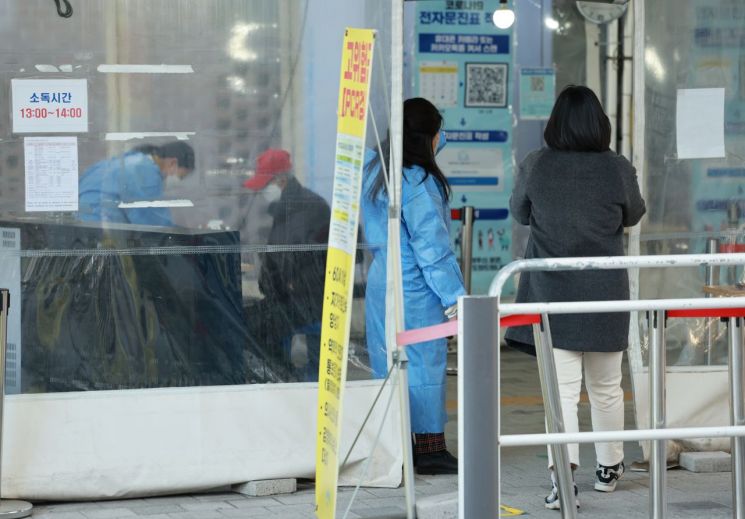 On the 7th, citizens who visited the COVID-19 screening clinic at Mapo-gu Public Health Center in Seoul are filling out questionnaires to undergo testing. Photo by Yonhap News Agency
[Asia Economy Reporter Yoon Seul-gi] As a new variant of the COVID-19 Omicron lineage has emerged, raising concerns that it could become a variable in the 7th wave, the scale of the outbreak appears relatively stable. The health authorities explained that the Omicron variant has been circulating for about a year now and that the mutation pattern shows different characteristics compared to before.
According to the Central Disease Control Headquarters (CDCH) of the Korea Disease Control and Prevention Agency (KDCA) on the 7th, as of the first week of December (3rd), the BN.1 variant increased by 5.5 percentage points from the previous week to 13.2%. It ranks second after BA.5 (67.8%). Other Omicron sub-lineage variants detected include BQ.1.1 at 6.0%, BA.2.75 at 3.8%, BF.7 at 2.8%, and BQ.1 at 1.4%.
The BN.1 variant is a derivative of the BA.2.75 variant, which is known to have the highest transmissibility and immune evasion capabilities. Discovered in September, BN.1 began to stand out after November. Although there are no specific research results on this variant virus yet, scientists estimate that its immune evasion ability is stronger than other variants based on the increasing detection rate.
With new variants emerging rapidly, there have been predictions that the scale of the resurgence could be larger than expected. On December 2nd, Lim Sook-young, the Situation General Manager of the Central Disease Control Headquarters, stated at a regular briefing of the Central Disaster and Safety Countermeasures Headquarters (CDSCH), "When a major outbreak occurs, it is generally related to variants," adding that the 7th wave could be assessed depending on the situation of new variant viruses.
However, as the mutation pattern shows different characteristics from before, the scale of the 7th wave also appears to be relatively stable. The number of confirmed COVID-19 cases during the week from November 27 to December 3 decreased by 1.8% compared to the previous week, recording 371,103 cases.
Regarding this, Lee Sang-won, Head of the Epidemiological Investigation and Analysis Division at the CDCH, explained at the briefing, "Previously, variant strains appeared approximately every 4 to 6 months, driving outbreaks, but now Omicron has persisted for about a year, leading to a stable overarching trend. Although small variant strains under Omicron are emerging, their appearance does not necessarily lead to an increase in patients."
He continued, "In other countries, variants like BQ.1 or XBB have led to increases in some countries but not significant increases in others, so we need to observe how they will affect our country."
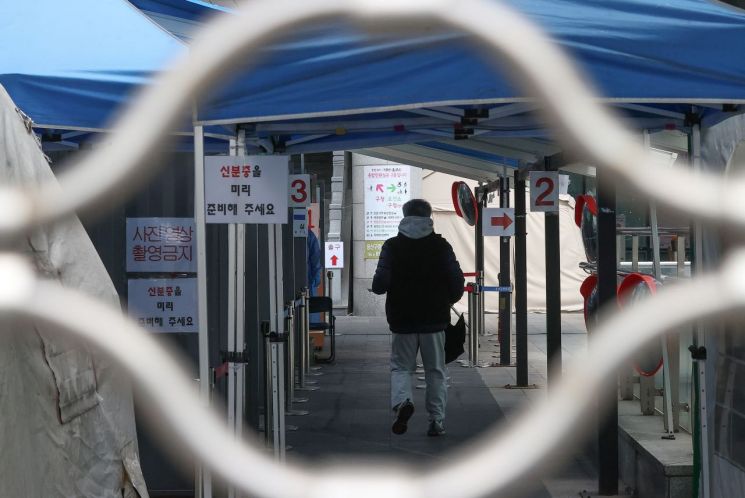 On the 6th, when 77,604 new COVID-19 cases were reported, citizens visiting the screening clinic set up at Yongsan-gu Public Health Center in Seoul are moving for testing. Photo by Yonhap News
Consequently, discussions about lifting the 'indoor mask-wearing mandate,' which was considered the last line of defense in COVID-19 prevention measures, are gaining momentum. The government has formalized plans to lift the indoor mask mandate along with ending the 7-day isolation for confirmed cases and is coordinating the specific timing.
On the 7th, Lee Sang-min, Minister of the Ministry of the Interior and Safety, stated at the Central Disaster and Safety Countermeasures Headquarters (CDSCH) meeting, "We plan to discuss the adjustment direction regarding the mask-wearing mandate at the CDSCH meeting on the 9th," adding, "After a public debate on the 15th and expert advisory meetings, we will finalize the adjustment plan by the end of this month."
Baek Kyung-ran, Commissioner of the Korea Disease Control and Prevention Agency, also announced that the indoor mask mandate would be lifted as early as January next year or by March at the latest. At the CDCH briefing that day, Commissioner Baek said, "We are reviewing a policy to gradually transition mask-wearing from an administrative order and penalty clause to a recommendation and voluntary compliance."
© The Asia Business Daily(www.asiae.co.kr). All rights reserved.
![Clutching a Stolen Dior Bag, Saying "I Hate Being Poor but Real"... The Grotesque Con of a "Human Knockoff" [Slate]](https://cwcontent.asiae.co.kr/asiaresize/183/2026021902243444107_1771435474.jpg)

















